< Назад
|
Содержимое
|
Далее >
TRANSMISSION
Automatic Transmission - 5ET50 (MKV) - Volt
SPECIFICATIONS
TEMPERATURE VERSUS RESISTANCE (TRANSMISSION FLUID TEMPERATURE SENSOR)
|
Temperature
|
Temperature
|
Minimum Resistance
|
Nominal Resistance
|
Maximum Resistance
|
|
°C
|
°F
|
Ω
|
Ω
|
Ω
|
|
-50
|
-58
|
71455
|
77458
|
83641
|
|
-40
|
-40
|
40,221
|
43,321
|
46,422
|
|
-30
|
-22
|
23,515
|
25,155
|
26,794
|
|
-20
|
-4
|
14,228
|
15,126
|
16,023
|
|
-10
|
14
|
8,881
|
9,388
|
9,894
|
|
0
|
32
|
5,704
|
5,997
|
6,291
|
|
10
|
50
|
3,759
|
3,934
|
4,108
|
|
20
|
68
|
2,537
|
2,643
|
2,749
|
|
30
|
86
|
1,750
|
1,816
|
1,882
|
|
40
|
104
|
1,232
|
1,274
|
1,315
|
|
50
|
122
|
883
|
910
|
937
|
|
60
|
140
|
645
|
662
|
679
|
|
70
|
158
|
478
|
489
|
500
|
|
80
|
176
|
360
|
367
|
376
|
|
90
|
194
|
275
|
280
|
284
|
|
100
|
212
|
212
|
216
|
219
|
|
110
|
230
|
166
|
168
|
170
|
|
120
|
248
|
132
|
133
|
134
|
|
130
|
266
|
105
|
106
|
107
|
|
140
|
284
|
84
|
86
|
87
|
|
150
|
302
|
69
|
70
|
71
|
FASTENER SPECIFICATIONS (OFF-VEHICLE)
Single Use Non-Threaded Fasteners/Components
|
NOTE:
All fasteners/components listed in this table MUST BE DISCARDED and
replaced with NEW after removal.
|
|
Application
|
|
Automatic Transmission Fluid Filter Seal
|
|
NOTE:
All fasteners/components listed in this table MUST BE DISCARDED and
replaced with NEW after removal.
|
|
Application
|
|
Automatic Transmission Pump Fluid Outlet Seal
|
|
Automatic Transmission Torque Dampener and Differential Housing Gasket
|
|
Automatic Transmission Torque Dampener Bypass Clutch Piston Inner Seal
|
|
Automatic Transmission Torque Dampener Bypass Clutch Piston Outer Seal
|
|
Control Valve Lower Body Spacer Plate
|
|
Drive Motor Power Inverter Module Connector
|
|
Drive Motor Power Inverter Module Fluid Seal
|
|
Drive Motor Rotor Bearing Retaining Ring
|
|
Drive Motor Support
|
|
Manual Shift Shaft Pin
|
|
Transmission Fluid Level Hole Plug
|
|
Variable Low Clutch Backing Plate Retaining Ring
|
|
Variable Low Clutch Fluid Passage Seal
|
|
Variable High Clutch Fluid Seal Ring
|
|
Variable High Clutch Fluid Transfer Support Seal
|
|
Variable High Clutch Housing Seal
|
|
Variable High Clutch Piston Dam Inner Seal
|
|
Variable High Clutch Piston Dam Outer Seal
|
|
Variable High Clutch Piston Dam Retaining Ring
|
|
Variable High Clutch Piston Inner Seal
|
|
Variable High Clutch Piston Outer Seal
|
Single Use Threaded Fastener/Component Tightening Specifications
|
NOTE:
All fasteners/components listed in this table MUST BE DISCARDED and
replaced with NEW after removal.
|
|
Application
|
Reference number
from Disassembled Views
|
Quantity
|
Size
|
Specification
|
|
Metric (English)
|
|
Automatic Transmission Case Extension Bolt
|
230
|
1
|
M8 x 38.5
|
38 N.m (28 lb ft)
|
|
NOTE:
All fasteners/components listed in this table MUST BE DISCARDED and
replaced with NEW after removal.
|
|
Application
|
Reference number from Disassembled
Views
|
Quantity
|
Size
|
Specification
|
|
Metric (English)
|
|
Automatic Transmission Case Extension Bolt
|
252
|
1
|
M8 x 55.8
|
38 N.m (28 lb ft)
|
|
Automatic Transmission Torque Dampener Bolt
|
|
 First Pass
|
305
|
6
|
M10 x 31.05
|
58 N.m (35 lb ft)
|
|
 Final Pass
|
305
|
6
|
M10 x 31.05
|
37.5 Degrees
|
|
Drive Motor Position Sensor Bolt
|
502
|
4
|
M6 x 15.5
|
5 N.m (44 lb in)
|
|
Drive Motor Position Sensor Bolt
|
522
|
4
|
M6 x 15.5
|
5 N.m (44 lb in)
|
|
Drive Motor Power Inverter Module Connector Bolt
|
231
|
2
|
M6 x 21
|
9 N.m (80 lb in)
|
|
Drive Motor Stator Bolt
|
509
|
4
|
M6 x 55
|
11 N.m (97 lb in)
|
|
Drive Motor Stator Bolt
|
529
|
4
|
M6 x 80.75
|
11 N.m (97 lb in)
|
Reusable Threaded Fastener Tightening Specifications
|
NOTE:
All fasteners listed in this table can be reused after removal.
|
|
Application
|
Reference number from Disassembled
Views
|
Quantity
|
Size
|
Specification
|
|
Metric (English)
|
|
Automatic Transmission Case Extension Bolt
|
238
|
2
|
M8 x 35.7
|
38 N.m (28 lb ft)
|
|
Automatic Transmission Case Extension Bolt
|
247
|
4
|
M8 x 60.8
|
26 N.m (19 lb ft)
|
|
Automatic Transmission Case Plug
|
68
|
1
|
1/8"-27
NPTF
|
11 N.m (97 lb in)
|
|
Automatic Transmission Fluid Filter Bolt
|
202
|
1
|
M6 x 20
|
9 N.m (80 lb in)
|
|
Automatic Transmission Fluid Level Hole Plug
|
66
|
1
|
1/8"-27
NPTF
|
11 N.m (97 lb in)
|
|
NOTE:
All fasteners listed in this table can be reused after removal.
|
|
Application
|
Reference number
from Disassembled Views
|
Quantity
|
Size
|
Specification
|
|
Metric (English)
|
|
Automatic Transmission Fluid Pressure Test Hole Plug
|
57
|
1
|
1/8"-27
NPTF
|
11 N.m (97 lb in)
|
|
Automatic Transmission Fluid Pressure Test Hole Plug
|
59
|
1
|
1/8"-27
NPTF
|
11 N.m (97 lb in)
|
|
Automatic Transmission Fluid Pump Bolt
|
209
|
3
|
M8 x 35
|
22 N.m (16 lb ft)
|
|
Automatic Transmission Output Speed Sensor Bolt
|
240
|
1
|
M6 x 25
|
9 N.m (80 lb in)
|
|
Automatic Transmission Wiring Harness Connector Bracket Bolt
|
709
|
2
|
M6 x 20
|
9 N.m (80 lb in)
|
|
Drive Link Snubber Bolt
|
210
|
2
|
M6 x 30
|
9 N.m (80 lb in)
|
|
Drive Link Snubber Bolt
|
212
|
2
|
M6 x 25
|
9 N.m (80 lb in)
|
|
Drive Motor Battery Positive and Negative Cable Connector Bolt
|
28
|
4
|
M6 x 26
|
9 N.m (80 lb in)
|
|
Drive Motor Power Inverter Module 3-Phase Buss Bar Bolt
|
30
|
6
|
M6 x 25
|
9 N.m (80 lb in)
|
|
Drive Motor Power Inverter Module 3-Phase Cable Bolt
|
504
|
3
|
M6 x 35
|
9 N.m (80 lb in)
|
|
Drive Motor Power Inverter Module 3-Phase Cable Bolt
|
524
|
3
|
M6 x 35
|
9 N.m (80 lb in)
|
|
Drive Motor Power Inverter Module Bolt
|
22
|
7
|
M6 x 25
|
9 N.m (80 lb in)
|
|
Drive Motor Stator Cooling Tube Bolt
|
242
|
2
|
M6 x 25
|
9 N.m (80 lb in)
|
|
Fluid Transfer Pipe Bolt
|
9
|
1
|
M6 x 23
|
9 N.m (80 lb in)
|
|
Front Differential Carrier Baffle Bolt
|
204
|
2
|
M6 x 25
|
9 N.m (80 lb in)
|
|
Manual Shift Detent Lever Spring
|
706
|
1
|
M6 x 25.65
|
9 N.m (80 lb in)
|
|
Park Pawl Actuator Guide Bolt
|
700
|
1
|
M6 x 35
|
9 N.m (80 lb in)
|
|
Torque Converter and Differential Housing Bolt
|
60
|
16
|
M8 x 30
|
32 N.m (24 lb ft)
|
|
Transmission Fluid Drain Plug
|
67
|
1
|
1/8"-27
NPTF
|
11 N.m (97 lb in)
|
|
Valve Body Bolt
|
5
|
4
|
M6 x 72
|
9 N.m (80 lb in)
|
|
Valve Body Bolt
|
8
|
13
|
M6 x 45
|
9 N.m (80 lb in)
|
|
Valve Body Cover Bolt
|
1
|
16
|
M6 x 30
|
9 N.m (80 lb in)
|
|
Drive Motor Power Inverter Module Cover Bolt
|
25
|
17
|
M6 x 30
|
9 N.m (80 lb in)
|
|
NOTE:
All fasteners listed in this table can be reused after removal.
|
|
Application
|
Reference number
from Disassembled Views
|
Quantity
|
Size
|
Specification
|
|
Metric (English)
|
|
Variable High Clutch Housing Bolt
|
637
|
8
|
M6 x 16
|
9 N.m (80 lb in)
|
FASTENER SPECIFICATIONS (ON-VEHICLE)
Single Use Non-Threaded Fasteners/Components
|
NOTE:
All fasteners/components listed in this table MUST BE DISCARDED and
replaced with NEW after removal.
|
|
Application
|
|
Front Wheel Drive Shaft Seal - Left
|
|
Front Wheel Drive Shaft Seal - Right
|
|
Main Shift Shaft Seal
|
Single Use Threaded Fastener/Component Tightening Specifications
|
NOTE:
All fasteners/components listed in this table MUST BE DISCARDED and
replaced with NEW after removal.
|
|
Application
|
Specification
|
|
Metric (English)
|
|
Transmission Mount Bolt (1)
|
|
 First Pass:
|
100 N.m (74 lb ft)
|
|
 Final Pass:
|
60-75 Degrees
|
|
Transmission Mount Bolt (2)
|
|
 First Pass:
|
100 N.m (74 lb ft)
|
|
NOTE:
All fasteners/components listed in this table MUST BE DISCARDED and
replaced with NEW after removal.
|
|
Application
|
Specification
|
|
Metric (English)
|
|
 Final Pass:
|
60-75 Degrees
|
|
Transmission Mount Strut Bolt
|
|
 First Pass:
|
100 N.m (74 lb ft)
|
|
 Final Pass:
|
60-75 Degrees
|
|
Transmission Mount Strut Bracket Bolt
|
|
 First Pass:
|
75 N.m (55 lb ft)
|
|
 Final Pass:
|
45-60 Degrees
|
|
Transmission Mount Transmission Side Bracket Bolt
|
|
 First Pass:
|
58 N.m (43 lb ft)
|
|
 Final Pass:
|
60-75 Degrees
|
Reusable Threaded Fastener Tightening Specifications
|
NOTE:
All fasteners listed in this table can be reused after removal.
|
|
Application
|
Specification
|
|
Metric (English)
|
|
Automatic Transmission Fluid Pressure Test Hole Plug
|
11 N.m (97 lb in)
|
|
Control Valve Body Bolt
|
9 N.m (80 lb in)
|
|
Control Valve Body Bolt @ Fluid Transfer Pipe Bolt
|
9 N.m (80 lb in)
|
|
Control Valve Body Cover Bolt
|
9 N.m (80 lb in)
|
|
Drive Motor Battery Positive and Negative Cable Connector Bolt
|
9 N.m (80 lb in)
|
|
Drive Motor Generator Control Module Cooling Outlet Hose Bolt
|
9 N.m (80 lb in)
|
|
Drive Motor Power Inverter Module 3-Phase Buss Bar Bolt
|
9 N.m (80 lb in)
|
|
NOTE:
All fasteners listed in this table can be reused after removal.
|
|
Application
|
Specification
|
|
Metric (English)
|
|
Drive Motor Power Inverter Module Bolt
|
9 N.m (80 lb in)
|
|
Engine Wiring Harness Bracket Nut
|
9 N.m (80 lb in)
|
|
Engine Wiring Harness Fuse Block Bracket Bolt
|
22 N.m (17 lb ft)
|
|
Engine Wiring Harness Stud
|
9 N.m (80 lb in)
|
|
Ground Cable Bolt
|
9 N.m (80 lb in)
|
|
Heater Inlet Hose Bracket Bolt
|
9 N.m (80 lb in)
|
|
Heater Water Shutoff Valve Inlet Hose Bolt
|
22 N.m (17 lb ft)
|
|
Main Shaft Bolt, Nut
|
7 N.m (62 lb in)
|
|
Manual Shift Detent Lever Spring Bolt
|
12 N.m (106 lb in)
|
|
Torque Converter Bolt
|
60 N.m (44 lb ft)
|
|
Transmission Control Lever Housing Bracket Nut
|
9 N.m (80 lb in)
|
|
Transmission to Engine Bolts
|
58 N.m (43 lb ft)
|
|
Transmission Fluid Cooler Pipe Bolt
|
22 N.m (17 lb ft)
|
|
Transmission Fluid Drain Plug
|
11 N.m (97 lb in)
|
|
Transmission Mount Transmission Side Bolt
|
58 N.m (43 lb ft)
|
|
Transmission Range Selector Lever Cable Bracket Bolt
|
22 N.m (17 lb ft)
|
|
Transmission Range Selector Lever Nut
|
30 N.m (22 lb ft)
|
|
Wiring Harness Bracket Bolt
|
9 N.m (80 lb in)
|
APPROXIMATE FLUID CAPACITIES
|
Application
|
Specification
|
|
Metric
|
English
|
|
5ET50
|
|
Fluid Change - Drain Plug - Approximate Capacity
|
3.2 liters
|
3.4 quarts
|
|
Overhaul - Approximate Capacity (Includes Cooling System)
|
6.75 liters
|
7.13 quarts
|
TRANSMISSION GENERAL SPECIFICATIONS
|
Name
|
5ET50
|
|
RPO Codes
|
MKV
|
|
Production Location
|
Warren, Michigan
|
|
Transmission Drive
|
Front Wheel Drive Transaxle
|
|
One-Motor EV Drive (CD)
|
Motor-Generator B provide or absorb vehicle torque for electric only
|
|
Two-Motor EV Drive (CD)
|
Motor-Generator B and Motor-Generator A combine to provide or absorb vehicle torque for electric only
|
|
Name
|
5ET50
|
|
|
operation
|
|
Extended Range Low (Mode 1) (CS)
|
Online optimizer balances engine, Motor-Generator A, and Motor-Generator B, to achieve the most efficient vehicle operation at lower vehicle speeds
|
|
Extended Range High (Mode 2) (CS)
|
Online optimizer balances engine, Motor-Generator A, and Motor-Generator B, to achieve the most efficient
vehicle operation at higher vehicle speeds
|
|
Fixed Ratio Extended Range (CS)
|
Motor/Generator B will be able to electrically boost or regenerate the vehicle torque in parallel with the engine torque. Motor/Generator A is locked to the case and not
contribute to torque
|
|
Pressure Tap
|
Line Pressure
|
|
Transmission Fluid Type
|
DEXRON VI®
|
|
Transmission Type: Electric
|
Electrically Variable
|
|
Transmission Type: EV
|
MKV: 48 kW (Drive Motor A (1) and 87 kW (Drive Motor B (2) Internal Motor
|
|
Transmission Type: T
|
Transaxle Mount
|
|
Transmission Type: 50
|
Product Series
|
|
Position Quadrant
|
P, R, N, D, L
|
|
Case Material
|
Die Cast Aluminum
|
|
Transmission Net Weight (Wet)
|
119 kg (262 pounds)
|
|
Maximum Trailer Towing Capacity
|
MKV: N/A
|
ADHESIVES, FLUIDS, LUBRICANTS, AND SEALERS
|
Application
|
Type of Material
|
GM Part Number
|
|
Automatic Transmission Fluid
|
DEXRON®VI
|
Refer to Electronic Parts Catalog
|
|
Drive Motor Position Sensor Bolt
|
Threadlocker Red
|
Refer to Electronic Parts Catalog
|
|
Drive Motor Power Inverter Module Bolt
|
Threadlocker Blue
|
Refer to Electronic Parts Catalog
|
CLUTCH BACKING PLATE RETAINING RING SPECIFICATIONS
Variable High Clutch Backing Plate Retaining Ring
|
Clutch Pack Travel Specification - 0.98 - 1.54 mm (0.039 - 0.061 in)
|
|
Retaining Ring Thickness
|
Ring Identification Color
|
|
Metric
|
English
|
|
NOTE:
After measuring clutch pack travel, determine if the
|
|
Clutch Pack Travel Specification - 0.98 - 1.54 mm (0.039 - 0.061 in)
|
|
Retaining Ring Thickness
|
Ring Identification Color
|
|
Metric
|
English
|
|
measurement is within the specification. If the measurement is not within the specification, measure the thickness of the existing retaining ring, and then choose a thicker or thinner retaining ring that will bring the measurement within specification.
|
|
1.40 - 1.50 mm
|
0.055 - 0.059 in
|
Dark Green
|
|
1.70 - 1.80 mm
|
0.067 - 0.071 in
|
Yellow
|
|
2.01 - 2.11 mm
|
0.079 - 0.083 in
|
No Color
|
|
2.31 - 2.41 mm
|
0.091 - 0.095 in
|
Light Blue
|
|
2.62 - 2.72 mm
|
0.103 - 0.107 in
|
Orange
|
Variable Low Clutch Backing Plate Retaining Ring
|
Clutch Pack Travel Specification - 0.90 - 1.46 mm (0.035 - 0.057 in)
|
|
Retaining Ring Thickness
|
Ring Identification Color
|
|
Metric
|
English
|
|
NOTE:
After measuring clutch pack travel, determine if the measurement is within the specification. If the measurement is not within
|
|
Clutch Pack Travel Specification - 0.90 - 1.46 mm (0.035 - 0.057 in)
|
|
Retaining Ring Thickness
|
Ring Identification Color
|
|
Metric
|
English
|
|
the specification, measure the thickness of the existing retaining ring, and then choose a thicker or thinner retaining ring that will bring the measurement within specification.
|
|
2.55 - 2.85 mm
|
0.100 - 0.112 in
|
Dark Green
|
|
2.87 - 2.97 mm
|
0.113 - 0.117 in
|
Yellow
|
|
3.20 - 3.30 mm
|
0.126 - 0.130 in
|
Purple
|
|
3.52 - 3.62 mm
|
0.139 - 0.143 in
|
Light Blue
|
|
3.85 - 3.95 mm
|
0.152 - 0.156 in
|
Orange
|
AUTOMATIC TRANSMISSION TORQUE DAMPENER THRUST WASHER SPECIFICATIONS
|
Automatic Transmission Torque Dampener Thrust Washer Calculation Specification - Dimension B Min 47.870 - Max 49.620 mm - Dimension A Min 33.165 - Max 34.465 mm
|
|
Automatic Transmission Torque Dampener Thrust Washer Thickness
|
Ring Identification Color
|
Dimension B - Dimension A Calculation Range
|
|
Metric
|
English
|
|
NOTE:
Measure the thickness of the torque dampener and differential housing gasket and subtract from measured dimension A to use as dimension A in
|
|
Automatic Transmission Torque Dampener Thrust Washer Calculation Specification - Dimension B Min 47.870 - Max 49.620 mm - Dimension A Min 33.165 - Max 34.465 mm
|
|
Automatic Transmission Torque Dampener Thrust Washer Thickness
|
Ring Identification Color
|
Dimension B - Dimension A Calculation Range
|
|
Metric
|
English
|
|
calculation.
|
|
1.892 - 1.992 mm
|
0.0745 - 0.0784 in
|
Red
|
13.712 - 14.033 mm
|
|
2.214 - 2.314 mm
|
0.0872 - 0.0911 in
|
Light Grey
|
14.034 - 14.355 mm
|
|
2.536 - 2.636 mm
|
0.0998 - 0.1038 in
|
Blue
|
14.356 - 14.677 mm
|
|
2.858 - 2.958 mm
|
0.1125 - 0.1165 in
|
Natural
|
14.678 - 14.999 mm
|
|
3.180 - 3.280 mm
|
0.1252 - 0.1291 in
|
Black
|
15.000 - 15.321 mm
|
|
3.502 - 3.602 mm
|
0.1379 - 0.1418 in
|
Pink
|
15.322 - 15.643 mm
|
|
3.824 - 3.924 mm
|
0.1506 - 0.1545 in
|
Brown
|
15.644 - 15.965 mm
|
RANGE REFERENCE
|
Mode Chart
|
VFS Line Pressure Reg Solenoid (PR)
|
ON/OFF
High Range Clutch (C2)
|
ON/OFF
Low Range Clutch (C1)
|
ON/OFF
Lube Boost (Motor Cooling)
|
ON/OFF
Damper Bypass Clutch
(DBC)
|
|
Unpowered State (pressure)
|
Normally High
|
Normally Low
|
Normally Low
|
Normally Low
|
Normally Low
|
|
PCS Number
|
PCS1
|
PCS2
|
PCS3
|
PCS4
|
PCS5
|
|
Range State
|
Park
|
Engine On
|
Regulating
|
OFF
|
ON
|
On Demand**
|
OFF
|
|
Engine Off
|
OFF
|
ON
|
ON
|
|
Reverse EV Mode
|
Engine Off
|
OFF
|
ON
|
ON
|
|
Neutral
|
Engine Off
|
OFF
|
OFF
|
ON
|
|
Drive
|
-
|
-
|
-
|
-
|
|
Single or Dual Motor EV
|
Engine Off
|
OFF
|
ON
|
ON
|
|
Extended Range Low
|
Engine On
|
OFF
|
ON
|
OFF
|
|
Extended Range Fixed Ratio
|
Engine On
|
ON
|
ON
|
OFF
|
|
Extended Range High
|
Engine On
|
ON
|
OFF
|
OFF
|
|
**Demand based on torque and temperature
|
TRANSMISSION INTERNAL MODE SWITCH LOGIC

Internal Mode Switch
Internal Mode Switch
Internal Mode Switch
Selector Position
Selector Position
Selector Position
Internal Mode Switch
|
Circuits/Parameter
|
Park
|
Reverse
|
Neutral
|
Drive
|
Low
|
|
Switch Operating Conditions: Ignition ON, range selector in appropriate gear
|
|
Internal Mode Switch A
|
High
|
Low
|
Low
|
High
|
High
|
|
Internal Mode Switch B
|
Low
|
High
|
High
|
Low
|
Low
|
|
Internal Mode Switch C
|
High
|
High
|
Low
|
Low
|
Low
|
|
Internal Mode Switch P
|
Low
|
Low
|
High
|
High
|
High
|
|
Internal Mode Switch S
|
Low
|
High
|
Low
|
High
|
Low
|
|
Always High status: Open/short to voltage condition Always Low status: Short to ground condition
|
SCHEMATIC WIRING DIAGRAMS
AUTOMATIC TRANSMISSION CONTROLS WIRING SCHEMATICS
Drive Mode Select Function

Fig. 1: Drive Mode Select Function
Courtesy of GENERAL MOTORS COMPANY
Pressure Controls, Shift Controls and Speed Sensor

Fig. 2: Pressure Controls, Shift Controls and Speed Sensor
Courtesy of GENERAL MOTORS COMPANY
Shift Lever Position Indicator

Fig. 3: Shift Lever Position Indicator
Courtesy of GENERAL MOTORS COMPANY
COMPONENT LOCATOR
DISASSEMBLED VIEWS
Case and Associated Parts (1 of 2)

Fig. 4: Case and Associated Parts (1 of 2)
Courtesy of GENERAL MOTORS COMPANY
|
Callout
|
Component Name
|
|
1
|
Valve Body Cover Bolt
|
|
2
|
Control Valve Body Cover
|
|
3
|
Automatic Transmission Fluid Level Control Valve Seal - Gasket
|
|
4
|
Automatic Transmission Fluid Level Control Valve Seal - O-Ring
|
|
5
|
Valve Body Bolt
|
|
6
|
Control Solenoid Valve
|
|
8
|
Valve Body Bolt
|
|
9
|
Fluid Transfer Pipe Bolt
|
|
10
|
Fluid Transfer Pipe
|
|
11
|
Control Valve
|
|
12
|
Control Valve Lower Body Spacer Plate
|
|
13
|
Control Valve Body Spacer Plate Retainer
|
|
14
|
Variable Low Clutch Fluid Passage Seal
|
|
15
|
Automatic Transmission Case
|
|
16
|
Drive Motor Power Inverter Module Fluid Seal
|
|
Callout
|
Component Name
|
|
17
|
Automatic Transmission Wiring Harness - Control Solenoid Valve
|
|
18
|
Automatic Transmission Wiring Connector Seal - O Ring
|
|
19
|
Automatic Transmission Wiring Harness - Shift Shaft Position Switch
|
|
20
|
Automatic Transmission Wiring Connector Seal - O Ring
|
|
21
|
Drive Motor Generator Power Inverter Module
|
|
22
|
Drive Motor Power Inverter Module Bolt
|
|
23
|
Drive Motor Power Inverter Module Cover Gasket
|
|
24
|
Drive Motor Power Inverter Module Cover
|
|
25
|
Drive Motor Power Inverter Module Cover Bolt
|
|
26
|
Drive Motor Power Inverter Module Cover Vent
|
|
27
|
Drive Motor Battery Positive and Negative Cable Connector
|
|
28
|
Drive Motor Battery Positive and Negative Cable Connector Bolt
|
|
29
|
Drive Motor Power Inverter Module Electrical Connector Seal
|
|
30
|
Drive Motor Power Inverter Module 3-Phase Buss Bar Bolt
|
|
31
|
Input Drive Flange
|
|
32
|
Transmission Fluid Cooler Pipe Fitting Seal
|
|
33
|
Control Solenoid Valve Filter Plate
|
Case and Associated Parts (2 of 2)

Fig. 5: Case and Associated Parts (2 of 2)
Courtesy of GENERAL MOTORS COMPANY
|
Callout
|
Component Name
|
|
50
|
Transmission Fluid Filler Cap
|
|
51
|
Variable High Clutch Housing Seal - O Ring
|
|
52
|
Input Sun Gear Shaft
|
|
53
|
Input Sun Gear
|
|
54
|
Input Sun Gear Retaining Ring
|
|
55
|
Input Internal Gear Thrust Bearing
|
|
56
|
Automatic Transmission Torque Dampener and Differential Housing Gasket
|
|
57
|
Automatic Transmission Fluid Pressure Test Hole Plug
|
|
58
|
Automatic Transmission Torque Dampener and Differential Housing
|
|
59
|
Automatic Transmission Fluid Pressure Test Hole Plug
|
|
60
|
Torque Converter and Differential Housing Bolt
|
|
61
|
Transmission Fluid Filler Tube Plug
|
|
62
|
Front Differential Carrier Bearing
|
|
63
|
Front Differential Carrier
|
|
64
|
Differential Carrier Sun Gear Thrust Bearing
|
|
65
|
Front Differential Carrier Sun Gear
|
|
66
|
Automatic Transmission Fluid Level Hole Plug
|
|
67
|
Transmission Fluid Drain Plug
|
|
68
|
Automatic Transmission Case Plug
|
Transmission Case Assembly (1 of 2)

Fig. 6: Transmission Case Assembly (1 of 2)
Courtesy of GENERAL MOTORS COMPANY
|
Callout
|
Component Name
|
|
200
|
Automatic Transmission Fluid Filter
|
|
201
|
Automatic Transmission Fluid Filter Seal
|
|
202
|
Automatic Transmission Fluid Filter Bolt
|
|
203
|
Automatic Transmission Auxiliary Fluid Pump Motor 3-Phase Cable Seal
|
|
204
|
Front Differential Carrier Baffle Bolt
|
|
205
|
Front Differential Carrier Baffle
|
|
206
|
Automatic Transmission Fluid Chip Collector Magnet
|
|
207
|
Automatic Transmission Pump Fluid Outlet Seal
|
|
208
|
Automatic Transmission Fluid Pump Motor
|
|
209
|
Automatic Transmission Fluid Pump Bolt
|
|
210
|
Drive Link Snubber Bolt
|
|
211
|
Drive Link Snubber - (Drive Side)
|
|
212
|
Drive Link Snubber Bolt
|
|
213
|
Drive Link Snubber - (Coast Side)
|
|
214
|
Drive Sprocket Retaining Ring
|
|
215
|
Drive Sprocket
|
|
Callout
|
Component Name
|
|
216
|
Park Gear Spring
|
|
217
|
Park Gear
|
|
218
|
Input Carrier
|
|
219
|
Driven Sprocket
|
|
220
|
Drive Link
|
|
221
|
Driven Sprocket Bearing
|
Transmission Case Assembly (2 of 2)

Fig. 7: Transmission Case Assembly (2 of 2)
Courtesy of GENERAL MOTORS COMPANY
|
Callout
|
Component Name
|
|
230
|
Automatic Transmission Case Extension Bolt
|
|
231
|
Drive Motor Power Inverter Module Connector Bolt
|
|
232
|
Drive Motor Power Inverter Module Connector
|
|
233
|
Drive Motor Power Inverter Module Pin
|
|
234
|
Drive Motor Power Inverter Module Cover Pin
|
|
235
|
Front Wheel Drive Shaft Oil Seal
|
|
236
|
Automatic Transmission Fluid Pump Locating Pin
|
|
Callout
|
Component Name
|
|
237
|
Drive Motor - (2nd Position)
|
|
238
|
Automatic Transmission Case Extension Bolt
|
|
239
|
Automatic Transmission Output Speed Sensor
|
|
240
|
Automatic Transmission Output Speed Sensor Bolt
|
|
241
|
Drive Motor Stator Cooling Tube
|
|
242
|
Drive Motor Stator Cooling Tube Bolt
|
|
243
|
Output Carrier
|
|
244
|
Output Carrier Thrust Bearing
|
|
245
|
Output Carrier Internal Gear
|
|
246
|
Output Carrier Internal Gear Hub Thrust Bearing
|
|
247
|
Automatic Transmission Case Extension Bolt
|
|
248
|
Drive Motor - (1st Position)
|
|
249
|
Variable High Clutch Fluid Transfer Support Seal
|
|
250
|
Variable High Clutch Fluid Transfer Support Seal
|
|
251
|
Transmission Case Locating Pin
|
|
252
|
Automatic Transmission Case Extension Bolt
|
|
253
|
Variable High Clutch Fluid Seal Ring
|
Torque Dampener and Differential Housing Assembly

Fig. 8: Torque Dampener and Differential Housing Assembly
Courtesy of GENERAL MOTORS COMPANY
|
Callout
|
Component Name
|
|
300
|
Input Internal Gear Retaining Ring
|
|
301
|
Input Internal Gear
|
|
302
|
Input Brake Clutch Retaining Ring
|
|
303
|
Input Brake Clutch
|
|
304
|
Automatic Transmission Torque Dampener Thrust Washer
|
|
305
|
Automatic Transmission Torque Dampener Bolt
|
|
306
|
Automatic Transmission Torque Dampener
|
|
307
|
Automatic Transmission Torque Dampener Thrust Bearing
|
|
308
|
Automatic Transmission Torque Dampener Bypass Clutch Piston Return Spring Retaining Ring
|
|
309
|
Automatic Transmission Torque Dampener Bypass Clutch Piston Return Spring
|
|
310
|
Automatic Transmission Torque Dampener Bypass Clutch Apply Bearing
|
|
311
|
Automatic Transmission Torque Dampener Bypass Clutch Piston
|
|
312
|
Automatic Transmission Torque Dampener Bypass Clutch Piston Outer Seal
|
|
313
|
Automatic Transmission Torque Dampener Bypass Clutch Piston Inner Seal
|
|
314
|
Input Shaft Bearing
|
|
315
|
Input Shaft Seal
|
|
316
|
Front Wheel Drive Shaft Oil Seal
|
|
317
|
Automatic Transmission Torque Dampener and Differential Housing
|
|
318
|
Front Differential Carrier Internal Gear Wear Ring
|
|
319
|
Front Differential Ring Gear
|
|
320
|
Front Differential Ring Gear Retainer
|
Control Valve Body Assembly

Fig. 9: Control Valve Body Assembly
Courtesy of GENERAL MOTORS COMPANY
|
Callout
|
Component Name
|
|
400
|
Pressure Regulator Valve Bore Plug Retainer
|
|
401
|
Pressure Regulator Valve Bore Plug
|
|
402
|
Pressure Regulator Valve
|
|
403
|
Pressure Regulator Valve Spring
|
|
404
|
Lube Regulator Valve Spring
|
|
405
|
Lube Regulator Valve
|
|
406
|
Lube Regulator Valve Bore Plug
|
|
407
|
Lube Regulator Valve Bore Plug Retainer
|
|
408
|
Variable Low Clutch Accumulator Piston Spring Retainer
|
|
409
|
Variable Low Clutch Accumulator Piston Spring
|
|
410
|
Variable Low Clutch Accumulator Piston
|
|
411
|
Automatic Transmission Torque Dampener Bypass Clutch Valve Bore Plug Retainer
|
|
412
|
Automatic Transmission Torque Dampener Bypass Clutch Spring
|
|
413
|
Variable Low Clutch Valve
|
|
414
|
Line Pressure Control Solenoid Valve Accumulator Piston
|
|
415
|
Line Pressure Control Solenoid Valve Accumulator Piston Spring
|
|
Callout
|
Component Name
|
|
416
|
Control Valve Body
|
|
417
|
Automatic Transmission Torque Dampener Bypass Clutch Valve
|
|
418
|
Variable Low Clutch Regulator Valve Spring
|
|
419
|
Variable Low Clutch Regulator Valve Bore Plug Retainer
|
|
420
|
Variable High Clutch Valve
|
|
421
|
Variable Low Clutch Regulator Valve Spring
|
|
422
|
Variable Low Clutch Regulator Valve Bore Plug Retainer
|
|
423
|
Variable High Clutch Dam Feed Regulator Valve
|
|
424
|
Variable High Clutch Dam Feed Regulator Valve Spring
|
|
425
|
Variable High Clutch Dam Feed Regulator Valve Bore Plug Retainer
|
|
426
|
Line Pressure Control Solenoid Valve Retainer
|
|
427
|
Line Pressure Control Solenoid Valve
|
|
428
|
Pressure Relief Ball Valve Spring Pin
|
|
429
|
Pressure Relief Ball Valve Spring
|
|
430
|
Pressure Relief Ball Valve
|
Drive Motor Assembly (1st Position)

Fig. 10: Drive Motor Assembly (1st Position)
Courtesy of GENERAL MOTORS COMPANY
|
Callout
|
Component Name
|
|
500
|
Drive Motor Support
|
|
501
|
Drive Motor Position Sensor Stator
|
|
502
|
Drive Motor Position Sensor Bolt
|
|
503
|
Drive Motor Position Sensor Connector Clip
|
|
504
|
Drive Motor Power Inverter Module 3-Phase Cable Bolt
|
|
505
|
Drive Motor Power Inverter Module Cable Bolt Install Guide Retainer
|
|
506
|
Drive Motor Power Inverter Module Cable Bolt Install Guide Bushing
|
|
507
|
Drive Motor Power Inverter Module Cable Guide
|
|
508
|
Drive Motor Stator - (1st Position)
|
|
509
|
Drive Motor Stator Bolt
|
|
510
|
Drive Motor Rotor - (1st Position)
|
|
511
|
Drive Motor Rotor Bearing Retaining Ring
|
Drive Motor Assembly (2nd Position)

Fig. 11: Drive Motor Assembly (2nd Position)
Courtesy of GENERAL MOTORS COMPANY
|
Callout
|
Component Name
|
|
520
|
Drive Motor Support
|
|
Callout
|
Component Name
|
|
521
|
Drive Motor Position Sensor Stator
|
|
522
|
Drive Motor Position Sensor Bolt
|
|
523
|
Drive Motor Position Sensor Connector Clip
|
|
524
|
Drive Motor Power Inverter Module 3-Phase Cable Bolt
|
|
525
|
Drive Motor Power Inverter Module Cable Bolt Install Guide Retainer
|
|
526
|
Drive Motor Power Inverter Module Cable Bolt Install Guide Bushing
|
|
527
|
Drive Motor Power Inverter Module Cable Guide
|
|
528
|
Drive Motor Stator - (2nd Position)
|
|
529
|
Drive Motor Stator Bolt
|
|
530
|
Drive Motor Rotor - (2nd Position)
|
|
531
|
Drive Motor Rotor Bearing Retaining Ring
|
|
532
|
Output Sun Gear
|
|
533
|
Output Sun Gear Retaining Ring
|
Output Carrier Internal Gear Assembly

Fig. 12: Output Carrier Internal Gear Assembly
Courtesy of GENERAL MOTORS COMPANY
|
Callout
|
Component Name
|
|
600
|
Output Carrier Internal Gear
|
|
601
|
Output Carrier Internal Gear Hub
|
|
602
|
Output Carrier Internal Gear Retaining Ring
|
Variable Low Clutch Assembly

Fig. 13: Variable Low Clutch Assembly
Courtesy of GENERAL MOTORS COMPANY
|
Callout
|
Component Name
|
|
610
|
Variable Low Clutch Backing Plate Retaining Ring - (Selective)
|
|
611
|
Variable Low Clutch Backing Plate
|
|
612
|
Variable Low Clutch Plate - Friction
|
|
613
|
Variable Low Clutch Plate
|
|
614
|
Variable Low Clutch Spring
|
|
615
|
Variable Low Clutch Piston
|
|
616
|
Drive Motor - (1st Position)
|
Variable High Clutch Assembly

Fig. 14: Variable High Clutch Assembly
Courtesy of GENERAL MOTORS COMPANY
|
Callout
|
Component Name
|
|
620
|
Variable High Clutch Hub Thrust Washer
|
|
621
|
Variable High Clutch Hub
|
|
622
|
Variable High Clutch Hub Thrust Washer
|
|
623
|
Variable High Clutch Backing Plate Retaining Ring - (Selective)
|
|
624
|
Variable High Clutch Backing Plate
|
|
625
|
Variable High Clutch Plate - Friction
|
|
626
|
Variable High Clutch Plate
|
|
627
|
Variable High Clutch Waved Plate
|
|
628
|
Variable High Clutch Piston Dam Retaining Ring
|
|
629
|
Variable High Clutch Piston Outer Seal
|
|
630
|
Variable High Clutch Piston Dam
|
|
631
|
Variable High Clutch Piston Spring
|
|
632
|
Variable High Clutch Piston
|
|
633
|
Variable High Clutch Piston Dam Outer Seal
|
|
634
|
Variable High Clutch Piston Dam Inner Seal
|
|
635
|
Variable High Clutch Piston Inner Seal
|
|
Callout
|
Component Name
|
|
636
|
Variable High Clutch Housing
|
|
637
|
Variable High Clutch Housing Bolt
|
Torque Limiting Clutch Assembly

Fig. 15: Torque Limiting Clutch Assembly
Courtesy of GENERAL MOTORS COMPANY
|
Callout
|
Component Name
|
|
640
|
Automatic Transmission Torque Limit Clutch Backing Plate Ring
|
|
641
|
Automatic Transmission Torque Limit Clutch Backing Plate
|
|
642
|
Automatic Transmission Torque Limit Clutch Spring
|
|
643
|
Automatic Transmission Torque Limit Clutch Backing Plate
|
|
644
|
Input Internal Gear
|
|
645
|
Input Internal Gear Hub
|
|
646
|
Input Internal Gear Retaining Ring
|
Park System Components

Fig. 16: Park System Components
Courtesy of GENERAL MOTORS COMPANY
|
Callout
|
Component Name
|
|
700
|
Park Pawl Actuator Guide Bolt
|
|
701
|
Park Pawl Actuator Guide
|
|
702
|
Manual Shift Detent Lever Shaft
|
|
703
|
Manual Shift Shaft Seal
|
|
704
|
Manual Shift Detent Lever Pin
|
|
705
|
Manual Shift Shaft Pin
|
|
706
|
Manual Shift Detent Lever Spring
|
|
707
|
Manual Shift Detent Lever
|
|
708
|
Automatic Transmission Wiring Harness Bracket
|
|
709
|
Automatic Transmission Wiring Harness Connector Bracket Bolt
|
|
710
|
Automatic Transmission Wiring Harness Bracket
|
|
711
|
Park Pawl Actuator
|
|
712
|
Park Pawl Shaft
|
|
713
|
Park Pawl Spring
|
|
714
|
Park Pawl
|
COMPONENT LOCATION
Component Locations

Fig. 17: Transaxle Internal Component Locations
Courtesy of GENERAL MOTORS COMPANY
|
Callout
|
Component Name
|
|
6
|
Control Solenoid Valve
|
|
11
|
Control Valve
|
|
31
|
Input Drive Flange
|
|
52
|
Input Sun Gear Shaft
|
|
63
|
Front Differential Carrier Assembly
|
|
65
|
Front Differential Carrier Sun Gear
|
|
215
|
Drive Sprocket
|
|
217
|
Park Gear
|
|
218
|
Input Carrier
|
|
220
|
Drive Link
|
|
237
|
Drive Motor
|
|
239
|
Automatic Transmission Output Speed Sensor
|
|
243
|
Output Carrier Assembly
|
|
Callout
|
Component Name
|
|
245
|
Output Carrier Internal Gear
|
|
248
|
Drive Motor
|
|
301
|
Input Internal Gear
|
|
303
|
Input Brake Clutch
|
|
306
|
Automatic Transmission Torque Dampener
|
|
319
|
Front Differential Ring Gear
|
|
500
|
Drive Motor Support
|
|
508
|
Drive Motor Stator
|
|
520
|
Drive Motor Support
|
|
636
|
Variable High Clutch Housing
|
BUSHING, BEARING, AND WASHER LOCATIONS
Location Of The Bushings, Bearings, and Washers

Fig. 18: Bushings, Bearings, And Washer Locations
Courtesy of GENERAL MOTORS COMPANY
|
Callout
|
Component Name
|
|
55
|
Input Internal Gear Thrust Bearing
|
|
Callout
|
Component Name
|
|
62
|
Front Differential Carrier Bearing
|
|
64
|
Differential Carrier Sun Gear Thrust Bearing
|
|
221
|
Driven Sprocket Bearing
|
|
244
|
Output Carrier Thrust Bearing
|
|
246
|
Output Carrier Internal Gear Hub Thrust Bearing
|
|
304
|
Automatic Transmission Torque Dampener Thrust Washer
|
|
307
|
Automatic Transmission Torque Dampener Thrust Bearing
|
|
310
|
Automatic Transmission Torque Dampener Bypass Clutch Apply Bearing
|
|
314
|
Input Shaft Bearing
|
|
620
|
Variable High Clutch Hub Thrust Washer
|
|
622
|
Variable High Clutch Hub Thrust Washer
|
SEAL LOCATIONS
Seal Locations #1

Fig. 19: Seal Locations #1
Courtesy of GENERAL MOTORS COMPANY
|
Callout
|
Component Name
|
|
3
|
Automatic Transmission Fluid Level Control Valve Seal - (Gasket)
|
|
14
|
Variable Low Clutch Fluid Passage Seal
|
|
51
|
Variable High Clutch Housing Seal - (O-ring)
|
|
56
|
Automatic Transmission Torque Dampener and Differential Housing Gasket
|
|
235
|
Front Wheel Drive Shaft Oil Seal
|
|
249
|
Variable High Clutch Fluid Transfer Support Seal
|
|
250
|
Variable High Clutch Fluid Transfer Support Seal
|
|
253
|
Variable High Clutch Fluid Seal Ring
|
|
312
|
Automatic Transmission Torque Dampener Bypass Clutch Piston Outer Seal
|
|
313
|
Automatic Transmission Torque Dampener Bypass Clutch Piston Inner Seal
|
|
315
|
Input Shaft Seal
|
|
316
|
Front Wheel Drive Shaft Oil Seal
|
|
615
|
Variable Low Clutch Piston
|
|
629
|
Variable High Clutch Piston Outer Seal
|
|
633
|
Variable High Clutch Piston Dam Outer Seal
|
|
635
|
Variable High Clutch Piston Inner Seal
|
Seal Locations #2

Fig. 20: Seal Locations #2
Courtesy of GENERAL MOTORS COMPANY
|
Callout
|
Component Name
|
|
4
|
Automatic Transmission Fluid Level Control Valve Seal - (O-ring)
|
|
16
|
Drive Motor Power Inverter Module Fluid Seal
|
|
18
|
Automatic Transmission Wiring Connector Seal - (O-ring)
|
|
Callout
|
Component Name
|
|
20
|
Automatic Transmission Wiring Connector Seal - (O-ring)
|
|
29
|
Drive Motor Power Inverter Module Electrical Connector Seal
|
|
32
|
Transmission Fluid Cooler Pipe Fitting Seal
|
|
201
|
Automatic Transmission Fluid Filter Seal
|
|
203
|
Automatic Transmission Auxiliary Fluid Pump Motor 3-Phase Cable Seal
|
|
207
|
Automatic Transmission Pump Fluid Outlet Seal
|
|
703
|
Manual Shift Shaft Seal
|
DIAGNOSTIC INFORMATION AND PROCEDURES
DTC P0658 OR P0659: ACTUATOR HIGH CONTROL CIRCUIT GROUP 1 VOLTAGE
Diagnostic Instructions
 Perform the Diagnostic System Check prior to using this diagnostic procedure:
Diagnostic System Check -
Vehicle
Perform the Diagnostic System Check prior to using this diagnostic procedure:
Diagnostic System Check -
Vehicle
 Review the description of Strategy Based Diagnosis:
Strategy Based Diagnosis
Review the description of Strategy Based Diagnosis:
Strategy Based Diagnosis
 An overview of each diagnostic category can be found here:
Diagnostic Procedure Instructions
An overview of each diagnostic category can be found here:
Diagnostic Procedure Instructions
DTC Descriptor
DTC P0658
Actuator High Control Circuit Group 1 Low Voltage
DTC P0659
Actuator High Control Circuit Group 1 High Voltage
Diagnostic Fault Information
|
Circuit
|
Short to Ground
|
Open/High Resistance
|
Short to Voltage
|
Signal Performance
|
|
Ignition
|
P0658
|
P0659
|
P0659
|
-
|
Typical Scan Tool Data
High Side Drive 1
|
Circuit
|
Short to Ground
|
Open
|
Short to Voltage
|
|
Operating Conditions: Ignition On
Parameter Normal Range: On
|
|
High Side Driver 1
|
Off
|
On
|
Off
|
Circuit/System Description
The high side driver 1 is internal to the Hybrid/EV powertrain Control Module 1. With the ignition On, the high side driver 1 provides 12 V to the transmission control solenoid valve and line pressure control solenoid. If excessive current flow is detected in high side driver 1 circuit, the high side driver 1 will turn Off. When the circuit fault is corrected, the high side driver 1 will reset. The hybrid/EV powertrain control module 1 and both drive motor control modules are internal to the power inverter module, often referred to as the drive motor generator power inverter
module, and not serviced separately. Conditions for Running the DTC High side driver 1 is On.
Conditions for Setting the DTC
P0658
Hybrid/EV powertrain Control Module 1 has detected a short to ground on the high side driver 1 circuit during Hybrid/EV powertrain Control Module 1 initialization.
P0659
Hybrid/EV powertrain Control Module 1 has detected a short to voltage on the high side driver 1 circuit during Hybrid/EV powertrain Control Module 1 initialization.
Actions Taken When the DTC Sets
DTCs P0658, and P0659 are Type A DTCs.
P0658
 The Hybrid/EV powertrain control module commands maximum line pressure.
 The Hybrid/EV powertrain control module inhibits clutch 1, also call the variable low clutch.
Conditions for Clearing the DTC
DTCs P0658, and P0659 are Type A DTCs.
Reference Information
Schematic Reference
Automatic Transmission Controls Schematics
Connector End View Reference
 COMPONENT CONNECTOR END VIEWS - INDEX
 INLINE HARNESS CONNECTOR END VIEWS - INDEX
Description and Operation
 Electronic Component Description
 Transmission Component and System Description
 Transmission General Description
Electrical Information Reference
 Circuit Testing
 Connector Repairs
 Testing for Intermittent Conditions and Poor Connections
 Wiring Repairs
DTC Type Reference
Powertrain Diagnostic Trouble Code (DTC) Type Definitions
Scan Tool Reference
Control Module References
for scan tool information.
Circuit/System Verification
1. Ignition ON.
2. Verify the scan tool High Side Driver 1 Command parameter displays On.
 If On is not displayed
Refer to Circuit/System Testing.
 If On is displayed
3. Verify the parameters listed below do not display Malfunction when commanding the high side driver 1, On and Off with a scan tool.
 High Side Driver 1 Circuit Low Voltage Test Status
 High Side Driver 1 Circuit Open Test Status
 High Side Driver 1 Circuit High Voltage Test Status
 If Multifunction is displayed
Refer to Circuit/System Testing.
 If Multifunction is not displayed
4. Operate the vehicle within the Conditions for Running the DTC. You may also operate the vehicle within the conditions that you observe from the Freeze Frame/Failure Records data.
5. Verify the DTC does not set.
 If the DTC sets
Refer to Circuit/System Testing.
 If the DTC does not set
6. All OK.
Circuit/System Testing
WARNING: Always perform the High Voltage Disabling procedure prior to servicing any High Voltage component or connection. Personal Protection Equipment (PPE) and proper procedures must be followed.
The High Voltage Disabling procedure includes the following steps:
 Identify how to disable high voltage.
 Identify how to test for the presence of high voltage.
 Identify condition under which high voltage is always present and personal
protection equipment (PPE) and proper procedures must be followed.
Before working on any high voltage system, be sure to wear the following Personal Protection Equipment:
 Safety glasses with appropriate side shields when within 15 meters (50 feet) of the vehicle, either indoors or outdoors.
 Certified and up-to-date Class "0" Insulation gloves rated at 1000V with leather protectors.
 Visually and functionally inspect the gloves before use.
 Wear the Insulation gloves with leather protectors at all times when working with the high voltage battery assembly, whether the system is energized or not.
Failure to follow the procedures may result in serious injury or death.
1. Vehicle OFF, disable the high voltage at the T6 Power Inverter Module. Refer to High Voltage Disabling
.
2. Remove the Control Valve Body Cover. Refer to Control Valve Body Cover Replacement.
3. Ignition OFF and all vehicle systems OFF, disconnect the X1 harness connector at the Q8 Control Solenoid Valve.
4. Connect the 12 V battery.
5. Ignition ON, connect a test lamp between the high side driver circuit X1 terminal 1 and the ground.
6. Verify the test lamp turns ON.
 If the test lamp is always OFF
1. Ignition OFF, remove the test lamp, disconnect the harness connector at the T6 Power Inverter Module.
2. Test for infinite resistance between the control circuit and ground.
 If less than infinite resistance, replace the Automatic Transmission Wiring Harness - Control Solenoid Valve.
 If infinite resistance
3. Test for less than 2 Ω in the control circuit end to end.
 If 2 Ω or greater, replace the Automatic Transmission Wiring Harness - Control Solenoid Valve.
 If less than 2 Ω, replace the T6 Power Inverter Module.
 If the test lamp is always ON
1. Ignition OFF, remove the test lamp, disconnect the harness connector at the T6 Power Inverter Module, ignition ON.
2. Test for less than 1 V between the control circuit and ground.
 If 1 V or greater, repair the short to voltage on the circuit.
 If less than 1 V, replace the T6 Power Inverter Module.
 If the test lamp turns ON and OFF
7. Test or replace the Q8 Control Solenoid Valve.
Repair Instructions
Perform the Diagnostic Repair Verification
after completing the repair.
 Refer to
Control Module References
for T6 Power Inverter Module replacement, often referred to as the
Refer to
Control Module References
for T6 Power Inverter Module replacement, often referred to as the
Drive Motor Generator Power Inverter Module, replacement, programming, and setup.
 Refer to
Control Solenoid Valve Replacement
for Q8 Control Solenoid Valve replacement.
Refer to
Control Solenoid Valve Replacement
for Q8 Control Solenoid Valve replacement.
 Refer to
Control Valve Assembly and Transmission Wiring Harness Removal
for Automatic Transmission Wiring Harness - Control Solenoid Valve replacement.
Refer to
Control Valve Assembly and Transmission Wiring Harness Removal
for Automatic Transmission Wiring Harness - Control Solenoid Valve replacement.
 Refer to
Solenoid Valve Characterization Reprogramming
when the T6 Power Inverter Module is replaced.
Refer to
Solenoid Valve Characterization Reprogramming
when the T6 Power Inverter Module is replaced.
 Perform the Reset Transmission Adapts
following all transmission related repairs.
Perform the Reset Transmission Adapts
following all transmission related repairs.
DTC P0711-P0713: TRANSMISSION FLUID TEMPERATURE SENSOR
Diagnostic Instructions
 Perform the Diagnostic System Check prior to using this diagnostic procedure:
Diagnostic System Check -
Vehicle
Perform the Diagnostic System Check prior to using this diagnostic procedure:
Diagnostic System Check -
Vehicle
 Review the description of Strategy Based Diagnosis:
Strategy Based Diagnosis
Review the description of Strategy Based Diagnosis:
Strategy Based Diagnosis
 An overview of each diagnostic category can be found here:
Diagnostic Procedure Instructions
An overview of each diagnostic category can be found here:
Diagnostic Procedure Instructions
DTC Descriptor
DTC P0711
Transmission Fluid Temperature Sensor Performance
DTC P0712
Transmission Fluid Temperature Sensor Circuit Low Voltage
DTC P0713
Transmission Fluid Temperature Sensor Circuit High Voltage
Diagnostic Fault Information
|
Circuit
|
Short to Ground
|
Open/High Resistance
|
Short to Voltage
|
Signal Performance
|
|
TFT Sensor Signal
|
P0712
|
P0713
|
P0713
|
P0711
|
|
Low Reference
|
-
|
P0713
|
-
|
P0711
|
Typical Scan Tool Data
Transmission Fluid Temperature
|
Circuit
|
Short to Ground
|
Open/High Resistance
|
Short to Voltage
|
|
Operating Conditions: Engine running in Park, normal operating temperature
Parameter Normal Range: -39 to +149°C (-38 to +300°F)
|
|
TFT Signal
|
Greater than 149°C (300°F)
|
Less than -39°C (-38°F)
|
Less than -39°C (-38°F)*
|
|
Low Reference
|
-
|
Less than -39°C (-38°F)
|
Less than -39°C (-38°F)*
|
|
* Internal TFT sensor damage may result if shorted to B+
|
Circuit/System Description
The primary source of heat in the transmission is the drive motor generators. The drive motor generators are cooled by the transmission fluid. Hot fluid exits the drive motor generators and flows to the transmission cooler supply line. The supply line connects to the transmission cooler, which is internal to the radiator. The transmission fluid cooler pipe assembly is equipped with an internal thermostat that opens at 80°C (176°F) for optimum transmission operation and fuel economy. The transmission cooler pipe thermostat is part of the transmission fluid cooler pipe assembly, located near the transmission and is not serviced separately. From the cooler, the fluid returns through the transmission fluid cooler pipe assembly and enters the lubrication circuits. After lubricating the internal components, the fluid returns to the oil pan. The transmission fluid temperature sensor is part of the control solenoid valve assembly and is not serviced separately.
Conditions for Running the DTC
 The ignition On is greater than 3 s.
 The system voltage is greater than 9 V.
P0711
 DTCs P0712, P0713, U179A, or U0293 are not active.
 Vehicle speed is detected for 5 s.
 Cold soak average and vehicle running transmission fluid temperature is between -40°C (-40°F) and 130°C (266°F).
 The difference between the transmission fluid temperature sensor and the cold soak average temperature is less than 15°C (27°F) at -40°C to -20°C (-40°F to -4°F) or less than 10°C (18°F) greater than
-20°C (-40°F) ambient temperature.
Conditions for Setting the DTC
P0711
 The difference between the transmission fluid temperature sensor and the cold soak average temperature is greater than 15°C (27°F) at -40°C to -20°C (-40°F to -4°F) or greater than 10°C (18°F) greater than -20°C (-40°F) ambient temperature for greater than or equal to 300 s.
OR
 The transmission fluid temperature is stuck for greater than or equal to 300 s.
P0712
The Hybrid/EV Powertrain Control Module 1 detects a transmission fluid temperature sensor resistance of less than or equal to 68.6 Ω which corresponds to 149°C (300°F) for 2 s out of a 3 s window.
P0713
The Hybrid/EV Powertrain Control Module 1 detects a transmission fluid temperature sensor resistance of greater than or equal to 83,641 Ω which corresponds to -50°C (-58°F) for 2 s out of a 3 s window.
Actions Taken When the DTC Sets
 DTCs P0711, P0712 and P0713 are Type A DTCs.
 The Hybrid/EV powertrain control module switches to a calculated transmission fluid temperature.
Conditions for Clearing the DTC
DTCs P0711, P0712 and P0713 are Type A DTCs.
Diagnostic Aids
The Transmission Fluid Temperature parameter on the scan tool should rise steadily to a normal operating temperature, and then stabilize. Ask about the customer's driving habits, overloading, etc. Ensure the engine and transmission cooling system is functioning normally.
Reference Information
Schematic Reference
Automatic Transmission Controls Schematics
Connector End View Reference
COMPONENT CONNECTOR END VIEWS - INDEX
Electrical Information Reference
 Circuit Testing
 Connector Repairs
 Testing for Intermittent Conditions and Poor Connections
 Wiring Repairs
DTC Type Reference
Powertrain Diagnostic Trouble Code (DTC) Type Definitions
Special Tools
GE-24731 Tempil Stick
For equivalent regional tools, refer to Special Tools.
Circuit/System Verification
1. Vehicle ON, observe the scan tool Transmission Fluid Temperature and the ECT temperature parameter after a 9 hour cold soak. The readings should be between -50 to 149°C (-58°F to 300°F) and vary less than 15°C (27°F) at -40°C to -20°C (-40°F to -4°F) or less than 10°C (18°F) greater than -20°C
(-40°F) from ambient temperature after an 9.5 hour cold soak. The transmission fluid temperature parameter should rise steadily then stabilize when the vehicle is driven for greater than 300 s.
 If greater than the specified range, or stuck at a fixed temperature
Refer to Circuit/System Testing.
 If within the specified range
Test for a transmission overheat condition. Refer to Transmission Overheats
.
 If no automatic transmission overheating condition exists
2. Refer to Circuit System Testing.
Circuit/System Testing
WARNING: Always perform the High Voltage Disabling procedure prior to servicing any High Voltage component or connection. Personal Protection Equipment (PPE) and proper procedures must be followed.
The High Voltage Disabling procedure includes the following steps:
 Identify how to disable high voltage.
 Identify how to test for the presence of high voltage.
 Identify condition under which high voltage is always present and personal protection equipment (PPE) and proper procedures must be followed.
Before working on any high voltage system, be sure to wear the following Personal Protection Equipment:
 Safety glasses with appropriate side shields when within 15 meters (50 feet) of the vehicle, either indoors or outdoors.
 Certified and up-to-date Class "0" Insulation gloves rated at 1000V with leather protectors.
 Visually and functionally inspect the gloves before use.
 Wear the Insulation gloves with leather protectors at all times when working with the high voltage battery assembly, whether the system is energized or not.
Failure to follow the procedures may result in serious injury or death.
1. Vehicle OFF, disable the high voltage at the T6 Power Inverter Module. Refer to High Voltage Disabling
.
2. Remove the Control Valve Body Cover. Refer to Control Valve Body Cover Removal.
3. Vehicle Off and all vehicle systems Off. Disconnect the X1 harness connector at the Q8 Control Solenoid Valve. It may take up to 2 min. for all vehicle systems to power down.
4. Test for less than 10 Ω between the low reference circuit terminal 4 on the X1 harness connector and ground.
 If 10 Ω or greater
1. Vehicle Off, disconnect the Automatic Transmission Wiring Harness (Control Solenoid Valve) harness connector at the T6 Power Inverter Module.
2. Test for less than 2 Ω in the low reference circuit end to end.
 If 2 Ω or greater, replace the Automatic Transmission Wiring Harness (Control Solenoid Valve).
 If less than 2 Ω, replace the T6 Power Inverter Module.
 If less than 10 Ω
5. Vehicle in Service Mode.
6. Test for 4.8 - 5.2 V between the signal circuit terminal 3 and ground.
 If not between 4.8 - 5.2 V
1. Ignition Off, disconnect the Automatic Transmission Wiring Harness (Control Solenoid Valve) harness connector at the T6 Power Inverter Module.
2. Test for infinite resistance between the signal circuit terminal 3 and ground.
 If less than infinite resistance, replace the Automatic Transmission Wiring Harness (Control Solenoid Valve).
 If infinite resistance
3. Test for less than 1 Ω in the signal circuit end to end.
 If 1 Ω or greater, replace the Automatic Transmission Wiring Harness (Control Solenoid Valve).
 If less than 1 Ω, replace the T6 Power Inverter Module.
 If between 4.8 - 5.2 V
7. Replace the Q8 Control Solenoid Valve.
Component Testing
1. Perform each step listed below:
 Perform the
Fluid Leak Diagnosis
.
Perform the
Fluid Leak Diagnosis
.
 Perform the
Transmission Fluid Level and Condition Check
procedure.
Perform the
Transmission Fluid Level and Condition Check
procedure.
 Perform the Line Pressure Check
procedure.
Perform the Line Pressure Check
procedure.
 Perform the
Automatic Transmission Fluid Pump Pressure High or Low
procedure.
Perform the
Automatic Transmission Fluid Pump Pressure High or Low
procedure.
 With a hand held infra-red thermometer, or
GE-24731
tempil stick test for the transmission cooler supply line thermostat for opening at 80°C (176°F). The transmission cooler supply line temperature should be higher on the transmission side of the thermostat than the cooler side until 80°C (176°F) is reached.
With a hand held infra-red thermometer, or
GE-24731
tempil stick test for the transmission cooler supply line thermostat for opening at 80°C (176°F). The transmission cooler supply line temperature should be higher on the transmission side of the thermostat than the cooler side until 80°C (176°F) is reached.
 If the thermostat tests stuck open or closed
Replace the transmission cooler supply pipe assembly.
 If thermostat tests OK
2. Perform the Control Solenoid Valve Performance Test.
 If a concern is found
Replace the Q8 Control Solenoid Valve.
 If a concern is not found
3. All OK.
Repair Instructions
Perform the Diagnostic Repair Verification
after completing the repair.
 Refer to
Transmission Fluid Cooler Thermal Bypass Valve Replacement
Refer to
Transmission Fluid Cooler Thermal Bypass Valve Replacement
 Refer to
Control Module References
for T6 Power Inverter Module, often referred to as the Drive Motor Generator Power Inverter Module, replacement, programming and setup.
Refer to
Control Module References
for T6 Power Inverter Module, often referred to as the Drive Motor Generator Power Inverter Module, replacement, programming and setup.
 Refer to
Control Solenoid Valve Replacement
for Q8 Control Solenoid Valve replacement.
Refer to
Control Solenoid Valve Replacement
for Q8 Control Solenoid Valve replacement.
 Refer to Automatic Transmission Wiring Harness Replacement
 Refer to
Solenoid Valve Characterization Reprogramming
when the T6 Power Inverter Module, Valve Body, or Q23 Line Pressure Control Solenoid is replaced.
Refer to
Solenoid Valve Characterization Reprogramming
when the T6 Power Inverter Module, Valve Body, or Q23 Line Pressure Control Solenoid is replaced.
 Perform the
Reset Transmission Adapts
following all transmission related repairs.
Perform the
Reset Transmission Adapts
following all transmission related repairs.
DTC P0721: OUTPUT SPEED SENSOR PERFORMANCE
Diagnostic Instructions
 Perform the
Diagnostic System Check - Vehicle
prior to using this diagnostic procedure.
Perform the
Diagnostic System Check - Vehicle
prior to using this diagnostic procedure.
 Review Strategy Based Diagnosis
for an overview of the diagnostic approach.
Review Strategy Based Diagnosis
for an overview of the diagnostic approach.
 Refer to
Diagnostic Procedure Instructions
to provide an overview of each diagnostic category.
Refer to
Diagnostic Procedure Instructions
to provide an overview of each diagnostic category.
DTC Descriptor
DTC P0721
Output Speed Sensor Performance
Diagnostic Fault Information
|
Circuit
|
Short to Ground
|
Open/High Resistance
|
Short to Voltage
|
Signal Performance
|
|
OSS Supply Voltage
|
P077C, P215C
|
P077D, P215C
|
P215C
|
P0721, P077B, P215C
|
|
Low Reference
|
P215C
|
P215C
|
P215C
|
P0721, P077B, P215C
|
Typical Scan Tool Data
Output Shaft Direction
|
Circuit
|
Normal Range
|
Open/High Resistance
|
Short to Voltage
|
Short to Ground
|
|
Operating Conditions: Vehicle moving, normal operating temperature
|
|
Transmission OSS
|
Forward/Reverse
|
Invalid/Unknown
|
Invalid/Unknown
|
Invalid/Unknown
|
|
Output Shaft Speed Sensor
|
Greater than 0 RPM
|
0 RPM
|
0 RPM
|
0 RPM
|
Circuit/System Description
The A/Trans Output Speed Sensor Assembly has 2 internal hall-effect type sensors, and is capable of sensing both speed and direction. The output speed sensor is internal to the transmission and mounts to the A/Trans case assembly and is connected to the hybrid/EV powertrain control module 1 through the transmission internal harness. The A/Trans Output Speed Sensor Assembly faces the park gear machined teeth surface. The sensor receives 5 V on the OSS supply voltage circuit from the hybrid/EV powertrain control module 1. As the output shaft rotates, the sensor produces a signal frequency based on the machined surface of the output shaft. The two sensor elements in the output speed sensor assembly are spaced approximately 1/2 a tooth apart.
 When the vehicle is moving in a forward direction, sensor A detects a particular tooth before sensor B.
 When the vehicle is moving in a reverse direction, sensor B detects a particular tooth before sensor A.
The electronics in the sensor combine the two signals and send a signal with a different pulse width. This signal is interpreted by the hybrid/EV powertrain control module 1 for speed and direction and is transmitted through the serial data circuits to the engine control module (ECM) The ECM, hybrid/EV powertrain control module 1, compare the output speed sensor signal with the antilock brake system (ABS) wheel speed sensor signal. The hybrid/EV powertrain control module 1 is part of the drive motor generator power inverter module and is not serviced
separately.
Conditions for Running the DTC
The vehicle is ON.
Conditions for Setting the DTC
The hybrid/EV powertrain control module 1 detects an invalid Automatic Transmission Output Shaft Speed Sensor direction for 2.5 s within a 3 s window.
Action Taken When the DTC Sets
The hybrid/EV powertrain control module 1 calculates vehicle speed based on the drive motor 2 speed.
Conditions for Clearing the DTC DTC P0721 is a Type A DTC. Reference Information Schematic Reference
Automatic Transmission Controls Schematics
Connector End View Reference
COMPONENT CONNECTOR END VIEWS - INDEX
Electrical Information Reference
 Circuit Testing
 Connector Repairs
 Testing for Intermittent Conditions and Poor Connections
 Wiring Repairs
DTC Type Reference
Powertrain Diagnostic Trouble Code (DTC) Type Definitions
Scan Tool Reference
Control Module References
for scan tool information. Special Tools
EL 38522 Variable Signal Generator
For equivalent regional tools, refer to Special Tools.
Circuit/System Verification
1. Operate the vehicle at 16 - 32 km/h (10 - 20 mph), observe the scan tool Transmission OSS parameter. The reading should be greater than 150 RPM and not drop out.
2. Observe the scan tool OSS Supply Voltage parameter. The reading should display OK.
Circuit/System Testing
1. Vehicle ON.
2. Operate the vehicle within the Conditions for Running the DTC. You may also operate the vehicle within the conditions that you observed from the Freeze Frame/Failure Records data.
3. Verify DTC P7021 is not set.
 If DTC is set
Perform the Output Shaft Speed Input Test.
 If the DTC is not set
4. All OK
Repair Instructions
Perform the Diagnostic Repair Verification
after completing the repair.
 Refer to
Solenoid Valve Characterization Reprogramming
when the T6 Power Inverter Module, Valve Body, or Q23 Line Pressure Control Solenoid is replaced.
Refer to
Solenoid Valve Characterization Reprogramming
when the T6 Power Inverter Module, Valve Body, or Q23 Line Pressure Control Solenoid is replaced.
 Perform the
Reset Transmission Adapts
following all transmission related repairs.
Perform the
Reset Transmission Adapts
following all transmission related repairs.
DTC P077B-P077D: OUTPUT SPEED SENSOR CIRCUIT
Diagnostic Instructions
 Perform the
Diagnostic System Check - Vehicle
prior to using this diagnostic procedure.
Perform the
Diagnostic System Check - Vehicle
prior to using this diagnostic procedure.
 Review Strategy Based Diagnosis
for an overview of the diagnostic approach.
Review Strategy Based Diagnosis
for an overview of the diagnostic approach.
 Refer to
Diagnostic Procedure Instructions
to provide an overview of each diagnostic category.
Refer to
Diagnostic Procedure Instructions
to provide an overview of each diagnostic category.
DTC Descriptor
DTC P077B
Output Speed Sensor Circuit Direction Incorrect
DTC P077C
Output Speed Sensor Circuit Low Voltage
DTC P077D
Output Speed Sensor Circuit High Voltage
Diagnostic Fault Information
|
Circuit
|
Short to Ground
|
Open/High Resistance
|
Short to Voltage
|
Signal Performance
|
|
OSS Supply Voltage
|
P077C, P215B
|
P0721, P215B, P077D
|
P0721, P215B, P077D
|
P077B, P0721, P215C
|
|
Circuit
|
Short to Ground
|
Open/High Resistance
|
Short to Voltage
|
Signal Performance
|
|
OSS Signal
|
P077C, P215B
|
P0721, P215B, P077D
|
P0721, P215B, P077D
|
P077B, P0721, P215C
|
Typical Scan Tool Data
Output Shaft Direction
|
Circuit
|
Normal Range
|
Open/High Resistance
|
Short to Voltage
|
|
Operating Conditions: Engine running, normal operating temperature
|
|
Transmission OSS
|
Forward/Reverse
|
Out of Range
|
Out of Range
|
|
OSS Supply Voltage
|
OK
|
Out of Range
|
Out of Range
|
Circuit/System Description
The transmission output shaft speed sensor has 2 internal hall-effect type sensors, and is capable of sensing both speed and direction. The transmission output shaft speed sensor mounts to the A/Trans case assembly and is connected to the hybrid/EV powertrain control module 1 assembly through a wire harness and connector. The sensor faces the drive sprocket machined teeth surface. The sensor receives 5 V on the OSS supply voltage circuit from the hybrid/EV powertrain control module 1. As the drive sprocket rotates, the sensor produces a signal frequency based on the machined surface of the drive sprocket.
The two sensor elements in the transmission output shaft speed sensor are spaced approximately 1/2 a tooth apart.
 When the vehicle is moving in a forward direction, sensor A detects a particular tooth before sensor B.
 When the vehicle is moving in a reverse direction, sensor B detects a particular tooth before sensor A.
The electronics in the sensor combine the two signals and send a signal with a different pulse width. This signal is interpreted by the hybrid/EV powertrain control module 1 for speed and direction and is transmitted through the GMLAN circuits to the ECM. The ECM and hybrid/EV powertrain control module 1, compare the OSS signal with hybrid motor speed/direction and the ABS wheel speed sensor signal.
Conditions for Running the DTC
P077B
 DTC P0721, P077C, P077D, or P215C is not set.
 The drive motor estimated output speed is greater than 50 RPM.
P077C
 DTC P077D is not set.
 System voltage is at least 9 V and no more than 32 V.
P077D
 DTC P077B is not set.
 System voltage is at least 9 V and no more than 32 V.
Conditions for Setting the DTC
P077B
The hybrid/EV powertrain control module 1 detects an incorrect OSS direction.
P077C
The hybrid/EV powertrain control module 1 detects the output speed sensor signal voltage is less than 0.36 V for
0.25 s.
P077D
The hybrid/EV powertrain control module 1 detects the output speed sensor signal voltage is greater than 4.25 V for
0.25 s.
Action Taken When the DTC Sets
The hybrid/EV powertrain control module 1 uses drive motor 2 speed to calculate vehicle speed.
Conditions for Clearing the DTC
P077B, P077C, and P077D are Type A DTCs.
Diagnostic Aids
Inspect the output speed sensor, harness, connector and control solenoid valve assembly pins for metallic debris and output shaft machined face for damage or misalignment. Proper torque of the output speed sensor mounting bolt is critical to proper output speed sensor operation. Use a terminal test kit for any test that requires probing the control solenoid valve assembly harness connector or a component harness connector.
Reference Information
Schematic Reference
Automatic Transmission Controls Schematics
Connector End View Reference
COMPONENT CONNECTOR END VIEWS - INDEX
Description and Operation
Electronic Component Description
Electrical Information Reference
 Circuit Testing
 Connector Repairs
 Testing for Intermittent Conditions and Poor Connections
 Wiring Repairs
DTC Type Reference
Powertrain Diagnostic Trouble Code (DTC) Type Definitions
Scan Tool Reference
Control Module References
for scan tool information. Special Tools
EL 38522 Variable Signal Generator
For equivalent regional tools, refer to Special Tools.
Circuit/System Verification
1. Verify that DTC P0721, P0970, P0971, P0973, P2720, P2721, P2729, or P2730 are not set.
 If any of the DTCs are set, refer to
Diagnostic Trouble Code (DTC) List - Vehicle
.
If any of the DTCs are set, refer to
Diagnostic Trouble Code (DTC) List - Vehicle
.
2. Operate the vehicle at 16 - 32 km/h (10 - 20 mph) while observing the Transmission Data OSS Direction parameter on the scan tool. The OSS Direction parameter should match vehicle direction.
 If the OSS parameter corresponds with the vehicle direction and the DTC is set, replace the T6 power inverter module.
Circuit/System Testing
1. Vehicle ON.
2. Operate the vehicle within the Conditions for Running the DTC. You may also operate the vehicle within the conditions that you observed from the Freeze Frame/Failure Records data.
3. Verify DTC P077B, P077C, or P077D is not set.
 If DTC is set
Perform the Output Shaft Speed Input Test.
 If the DTC is not set
4. All OK
Repair Instructions
Perform the Diagnostic Repair Verification
after completing the repair.
 Refer to
Control Module References
for Drive Motor Generator Power Inverter Module, also called the T6 power inverter module replacement, programming, and setup
Refer to
Control Module References
for Drive Motor Generator Power Inverter Module, also called the T6 power inverter module replacement, programming, and setup
 Refer to
Solenoid Valve Characterization Reprogramming
when the T6 Power Inverter Module, Valve Body, or Q23 Line Pressure Control Solenoid is replaced.
Refer to
Solenoid Valve Characterization Reprogramming
when the T6 Power Inverter Module, Valve Body, or Q23 Line Pressure Control Solenoid is replaced.
 Perform the
Reset Transmission Adapts
following all transmission related repairs.
Perform the
Reset Transmission Adapts
following all transmission related repairs.
DTC P079A: TRANSMISSION CLUTCH 1 SLIP DETECTED
Diagnostic Instructions
 Perform the
Diagnostic System Check - Vehicle
prior to using this diagnostic procedure.
Perform the
Diagnostic System Check - Vehicle
prior to using this diagnostic procedure.
 Review Strategy Based Diagnosis
for an overview of the diagnostic approach.
Review Strategy Based Diagnosis
for an overview of the diagnostic approach.
 Refer to
Diagnostic Procedure Instructions
to provide an overview of each diagnostic category.
Refer to
Diagnostic Procedure Instructions
to provide an overview of each diagnostic category.
DTC Descriptor
DTC P079A
Transmission Clutch 1 Slip Detected
Typical Scan Tool Data
Variable Low Clutch Reference
|
Parameter
|
Commanded ON
|
Commanded OFF
|
Slipping when Commanded ON
|
|
Operating Conditions: Vehicle speed 0 - 161 km/h (0 - 100 mph)
Parameter Normal Range: 0 - 6,000 RPM
|
|
Clutch 1 Slip Speed
|
0 RPM
|
0 - 6,000 RPM
|
0 - 6,000 RPM
|
|
Clutch 1 Status
|
Applied
|
Released
|
Applied
|
Circuit/System Description
The hybrid/EV powertrain control module 1 monitors the Clutch 1 Slip Speed for each Hybrid Transmission Mode Commanded state. The hybrid/EV powertrain control module 1 monitors clutch slip when the variable low clutch is applied. The hybrid/EV powertrain control module 1 is part of the drive motor generator power inverter module and is not serviced separately.
Conditions for Running the DTC
 Clutch 1 is applied.
 No P1B0D, P1B0E, P1E4A or P1E4B DTCs.
 The commanded line pressure is at least 190 kPa (28 psi) for 1 s.
 The variable low clutch torque estimated is greater than 74 N.m (55 lb ft) for 1 s.
 Wheel slip speed is 0.
 Shutdown is not commanded.
Conditions for Setting the DTC
 The hybrid/EV powertrain control module 1 detects clutch 1 slip speed greater than 190 RPM for 1 s, 3 times within the same key cycle.
 Clutch 1 energy is greater than 8 joules 3 times within the same key cycle, the fault will set instantly.
Action Taken When the DTC Sets
 P079A is a Type A DTC.
 The hybrid/EV powertrain control module 1 commands the internal combustion engine On.
 The hybrid/EV powertrain control module 1 inhibits mode 1 and gear 1.
Conditions for Clearing the DTC P079A is a Type A DTC. Diagnostic Aids
When attempting to set transmission performance DTCs, observe the Freeze Frame and Failure Records to assist in duplicating the failure conditions. Ensure the transmission fluid level is correct and there are no leaks. If there are any other transmission DTCs set, diagnose those first.
Reference Information
Schematic Reference
Automatic Transmission Controls Schematics
Connector End View Reference
COMPONENT CONNECTOR END VIEWS - INDEX
Description and Operation
 Electronic Component Description
 Transmission Component and System Description
 Transmission General Description
Electrical Information Reference
 Circuit Testing
 Connector Repairs
 Testing for Intermittent Conditions and Poor Connections
 Wiring Repairs
DTC Type Reference
Powertrain Diagnostic Trouble Code (DTC) Type Definitions
Scan Tool Reference
Control Module References
for scan tool information.
Circuit/System Verification
1. Vehicle ON.
2. Verify that DTC P0721, P077B-P077D or P215C is not set.
 If the DTC is set
Refer to Diagnostic Trouble Code (DTC) List - Vehicle
.
 If the DTC is not set
3. Verify correct fluid level and condition by performing the Transmission Fluid Level and Condition Check.
4. Verify correct oil pressure by performing the Line Pressure Check.
5. Operate the vehicle within the Conditions for Running the DTC. The Clutch 1 Slip Speed parameter reading should be less than 190 RPM when the Clutch 1 Status parameter reading is Applied.
 If clutch slip speed is greater than 190 RPM
Refer to Component Testing.
 If clutch slip speed is less than 190 RPM
6. All OK.
Component Testing
WARNING: Always perform the High Voltage Disabling procedure prior to servicing any High Voltage component or connection. Personal Protection Equipment (PPE) and proper procedures must be followed.
The High Voltage Disabling procedure includes the following steps:
 Identify how to disable high voltage.
 Identify how to test for the presence of high voltage.
 Identify condition under which high voltage is always present and personal protection equipment (PPE) and proper procedures must be followed.
Before working on any high voltage system, be sure to wear the following Personal Protection Equipment:
 Safety glasses with appropriate side shields when within 15 meters (50 feet) of the vehicle, either indoors or outdoors.
 Certified and up-to-date Class "0" Insulation gloves rated at 1000V with leather protectors.
 Visually and functionally inspect the gloves before use.
 Wear the Insulation gloves with leather protectors at all times when working with the high voltage battery assembly, whether the system is energized or not.
Failure to follow the procedures may result in serious injury or death.
1. Vehicle OFF, disable the high voltage at the T6 Power Inverter Module. Refer to High Voltage Disabling
2. Verify control solenoid valve assembly condition by performing the Control Solenoid Valve Inspection.
3. Verify control solenoid valve assembly function by performing the Control Solenoid Valve Performance
Test.
 If a concern is found
Replace the Q8 Control Solenoid Valve.
 If no concern is found
4. Inspect the a/trans fluid level control valve for stuck closed or damaged condition.
 If you found a concern with the a/trans fluid level control valve
Replace the a/trans fluid level control valve.
 If no concern is found
5. Inspect the valve body components and hydraulic circuits listed below for a leak or a stuck valve. Refer to
Control Valve Body Diagnostic Inspection:
 Control valve body spacer (w/gasket) plate assembly
 Variable low clutch valve and variable low clutch accumulator.
 If you found a concern in the valve body
Repair or replace the valve or valve body.
 If no concern is found
6. Inspect the variable low clutch assembly snap ring, piston, clutch discs, and housing for a slipping or damaged condition.
 If you found a variable low clutch assembly concern
Repair or replace the variable low clutch assembly as necessary.
 If no concern is found
7. Replace the T6 Power Inverter Module.
Repair Instructions
Perform the Diagnostic Repair Verification
after completing the repair.
 Refer to
Control Valve Body Replacement
for control valve body replacement.
Refer to
Control Valve Body Replacement
for control valve body replacement.
 Refer to
Control Solenoid Valve Replacement
for Q8 Control Solenoid Valve replacement.
Refer to
Control Solenoid Valve Replacement
for Q8 Control Solenoid Valve replacement.
 Refer to
Variable Low Clutch Plate Removal, and Variable Low Clutch Plate Installation
for variable low clutch replacement.
Refer to
Variable Low Clutch Plate Removal, and Variable Low Clutch Plate Installation
for variable low clutch replacement.
 Refer to
Control Module References
for T6 Power Inverter Module, often referred to as the Drive Motor Generator Power Inverter Module replacement, programming, and setup.
Refer to
Control Module References
for T6 Power Inverter Module, often referred to as the Drive Motor Generator Power Inverter Module replacement, programming, and setup.
 Refer to
Solenoid Valve Characterization Reprogramming
when the T6 Power Inverter Module, Valve Body, or Q23 Line Pressure Control Solenoid is replaced.
Refer to
Solenoid Valve Characterization Reprogramming
when the T6 Power Inverter Module, Valve Body, or Q23 Line Pressure Control Solenoid is replaced.
 Perform the
Reset Transmission Adapts
following all transmission related repairs.
Perform the
Reset Transmission Adapts
following all transmission related repairs.
DTC P079B: TRANSMISSION CLUTCH 2 SLIP DETECTED
Diagnostic Instructions
 Perform the
Diagnostic System Check - Vehicle
prior to using this diagnostic procedure.
Perform the
Diagnostic System Check - Vehicle
prior to using this diagnostic procedure.
 Review Strategy Based Diagnosis
for an overview of the diagnostic approach.
Review Strategy Based Diagnosis
for an overview of the diagnostic approach.
 Refer to
Diagnostic Procedure Instructions
to provide an overview of each diagnostic category.
Refer to
Diagnostic Procedure Instructions
to provide an overview of each diagnostic category.
DTC Descriptor
DTC P079B
Transmission Clutch 2 Slip Detected
Typical Scan Tool Data
Variable High Clutch Reference
|
Parameter
|
Commanded ON
|
Commanded OFF
|
Slipping when Commanded ON
|
|
Operating Conditions: Vehicle speed 0 - 80 km/h (0 - 50 mph)
Parameter Normal Range: 0 - 6,000 RPM
|
|
Clutch 2 Slip Speed
|
0 RPM
|
0 - 6,000 RPM
|
0 - 6,000 RPM
|
|
Clutch 2 Status
|
Applied
|
Released
|
Applied
|
Circuit/System Description
The hybrid/EV powertrain control module 1 monitors Clutch 2 Slip Speed for each Hybrid Transmission Mode Commanded state. The hybrid/EV powertrain control module 1 monitors clutch slip when the variable high clutch is commanded ON. The hybrid/EV powertrain control module 1 is part of the drive motor generator power inverter module and is not serviced separately.
Conditions for Running the DTC
 Clutch 2 is applied.
 No P1B0D, P1B0E, P1E4A or P1E4B DTCs.
 The commanded line pressure is at least 190 kPa (28 psi) for 1 s.
 The variable high clutch torque estimated is greater than 15 N.m (11 lb ft) for 1 s.
 Wheel slip speed is 0.
 Shutdown is not commanded.
Conditions for Setting the DTC
 The hybrid/EV powertrain control module 1 detects clutch 2 slip speed greater than 100 RPM for 2.5 s within a 3 s window, 3 times within the same key cycle.
 Clutch 1 energy is greater than 5.8 joules 3 times within the same key cycle, the fault will set instantly.
Action Taken When the DTC Sets
 DTC P079B is a Type A DTC.
 The hybrid/EV powertrain control module 1 inhibits mode 2 and gear 1.
Conditions for Clearing the DTC P079B is a Type A DTC. Diagnostic Aids
When attempting to set transmission performance DTCs, observe the Freeze Frame and Failure Records to assist in duplicating the failure conditions. Ensure the transmission fluid level is correct and there are no leaks. If there are any other transmission DTCs set, diagnose those first.
Reference Information
Schematic Reference
Automatic Transmission Controls Schematics
Connector End View Reference
COMPONENT CONNECTOR END VIEWS - INDEX
Description and Operation
 Electronic Component Description
 Transmission Component and System Description
 Transmission General Description
Electrical Information Reference
 Circuit Testing
 Connector Repairs
 Testing for Intermittent Conditions and Poor Connections
 Wiring Repairs
DTC Type Reference
Powertrain Diagnostic Trouble Code (DTC) Type Definitions
Scan Tool Reference
Control Module References
for scan tool information
Circuit/System Verification
1. Vehicle ON.
2. Verify that DTC P0721, P077B-P077D or P215C is not set.
 If the DTC is set
Refer to Diagnostic Trouble Code (DTC) List - Vehicle
.
 If the DTC is not set
3. Verify correct fluid level and condition by performing the Transmission Fluid Level and Condition Check.
4. Verify correct oil pressure by performing the Line Pressure Check.
5. Operate the vehicle within the Conditions for Running the DTC. The Clutch 2 Slip Speed parameter reading should be less than 100 RPM when the Clutch 2 Status parameter reading is Applied.
 If clutch slip speed is greater than 100 RPM
Refer to Component Testing.
 If clutch slip speed is less than 100 RPM
6. All OK.
Component Testing
WARNING: Always perform the High Voltage Disabling procedure prior to servicing any High Voltage component or connection. Personal Protection Equipment (PPE) and proper procedures must be followed.
The High Voltage Disabling procedure includes the following steps:
 Identify how to disable high voltage.
 Identify how to test for the presence of high voltage.
 Identify condition under which high voltage is always present and personal protection equipment (PPE) and proper procedures must be followed.
Before working on any high voltage system, be sure to wear the following
Personal Protection Equipment:
 Safety glasses with appropriate side shields when within 15 meters (50 feet) of the vehicle, either indoors or outdoors.
 Certified and up-to-date Class "0" Insulation gloves rated at 1000V with leather protectors.
 Visually and functionally inspect the gloves before use.
 Wear the Insulation gloves with leather protectors at all times when working with the high voltage battery assembly, whether the system is energized or not.
Failure to follow the procedures may result in serious injury or death.
1. Vehicle OFF, disable the high voltage at the T6 Power Inverter Module. Refer to High Voltage Disabling
.
2. Verify control solenoid valve assembly condition by performing the Control Solenoid Valve Inspection.
3. Verify control solenoid valve assembly function by performing the Control Solenoid Valve Performance
Test.
 If a concern is found
Replace the Q8 Control Solenoid Valve.
 If no concern is found
4. Inspect the a/trans fluid level control valve is for a stuck, closed or damaged condition.
 If you found a concern with the a/trans fluid level control valve
Replace the a/trans fluid level control valve.
 If no concern is found
5. Inspect the variable high clutch valve is not sticking or damaged. Refer to Control Valve Body Diagnostic
Inspection.
 If you found a concern with the variable high clutch valve
Repair or replace the valve body.
 If no concern is found
6. Verify the variable high clutch assembly piston, snap ring, and clutch discs are not in a damaged condition.
 If you found a variable high clutch concern
Repair or replace the variable high clutch as necessary.
 If no concern is found
7. Replace the T6 Power Inverter Module.
Repair Instructions
Perform the Diagnostic Repair Verification
after completing the repair.
 Refer to
Control Valve Body Replacement
for control valve body replacement
Refer to
Control Valve Body Replacement
for control valve body replacement
 Refer to
Control Solenoid Valve Replacement
for Q8 Control Solenoid Valve replacement.
Refer to
Control Solenoid Valve Replacement
for Q8 Control Solenoid Valve replacement.
 Refer to
Variable High Clutch Removal, and Variable High Clutch Installation
for variable high clutch replacement.
Refer to
Variable High Clutch Removal, and Variable High Clutch Installation
for variable high clutch replacement.
 Refer to
Control Valve Body Diagnostic Inspection
Refer to
Control Valve Body Diagnostic Inspection
 Refer to
Transmission Replacement
for Transmission removal.
Refer to
Transmission Replacement
for Transmission removal.
 Refer to
Control Module References
for T6 Power Inverter Module, often referred to as the Drive Motor Generator Power Inverter Module replacement, programming, and setup.
Refer to
Control Module References
for T6 Power Inverter Module, often referred to as the Drive Motor Generator Power Inverter Module replacement, programming, and setup.
 Refer to
Solenoid Valve Characterization Reprogramming
when the T6 Power Inverter Module, Valve Body, or Q23 Line Pressure Control Solenoid is replaced.
Refer to
Solenoid Valve Characterization Reprogramming
when the T6 Power Inverter Module, Valve Body, or Q23 Line Pressure Control Solenoid is replaced.
 Perform the
Reset Transmission Adapts
following all transmission related repairs.
Perform the
Reset Transmission Adapts
following all transmission related repairs.
DTC P079C: TRANSMISSION CLUTCH 3 SLIP DETECTED
Diagnostic Instructions
 Perform the
Diagnostic System Check - Vehicle
prior to using this diagnostic procedure.
Perform the
Diagnostic System Check - Vehicle
prior to using this diagnostic procedure.
 Review Strategy Based Diagnosis
for an overview of the diagnostic approach.
Review Strategy Based Diagnosis
for an overview of the diagnostic approach.
 Refer to
Diagnostic Procedure Instructions
to provide an overview of each diagnostic category.
Refer to
Diagnostic Procedure Instructions
to provide an overview of each diagnostic category.
DTC Descriptor
DTC P079C
Transmission Clutch 3 Slip Detected
Typical Scan Tool Data
Input Brake Clutch Reference
|
Parameter
|
Commanded ON
|
Commanded OFF
|
Slipping when Commanded ON
|
|
Operating Conditions: Vehicle speed 0 - 161 km/h (0 - 100 mph)
Parameter Normal Range: 0 - 6,000 RPM
|
|
Clutch 3 Slip Speed
|
0 RPM
|
0 - 6,300 RPM
|
0 - 6,300 RPM
|
|
Clutch 3 Status
|
Applied
|
Released
|
Applied
|
Circuit/System Description
The hybrid/EV powertrain control module 1 monitors the Clutch Slip 3 Speed for each Hybrid Transmission Mode Commanded state. Clutch 3 in the vehicle software is tied to the input brake clutch in the transmission. This is a one way mechanical clutch. The hybrid/EV powertrain control module 1 is part of the drive motor generator power inverter module and is not serviced separately.
Conditions for Running the DTC
 Line pressure command is greater than 190 kPa (27.6 psi) for 1 s.
 No P1B0D, P1B0E, P1E4A, or P1E4B motor speed DTCs are set.
 Clutch 3 command is Locked.
 Wheel slip speed is 0.
 Shutdown is not commanded.
Conditions for Setting the DTC
The hybrid/EV powertrain control module 1 detects the clutch 3 Slip Speed is greater than 100 RPM for 1 s.
Action Taken When the DTC Sets
 P079C is a Type A DTC.
 The hybrid/EV powertrain control module 1 commands the internal combustion engine On.
Conditions for Clearing the DTC P079C is a Type A DTC. Diagnostic Aids
When attempting to set transmission performance DTCs, observe the Freeze Frame and Failure Records to assist in duplicating the failure conditions. Ensure the transmission fluid level is correct and there are no leaks. If there are any other transmission DTCs set, diagnose those first.
Reference Information
Schematic Reference
Automatic Transmission Controls Schematics
Connector End View Reference
COMPONENT CONNECTOR END VIEWS - INDEX
Electrical Information Reference
 Circuit Testing
 Connector Repairs
 Testing for Intermittent Conditions and Poor Connections
 Wiring Repairs
DTC Type Reference
Powertrain Diagnostic Trouble Code (DTC) Type Definitions
Scan Tool Reference
Control Module References
for scan tool information
Component Testing
WARNING: Always perform the High Voltage Disabling procedure prior to servicing any High Voltage component or connection. Personal Protection Equipment (PPE) and proper procedures must be followed.
The High Voltage Disabling procedure includes the following steps:
 Identify how to disable high voltage.
 Identify how to test for the presence of high voltage.
 Identify condition under which high voltage is always present and
personal protection equipment (PPE) and proper procedures must be followed.
Before working on any high voltage system, be sure to wear the following Personal Protection Equipment:
 Safety glasses with appropriate side shields when within 15 meters (50 feet) of the vehicle, either indoors or outdoors.
 Certified and up-to-date Class "0" Insulation gloves rated at 1000V with leather protectors.
 Visually and functionally inspect the gloves before use.
 Wear the Insulation gloves with leather protectors at all times when working with the high voltage battery assembly, whether the system is energized or not.
Failure to follow the procedures may result in serious injury or death.
1. Vehicle OFF, disable the high voltage at the T6 Power Inverter Module. Refer to High Voltage Disabling
.
2. Inspect the flexplate for a broken condition.
3. Inspect the input brake clutch for a broken condition.
Repair Instructions
Perform the Diagnostic Repair Verification
after completing the repair.
 Refer to
Transmission Replacement
for Transmission removal
Refer to
Transmission Replacement
for Transmission removal
 Refer to Automatic Transmission Flex Plate Removal
 Refer to
Automatic Transmission Torque Dampener and Differential Housing Disassemble
for Input Brake Clutch removal procedure
Refer to
Automatic Transmission Torque Dampener and Differential Housing Disassemble
for Input Brake Clutch removal procedure
 Refer to
Solenoid Valve Characterization Reprogramming
when the T6 Power Inverter Module, Valve Body, or Q23 Line Pressure Control Solenoid is replaced.
Refer to
Solenoid Valve Characterization Reprogramming
when the T6 Power Inverter Module, Valve Body, or Q23 Line Pressure Control Solenoid is replaced.
 Perform the
Reset Transmission Adapts
following all transmission related repairs.
Perform the
Reset Transmission Adapts
following all transmission related repairs.
DTC P07A3: TRANSMISSION CLUTCH 1 STUCK ON
Diagnostic Instructions
 Perform the
Diagnostic System Check - Vehicle
prior to using this diagnostic procedure.
Perform the
Diagnostic System Check - Vehicle
prior to using this diagnostic procedure.
 Review Strategy Based Diagnosis
for an overview of the diagnostic approach.
Review Strategy Based Diagnosis
for an overview of the diagnostic approach.
 Refer to
Diagnostic Procedure Instructions
to provide an overview of each diagnostic category.
Refer to
Diagnostic Procedure Instructions
to provide an overview of each diagnostic category.
DTC Descriptor
DTC P07A3
Transmission Clutch 1 Stuck On
Typical Scan Tool Data
Variable Low Clutch Reference
|
Parameter
|
Commanded ON
|
Commanded OFF
|
Stuck/Welded When
|
|
|
|
|
Commanded OFF
|
|
Operating Conditions: Vehicle speed 0 - 50 MPH (80 km/h)
Parameter Normal Range: 0 - 6,000 RPM
|
|
Clutch 1 Slip Speed
|
0 RPM
|
0 - 9,500 RPM
|
0 RPM
|
|
Clutch 1 Status
|
Applied
|
Released
|
Released
|
Circuit/System Description
The hybrid/EV powertrain control module 1 monitors the variable low clutch slip speed for each Hybrid/EV Transmission Mode Command state. Low clutch slip speed when the clutch is commanded Off indicates a stuck or welded clutch condition. If the hybrid/EV powertrain control module 1 detects a stuck clutch condition, the hybrid/EV powertrain control module 1 will cycle the clutch 3 times within 30 seconds. The customer may feel 3 bumps before the DTC sets. The hybrid/EV powertrain control module 1 is part of the drive motor generator power inverter module and is not serviced separately.
Conditions for Running the DTC
 Variable low clutch (Clutch 1) is commanded OFF.
 No P179A, P1B0D, P1B0E, P1E4A, or P1E4B motor speed DTCs are set.
 Shutdown is not commanded.
Conditions for Setting the DTC
Clutch slip is less than 30 RPM 3 times within 1 s when clutch slip is expected.
Action Taken When the DTC Sets
 P07A3 is a Type A DTC.
 The hybrid/EV powertrain control module 1 commands clutch 1 and clutch 2 Off.
Conditions for Clearing the DTC P07A3 is a Type A DTC. Diagnostic Aids
When attempting to set transmission performance DTCs, observe the Freeze Frame and Failure Records to assist in duplicating the failure conditions. Ensure the transmission fluid level is correct and there are no leaks. If there are any transmission output speed sensor DTCs set, diagnose those first.
Reference Information
Schematic Reference
Automatic Transmission Controls Schematics
Connector End View Reference
COMPONENT CONNECTOR END VIEWS - INDEX
Electrical Information Reference
 Circuit Testing
 Connector Repairs
 Testing for Intermittent Conditions and Poor Connections
 Wiring Repairs
DTC Type Reference
Powertrain Diagnostic Trouble Code (DTC) Type Definitions
Scan Tool Reference
Control Module References
for scan tool information.
Circuit/System Verification
1. Verify that P0721, P077B-P077D or P215C is not set.
 If any of the DTCs are set, refer to
Diagnostic Trouble Code (DTC) List - Vehicle
.
If any of the DTCs are set, refer to
Diagnostic Trouble Code (DTC) List - Vehicle
.
2. Perform the Transmission Fluid Level and Condition Check
to verify correct fluid level and condition.
 If the transmission fluid is low or discolored, refer to Transmission Fluid Drain and Fill.
3. Operate the vehicle within the Conditions for Running the DTC while monitoring the Clutch 1 Slip Speed parameter. The Clutch 1 Slip Speed parameter should display greater than 30 RPM when the Clutch 1 Status parameter displays Released.
 If the DTC P07A3 resets, go to Component Testing.
Component Testing
1. Verify correct oil pressure by performing the Line Pressure Check.
2. Perform the Control Solenoid Valve Performance Test.
 If a concern is found, replace the Q8 control solenoid valve.
3. Inspect the valve body assembly for sticking or damaged valves. Refer Control Valve Body Diagnostic
Inspection.
 If you found a stuck or damaged valve, repair or replace the valve or valve body.
4. Inspect the variable low clutch for a stuck On or damaged condition.
 If you found a variable low clutch concern, repair or replace the variable low clutch assembly as necessary.
Repair Instructions
Perform the Diagnostic Repair Verification
after completing the diagnostic procedure.
 Refer to
Variable Low Clutch Plate Removal, and Variable Low Clutch Plate Installation
for variable clutch repair or replacement.
Refer to
Variable Low Clutch Plate Removal, and Variable Low Clutch Plate Installation
for variable clutch repair or replacement.
 Refer to
Control Valve Assembly and Transmission Wiring Harness Removal
for Q8 control solenoid valve or control valve body replacement.
Refer to
Control Valve Assembly and Transmission Wiring Harness Removal
for Q8 control solenoid valve or control valve body replacement.
 Refer to
Transmission Replacement
for transmission removal.
Refer to
Transmission Replacement
for transmission removal.
 Refer to
Solenoid Valve Characterization Reprogramming
when the T6 Power Inverter Module, Valve Body, or Q23 Line Pressure Control Solenoid is replaced.
Refer to
Solenoid Valve Characterization Reprogramming
when the T6 Power Inverter Module, Valve Body, or Q23 Line Pressure Control Solenoid is replaced.
 Perform the
Reset Transmission Adapts
following all transmission related repairs.
Perform the
Reset Transmission Adapts
following all transmission related repairs.
DTC P07A5: TRANSMISSION CLUTCH 2 STUCK ON
Diagnostic Instructions
 Perform the
Diagnostic System Check - Vehicle
prior to using this diagnostic procedure.
Perform the
Diagnostic System Check - Vehicle
prior to using this diagnostic procedure.
 Review Strategy Based Diagnosis
for an overview of the diagnostic approach.
Review Strategy Based Diagnosis
for an overview of the diagnostic approach.
 Refer to
Diagnostic Procedure Instructions
to provide an overview of each diagnostic category.
Refer to
Diagnostic Procedure Instructions
to provide an overview of each diagnostic category.
DTC Descriptor
DTC P07A5
Transmission Clutch 2 Stuck On
Typical Scan Tool Data
Variable High Clutch Reference
|
Parameter
|
Commanded ON
|
Commanded OFF
|
Stuck/Welded When Commanded OFF
|
|
Operating Conditions: Vehicle speed 0 - 50 MPH (80 km/h)
Parameter Normal Range: 0 - 6,000 RPM
|
|
Clutch 2 Slip Speed
|
0 RPM
|
0 - 6,000 RPM
|
0 RPM
|
|
Clutch 2 Status
|
Applied
|
Released
|
Released
|
Circuit/System Description
The hybrid/EV powertrain control module monitors the Clutch Slip parameters for each Hybrid/EV Transmission Mode Command state. Low clutch slip speed when the clutch is commanded Off indicates a stuck or welded clutch condition. If the hybrid/EV powertrain control module 1 detects a stuck clutch condition, the hybrid/EV powertrain control module 1 will cycle the clutch 3 times within 30 seconds. The customer may feel 3 bumps before the DTC sets. The hybrid/EV powertrain control module 1 is part of the drive motor generator power inverter module and is not serviced separately.
Conditions for Running the DTC
 Variable high clutch (Clutch 2) is commanded Off.
 No P179B, P1B0D, P1B0E, P1E4A, or P1E4B motor speed DTCs are set.
 Shutdown is not commanded.
Conditions for Setting the DTC
Clutch slip is less than 30 RPM 3 times within 1 s when clutch slip is expected.
Action Taken When the DTC Sets
 P07A5 is a Type A DTC.
 The hybrid/EV powertrain control module 1 inhibits mode 1.
 The hybrid/EV powertrain control module 1 commands clutch 1 and clutch 2 Off.
 The hybrid/EV powertrain control module 1 commands the internal combustion engine On.
Conditions for Clearing the DTC
P07A5 is a Type A DTC.
Diagnostic Aids
When attempting to set transmission performance DTCs, observe the Freeze Frame and Failure Records to assist in duplicating the failure conditions. Ensure the transmission fluid level is correct and there are no leaks. If there are any other transmission DTCs set, diagnose those first.
Reference Information
Schematic Reference
Automatic Transmission Controls Schematics
Connector End View Reference
COMPONENT CONNECTOR END VIEWS - INDEX
Electrical Information Reference
 Circuit Testing
 Connector Repairs
 Testing for Intermittent Conditions and Poor Connections
 Wiring Repairs
DTC Type Reference
Powertrain Diagnostic Trouble Code (DTC) Type Definitions
Scan Tool Reference
Control Module References
for scan tool information.
Circuit/System Verification
1. Verify that P0721, P077B-P077D or P215C is not set.
 If any of the DTCs are set, refer to
Diagnostic Trouble Code (DTC) List - Vehicle
.
If any of the DTCs are set, refer to
Diagnostic Trouble Code (DTC) List - Vehicle
.
2. Perform the Transmission Fluid Level and Condition Check
to verify correct fluid level and condition.
 If the transmission fluid is low or discolored, refer to Transmission Fluid Drain and Fill.
3. Operate the vehicle within the Conditions for Running the DTC while observing the Clutch 2 Slip Speed parameter. The Clutch 2 Slip Speed parameter should display greater than 30 RPM when the Clutch 2 Status parameter displays Released.
 If the DTC P07A5 is set, go to Component Testing.
Component Testing
WARNING: Always perform the High Voltage Disabling procedure prior to servicing any High Voltage component or connection. Personal Protection Equipment (PPE) and proper procedures must be followed.
The High Voltage Disabling procedure includes the following steps:
 Identify how to disable high voltage.
 Identify how to test for the presence of high voltage.
 Identify condition under which high voltage is always present and personal protection equipment (PPE) and proper procedures must be followed.
Before working on any high voltage system, be sure to wear the following Personal Protection Equipment:
 Safety glasses with appropriate side shields when within 15 meters (50 feet) of the vehicle, either indoors or outdoors.
 Certified and up-to-date Class "0" Insulation gloves rated at 1000V with leather protectors.
 Visually and functionally inspect the gloves before use.
 Wear the Insulation gloves with leather protectors at all times when working with the high voltage battery assembly, whether the system is energized or not.
Failure to follow the procedures may result in serious injury or death.
1. Vehicle OFF, disable the high voltage at the T6 Power Inverter Module. Refer to High Voltage Disabling
.
2. Verify correct oil pressure by performing the Line Pressure Check.
 If you found a concern, repair the concern.
3. Perform the Control Solenoid Valve Performance Test.
 If a concern is found, replace the Q8 control solenoid valve assembly.
4. Inspect the valve body assembly for sticking or damaged valves. Refer Control Valve Body Diagnostic
Inspection.
 If you found a concern, repair or replace the valve or valve body.
5. Inspect the variable high clutch for a stuck On or damaged condition.
 If you found a variable high clutch concern, repair or replace the variable high clutch assembly as necessary.
Repair Instructions
Perform the Diagnostic Repair Verification
after completing the diagnostic procedure.
 Refer to
Variable High Clutch Removal, and Variable High Clutch Installation
for variable high clutch replacement or overhaul.
Refer to
Variable High Clutch Removal, and Variable High Clutch Installation
for variable high clutch replacement or overhaul.
 Refer to
Control Valve Body Replacement
for control valve body replacement.
Refer to
Control Valve Body Replacement
for control valve body replacement.
 Perform the valve body inspection procedure, refer to
Control Solenoid Valve Inspection. If the inspection procedure indicates to replace the valve body, refer to Control Valve Body Replacement.
Perform the valve body inspection procedure, refer to
Control Solenoid Valve Inspection. If the inspection procedure indicates to replace the valve body, refer to Control Valve Body Replacement.
 Refer to
Transmission Replacement
for transmission removal.
Refer to
Transmission Replacement
for transmission removal.
 Refer to
Control Solenoid Valve Replacement
for Q8 Control Solenoid Valve replacement.
Refer to
Control Solenoid Valve Replacement
for Q8 Control Solenoid Valve replacement.
 Refer to
Solenoid Valve Characterization Reprogramming
when the T6 Power Inverter Module, Valve Body, or Q23 Line Pressure Control Solenoid is replaced.
Refer to
Solenoid Valve Characterization Reprogramming
when the T6 Power Inverter Module, Valve Body, or Q23 Line Pressure Control Solenoid is replaced.
 Perform the
Reset Transmission Adapts
following all transmission related repairs.
Perform the
Reset Transmission Adapts
following all transmission related repairs.
DTC P07A7: TRANSMISSION CLUTCH 3 STUCK ON
Diagnostic Instructions
 Perform the
Diagnostic System Check - Vehicle
prior to using this diagnostic procedure.
Perform the
Diagnostic System Check - Vehicle
prior to using this diagnostic procedure.
 Review Strategy Based Diagnosis
for an overview of the diagnostic approach.
Review Strategy Based Diagnosis
for an overview of the diagnostic approach.
 Refer to
Diagnostic Procedure Instructions
to provide an overview of each diagnostic category.
Refer to
Diagnostic Procedure Instructions
to provide an overview of each diagnostic category.
DTC Descriptor
DTC P07A7
Transmission Clutch 3 Stuck On
Typical Scan Tool Data
Input Brake Clutch Reference
|
Parameter
|
Commanded ON
|
Commanded OFF
|
Stuck when Commanded OFF
|
|
Operating Conditions: Vehicle speed 0 - 161 km/h (0 - 100 mph)
Parameter Normal Range: 0 - 6,000 RPM
|
|
Clutch 3 Slip Speed
|
0 RPM
|
0 - 6,300 RPM
|
0 - 6,300 RPM
|
|
Clutch 3 Status
|
Applied
|
Released
|
Applied
|
Circuit/System Description
The hybrid/EV powertrain control module 1 monitors the Clutch Slip 3 Speed for each Hybrid Transmission Mode Commanded state. Clutch 3 in the vehicle software is tied to the input brake clutch in the transmission. This is a one way mechanical clutch. The hybrid/EV powertrain control module 1 is part of the drive motor generator power inverter module and is not serviced separately.
Conditions for Running the DTC
Clutch 3 command is Off.
Conditions for Setting the DTC
The hybrid/EV powertrain control module 1 detects the clutch 3 Slip Speed is greater than 0 RPM for 1 s when commanded Off.
Action Taken When the DTC Sets
 P07A7 is a Type A DTC.
 The hybrid/EV powertrain control module 1 inhibits gear 1.
 The hybrid/EV powertrain control module 1 commands the internal combustion engine Off.
Conditions for Clearing the DTC P07A7 is a Type A DTC. Diagnostic Aids
When attempting to set transmission performance DTCs, observe the Freeze Frame and Failure Records to assist in
duplicating the failure conditions. Ensure the transmission fluid level is correct and there are no leaks. If there are any other transmission DTCs set, diagnose those first.
Reference Information
Schematic Reference
Automatic Transmission Controls Schematics
Connector End View Reference
COMPONENT CONNECTOR END VIEWS - INDEX
Electrical Information Reference
 Circuit Testing
 Connector Repairs
 Testing for Intermittent Conditions and Poor Connections
 Wiring Repairs
DTC Type Reference
Powertrain Diagnostic Trouble Code (DTC) Type Definitions
Scan Tool Reference
Control Module References
for scan tool information
Circuit/System Verification
1. Verify that the internal combustion engine (ICE) starts and stays running.
 If the ICE does not start
Refer to Engine Will Not Crank - Crankshaft Will Not Rotate
 If the ICE starts and stays running
2. All OK.
Component Testing
WARNING: Always perform the High Voltage Disabling procedure prior to servicing any High Voltage component or connection. Personal Protection Equipment (PPE) and proper procedures must be followed.
The High Voltage Disabling procedure includes the following steps:
 Identify how to disable high voltage.
 Identify how to test for the presence of high voltage.
 Identify condition under which high voltage is always present and personal protection equipment (PPE) and proper procedures must be followed.
Before working on any high voltage system, be sure to wear the following Personal Protection Equipment:
 Safety glasses with appropriate side shields when within 15 meters (50 feet) of the vehicle, either indoors or outdoors.
 Certified and up-to-date Class "0" Insulation gloves rated at 1000V with leather protectors.
 Visually and functionally inspect the gloves before use.
 Wear the Insulation gloves with leather protectors at all times when working with the high voltage battery assembly, whether the system is energized or not.
Failure to follow the procedures may result in serious injury or death.
1. Vehicle OFF, disable the high voltage at the T6 Power Inverter Module. Refer to High Voltage Disabling
.
2. Inspect the input brake clutch for a broken or seized condition. The input break clutch should rotate freely in one direction and lock in the other direction.
3. If the input brake clutch tests OK, replace the T6 Power Inverter Module.
Repair Instructions
Perform the Diagnostic Repair Verification
after completing the repair.
 Refer to
Seized Engine or Transmission Separation
Refer to
Seized Engine or Transmission Separation
 Refer to
Transmission Replacement
for Transmission removal
Refer to
Transmission Replacement
for Transmission removal
 Refer to
Automatic Transmission Torque Dampener and Differential Housing Disassemble
for Input Brake Clutch removal procedure
Refer to
Automatic Transmission Torque Dampener and Differential Housing Disassemble
for Input Brake Clutch removal procedure
 Refer to
Solenoid Valve Characterization Reprogramming
when the T6 Power Inverter Module, Valve Body, or Q23 Line Pressure Control Solenoid is replaced.
Refer to
Solenoid Valve Characterization Reprogramming
when the T6 Power Inverter Module, Valve Body, or Q23 Line Pressure Control Solenoid is replaced.
 Refer to
Control Module References
for T6 Power Inverter Module, replacement, programming, and setup.
Refer to
Control Module References
for T6 Power Inverter Module, replacement, programming, and setup.
 Perform the Reset Transmission Adapts
following all transmission related repairs.
Perform the Reset Transmission Adapts
following all transmission related repairs.
DTC P0960, P0962, OR P0963: TRANSMISSION CONTROL SOLENOID VALVE 1 CONTROL CIRCUIT
Diagnostic Instructions
 Perform the
Diagnostic System Check - Vehicle
prior to using this diagnostic procedure.
Perform the
Diagnostic System Check - Vehicle
prior to using this diagnostic procedure.
 Review Strategy Based Diagnosis
for an overview of the diagnostic approach.
Review Strategy Based Diagnosis
for an overview of the diagnostic approach.
 Refer to
Diagnostic Procedure Instructions
to provide an overview of each diagnostic category.
Refer to
Diagnostic Procedure Instructions
to provide an overview of each diagnostic category.
DTC Descriptors
DTC P0960
Transmission Control Solenoid Valve 1 Control Circuit Open
DTC P0962
Transmission Control Solenoid Valve 1 Control Circuit Low Voltage
DTC P0963
Transmission Control Solenoid Valve 1 Control Circuit High Voltage
Diagnostic Fault Information
|
Circuit
|
Short to Ground
|
Open/High Resistance
|
Short to Voltage
|
Signal Performance
|
|
Line Pressure Control Solenoid Low Side Driver
|
P0962
|
P0963
|
P0963
|
P0960
|
Circuit/System Description
The line pressure control solenoid regulates the transmission fluid line pressure. The hybrid/EV powertrain control module 1 varies the current to the normally high line pressure control solenoid valve from 0.1 amp for maximum line pressure, to 1.1 amps for minimum line pressure. This is accomplished by varying the current in order to obtain the desired line pressure in kPa (psi). The hybrid/EV powertrain control module 1 is part of the drive motor generator power inverter module and is not serviced separately.
Conditions for Running the DTC
 The propulsion system is active.
 The system voltage is 11 - 18 volts.
Conditions for Setting the DTC
P0960
The transmission control module detects an internal electrical performance malfunction of the line pressure control solenoid control circuit for 5 s.
P0962
The transmission control module detects an internal low voltage electrical malfunction of the line pressure control solenoid control circuit for 400 milliseconds.
P0963
The transmission control module detects an internal high voltage electrical malfunction of the line pressure control solenoid control circuit for 400 milliseconds.
Action Taken When the DTC Sets
DTCs P0960, P0962 and P0963 are Type A DTCs.
Conditions for Clearing the DTC
DTCs P0960, P0962 and P0963 are Type A DTCs.
Reference Information
Schematic Reference
Automatic Transmission Controls Schematics
Connector End View Reference
COMPONENT CONNECTOR END VIEWS - INDEX
Electrical Information Reference
 Circuit Testing
 Connector Repairs
 Testing for Intermittent Conditions and Poor Connections
 Wiring Repairs
DTC Type Reference
Powertrain Diagnostic Trouble Code (DTC) Type Definitions
Scan Tool Reference
Control Module References
for scan tool information.
Circuit/System Verification
1. Vehicle ON, verify the transmission fluid temperature is between 50 - 80°C (122 - 176°F).
2. Drive the vehicle, observe the scan tool Line Pressure Control Solenoid Valve Test Status parameters. The reading should display OK.
 If the reading is not within the specified value
Refer to Circuit/System Testing.
 If the reading is within specification
3. All OK.
Circuit/System Testing
WARNING: Always perform the High Voltage Disabling procedure prior to servicing any High Voltage component or connection. Personal Protection Equipment (PPE) and proper procedures must be followed.
The High Voltage Disabling procedure includes the following steps:
 Identify how to disable high voltage.
 Identify how to test for the presence of high voltage.
 Identify condition under which high voltage is always present and personal protection equipment (PPE) and proper procedures must be followed.
Before working on any high voltage system, be sure to wear the following Personal Protection Equipment:
 Safety glasses with appropriate side shields when within 15 meters (50 feet) of the vehicle, either indoors or outdoors.
 Certified and up-to-date Class "0" Insulation gloves rated at 1000V with leather protectors.
 Visually and functionally inspect the gloves before use.
 Wear the Insulation gloves with leather protectors at all times when working with the high voltage battery assembly, whether the system is energized or not.
Failure to follow the procedures may result in serious injury or death.
1. Vehicle OFF, disable the high voltage at the T6 Power Inverter Module. Refer to High Voltage Disabling
.
2. Remove the Control Valve Body Cover, refer to Control Valve Body Cover Replacement.
3. Ignition OFF and all vehicle systems OFF, disconnect the X1 harness connector at the Q23 Line Pressure Control Solenoid Valve.
4. Connect the 12 V battery.
5. Ignition ON, connect a test lamp between the Q23 Line Pressure Control Solenoid Valve circuit terminal A and the ground circuit terminal B.
6. Verify the test lamp turns ON and OFF when commanding the Line Pressure Control Solenoid Valve Increase and Decrease with a scan tool.
 If the test lamp is always OFF
1. Ignition OFF, remove the test lamp, disconnect the harness connector at the T6 Power Inverter Module.
2. Test for infinite resistance between the control circuit and switched ground circuit to ground.
 If less than infinite resistance, replace the Automatic Transmission Wiring Harness - Shift Shaft Position Switch.
 If infinite resistance
3. Test for less than 2 Ω in the control circuit and switched ground circuits end to end.
 If 2 Ω or greater, replace the Automatic Transmission Wiring Harness - Shift Shaft Position Switch.
 If less than 2 Ω, replace the T6 Power Inverter Module.
 If the test lamp is always ON
1. Ignition OFF, remove the test lamp, disconnect the harness connector at the T6 Power Inverter Module, ignition ON.
2. Test for less than 1 V between the control circuit and ground.
 If 1 V or greater, replace the Automatic Transmission Wiring Harness - Shift Shaft Position Switch.
 If less than 1 V, replace the T6 Power Inverter Module.
 If the test lamp turns ON and OFF
7. Replace the Q23 Line Pressure Control Solenoid Valve.
Repair Instructions
Perform the Diagnostic Repair Verification
after completing the repair.
 Refer to
Control Module References
for T6 Power Inverter Module replacement.
Refer to
Control Module References
for T6 Power Inverter Module replacement.
 Refer to
Line Pressure Control Solenoid Valve Replacement
for Q23 Line Pressure Control Solenoid Valve replacement.
Refer to
Line Pressure Control Solenoid Valve Replacement
for Q23 Line Pressure Control Solenoid Valve replacement.
 Refer to
Control Valve Assembly and Transmission Wiring Harness Removal
to replace the Automatic Transmission Wiring Harness - Shift Shaft Position Switch.
Refer to
Control Valve Assembly and Transmission Wiring Harness Removal
to replace the Automatic Transmission Wiring Harness - Shift Shaft Position Switch.
 Refer to
Solenoid Valve Characterization Reprogramming
when the T6 Power Inverter Module is replaced.
Refer to
Solenoid Valve Characterization Reprogramming
when the T6 Power Inverter Module is replaced.
 Perform the Reset Transmission Adapts
following all transmission related repairs.
Perform the Reset Transmission Adapts
following all transmission related repairs.
DTC P0964, P0966-P0968, P0970, P0971, P2718, P2720, P2721, P2727, P2729, OR P2730: TRANSMISSION CONTROL SOLENOID VALVE 2, 3, 4 OR 5 CONTROL CIRCUIT(S)
Diagnostic Instructions
 Perform the Diagnostic System Check prior to using this diagnostic procedure:
Diagnostic System Check -
Vehicle
Perform the Diagnostic System Check prior to using this diagnostic procedure:
Diagnostic System Check -
Vehicle
 Review the description of Strategy Based Diagnosis:
Strategy Based Diagnosis
Review the description of Strategy Based Diagnosis:
Strategy Based Diagnosis
 An overview of each diagnostic category can be found here:
Diagnostic Procedure Instructions
An overview of each diagnostic category can be found here:
Diagnostic Procedure Instructions
DTC Descriptor
DTC P0964
Transmission Control Solenoid Valve 2 Control Circuit Open
DTC P0966
Transmission Control Solenoid Valve 2 Control Circuit Low Voltage
DTC P0967
Transmission Control Solenoid Valve 2 Control Circuit High Voltage
DTC P0968
Transmission Control Solenoid Valve 3 Control Circuit Open
DTC P0970
Transmission Control Solenoid Valve 3 Control Circuit Low Voltage
DTC P0971
Transmission Control Solenoid Valve 3 Control Circuit High Voltage
DTC P2718
Transmission Control Solenoid Valve 4 Control Circuit Open
DTC P2720
Transmission Control Solenoid Valve 4 Control Circuit Low Voltage
DTC P2721
Transmission Control Solenoid Valve 4 Control Circuit High Voltage
DTC P2727
Transmission Control Solenoid Valve 5 Control Circuit Open
DTC P2729
Transmission Control Solenoid Valve 5 Control Circuit Low Voltage
DTC P2730
Transmission Control Solenoid Valve 5 Control Circuit High Voltage
Diagnostic Fault Information
|
Circuit
|
Short to Ground
|
Open/High Resistance
|
Short to Voltage
|
|
Clutch Pressure Control
|
P0966, P0970, P2720,
|
P0964, P0968, P2718, P2727
|
P0967, P0971, P2721,
|
|
Solenoid 2/3/4/5 Control
|
P2729
|
P2730
|
Circuit/System Description
The hybrid/EV powertrain control module 1 supplies 12 volts to the clutch pressure control solenoid valve. The hybrid/EV powertrain control module 1 controls the pressure control solenoids through the clutch pressure control solenoid valve control circuits. The normally closed pressure control solenoid valve flows fluid to the appropriate transmission hydraulic circuit when commanded ON. The clutch pressure control solenoids are part of the control solenoid valve and are not serviced separately.
Conditions for Running the DTC
 Propulsion system is active.
 The system voltage is 9 - 16 V.
Conditions for Setting the DTC
P0964, P0968, P2718, P2727
The hybrid/EV powertrain control module 1 detects an open solenoid control circuit for 1 s.
P0966, P0970, P2720, P2729
The hybrid/EV powertrain control module 1 detects a low voltage solenoid control circuit for 1 s.
P0967, P0971, P2721, P2730
The hybrid/EV powertrain control module 1 detects a high voltage solenoid control circuit for 1 s.
Actions Taken When the DTC Sets
DTCs P0964, P0966, P0967, P0968, P0970, P0971, P2718, P2720, P2721, P2727, P2729, and P2730 are Type A DTCs.
P0964, P0967
 The hybrid/EV powertrain control module 1 inhibits mode 1.
 The hybrid/EV powertrain control module 1 inhibits gear 1.
 The hybrid/EV powertrain control module 1 inhibits commands the internal combustion engine On.
P0966
 The hybrid/EV powertrain control module 1 inhibits mode 2.
 The hybrid/EV powertrain control module 1 commands clutch 1 and clutch 2 Off.
P2718
The hybrid/EV powertrain control module 1 inhibits mode 2 and gear 1.
P2720
 The hybrid/EV powertrain control module 1 inhibits mode 1.
 The hybrid/EV powertrain control module 1 inhibits commands the internal combustion engine On.
P2721
 The hybrid/EV powertrain control module 1 inhibits mode 2.
 The hybrid/EV powertrain control module 1 inhibits gear 1.
Conditions for Clearing the DTC
DTCs P0964, P0966, P0967, P0968, P0970, P0971, P2718, P2720, P2721, P2727, P2729, and P2730 are Type A DTCs.
Reference Information
Schematic Reference
Automatic Transmission Controls Schematics
Connector End View Reference
COMPONENT CONNECTOR END VIEWS - INDEX
Electrical Information Reference
 Circuit Testing
 Connector Repairs
 Testing for Intermittent Conditions and Poor Connections
 Wiring Repairs
DTC Type Reference
Powertrain Diagnostic Trouble Code (DTC) Type Definitions
Scan Tool Reference
Control Module References
for scan tool information.
Circuit/System Verification
1. Vehicle ON, verify the transmission fluid temperature is between 50 - 80°C (122 - 176°F).
2. Drive the vehicle in order to obtain single motor mode, observe the scan tool Pressure Control Solenoid Valve Performance Test Status parameters. The readings should display OK.
 If the reading is not within the specified range
Refer to Circuit/System Testing.
 If the reading is within specified range
3. All OK.
Circuit/System Testing
WARNING: Always perform the High Voltage Disabling procedure prior to servicing any High Voltage component or connection. Personal Protection Equipment (PPE) and proper procedures must be followed.
The High Voltage Disabling procedure includes the following steps:
 Identify how to disable high voltage.
 Identify how to test for the presence of high voltage.
 Identify condition under which high voltage is always present and personal protection equipment (PPE) and proper procedures must be followed.
Before working on any high voltage system, be sure to wear the following Personal Protection Equipment:
 Safety glasses with appropriate side shields when within 15 meters (50 feet) of the vehicle, either indoors or outdoors.
 Certified and up-to-date Class "0" Insulation gloves rated at 1000V with leather protectors.
 Visually and functionally inspect the gloves before use.
 Wear the Insulation gloves with leather protectors at all times when working with the high voltage battery assembly, whether the system is energized or not.
Failure to follow the procedures may result in serious injury or death.
1. Vehicle OFF, disable the high voltage at the T6 Power Inverter Module. Refer to High Voltage Disabling
.
2. Remove the Control Valve Body Cover, refer to Control Valve Body Cover Replacement.
3. Ignition OFF and all vehicle systems OFF, disconnect the X1 harness connector at the Q8 Control Solenoid Valve Assembly.
4. Connect the 12 V battery.
5. Ignition ON, connect a test lamp between the control circuit terminal and the ground circuit terminals listed below:
 Solenoid valve 2, high side driver circuit terminal 1 to control circuit terminal 2
 Solenoid valve 3, high side driver circuit terminal 7 to control circuit terminal 8
 Solenoid valve 4, high side driver circuit terminal 7 to control circuit terminal 6
 Solenoid valve 5, high side driver circuit terminal 7 to control circuit terminal 5
6. Verify the test lamp turns ON and OFF when commanding the Pressure Control Solenoid Valve On and Off with a scan tool for each corresponding solenoid.
 If the test lamp is always OFF
1. Ignition OFF, remove the test lamp, disconnect the harness connector at the T6 Power Inverter Module.
2. Test for infinite resistance between the control circuit and ground.
 If less than infinite resistance, replace the Automatic Transmission Wiring Harness - Control Solenoid Valve.
 If infinite resistance
3. Test for less than 2 Ω in the control circuit end to end.
 If 2 Ω or greater, replace the Automatic Transmission Wiring Harness - Control Solenoid Valve.
 If less than 2 Ω, replace the T6 Power Inverter Module.
 If the test lamp is always ON
1. Ignition OFF, remove the test lamp, disconnect the harness connector at the T6 Power Inverter Module, ignition ON.
2. Test for less than 1 V between the control circuit and ground.
 If 1 V or greater, repair the short to voltage on the circuit.
 If less than 1 V, replace the T6 Power Inverter Module.
 If the test lamp turns ON and OFF
7. Replace the Q8 Control Solenoid Valve.
Repair Instructions
Perform the Diagnostic Repair Verification
after completing the repair.
 Refer to
Control Module References
for T6 Power Inverter Module replacement.
Refer to
Control Module References
for T6 Power Inverter Module replacement.
 Refer to
Control Solenoid Valve Replacement
for Control Solenoid Valve replacement.
Refer to
Control Solenoid Valve Replacement
for Control Solenoid Valve replacement.
 Refer to
Control Valve Assembly and Transmission Wiring Harness Removal
for Automatic Transmission Wiring Harness - Control Solenoid Valve replacement.
Refer to
Control Valve Assembly and Transmission Wiring Harness Removal
for Automatic Transmission Wiring Harness - Control Solenoid Valve replacement.
 Refer to
Solenoid Valve Characterization Reprogramming
when the T6 Power Inverter Module, Valve Body, or Q23 Line Pressure Control Solenoid is replaced.
Refer to
Solenoid Valve Characterization Reprogramming
when the T6 Power Inverter Module, Valve Body, or Q23 Line Pressure Control Solenoid is replaced.
 Perform the
Reset Transmission Adapts
following all transmission related repairs.
Perform the
Reset Transmission Adapts
following all transmission related repairs.
DTC P152A OR P152D: REGENERATIVE BRAKING CONTROL SWITCH 1 CIRCUIT/REGENERATIVE BRAKING CONTROL SWITCH 1 AND 2 CIRCUIT
Diagnostic Instructions
 Perform the
Diagnostic System Check - Vehicle
prior to using this diagnostic procedure.
Perform the
Diagnostic System Check - Vehicle
prior to using this diagnostic procedure.
 Review Strategy Based Diagnosis
for an overview of the diagnostic approach.
Review Strategy Based Diagnosis
for an overview of the diagnostic approach.
 Refer to
Diagnostic Procedure Instructions
to provide an overview of each diagnostic category.
Refer to
Diagnostic Procedure Instructions
to provide an overview of each diagnostic category.
DTC Descriptors
DTC P152A
Regenerative Braking Control Switch 1 Circuit
DTC P152D
Regenerative Braking Control Switch 1 and 2 Circuit
Diagnostic Fault Information
Regenerative Braking On Demand
|
Circuit
|
Short to Ground
|
Open/High Resistance
|
Short to Voltage
|
Signal Performance
|
|
Normal Range = Inactive/Active
|
|
Tap Up/Tap Down Switch Signal 2 Circuit
|
P152D
|
Regenerative Braking On Demand
Malfunction
|
Regenerative Braking On Demand
Malfunction
|
P152A, P152C
|
Circuit/System Description
Regenerative Braking On Demand enables drivers to actively re-capture energy when slowing down, such as when approaching slower traffic or setting up for a tight turn. To engage Regenerative Braking On Demand, the driver releases the accelerator pedal and pulls back on the left steering-wheel paddle to begin regenerating electricity. When engaged, Regenerative Braking On Demand provides vehicle deceleration that is more than what a typical vehicle experiences while coasting or when the transmission shifter is in the L position, providing control and dynamic performance characteristics similar to downshifting in a manual-transmission vehicle. The feature does not bring the vehicle to a complete stop. Releasing the paddle cancels the Regeneration on Demand request, allowing the vehicle to coast normally. The driver can engage and disengage Regeneration on Demand as desired and as traffic conditions allow. When Regenerative Braking On Demand is requested, a signal is sent to the Body Control Module and then to the hybrid/EV powertrain control module 1 via serial data. The Regenerative Braking On Demand parameter is displayed as Inactive and Active on the scan tool. The Regenerative Braking On Demand parameter states are listed below:
 Inactive - when the S2L automatic transmission manual shift switch-left is not switch is pressed
 Active - when the S2L automatic transmission manual shift switch-left is pressed
Conditions for Running the DTC
Propulsion system is active. Conditions for Setting the DTC
P152A
The hybrid/EV powertrain control module 1 detects the Regenerative Braking On Demand is active for greater than
600 s.
P152D
The hybrid/EV powertrain control module 1 detects an invalid voltage regenerative braking on demand switch - left circuit for 60 s.
Action Taken When the DTC Sets
 DTC P152A and P152D are Type C DTCs.
 The hybrid/EV powertrain control module 1 disables regenerative braking on demand.
Conditions for Clearing the DTC
DTC P152A and P152D are Type C DTCs.
Diagnostic Aids
DTC P152A can be customer induced by holding regenerative braking control switch in the regeneration on demand position while driving for greater than 600 s. Verify the customer is not pressing the switch for greater than 600 s.
Reference Information
Schematic Reference
Automatic Transmission Controls Schematics
Connector End View Reference
 COMPONENT CONNECTOR END VIEWS - INDEX
 INLINE HARNESS CONNECTOR END VIEWS - INDEX
Electrical Information Reference
 Circuit Testing
 Connector Repairs
 Testing for Intermittent Conditions and Poor Connections
 Wiring Repairs
DTC Type Reference
Powertrain Diagnostic Trouble Code (DTC) Type Definitions
Scan Tool Reference
Control Module References
for scan tool information
Circuit/System Verification
1. Vehicle ON, verify with a scan tool the following hybrid/EV powertrain control module 1 parameter displays the correct values the S2L automatic transmission manual shift switch-left state:
 Regenerative Braking On Demand displays Inactive when not pressed.
 Regenerative Braking On Demand displays Active when pressed.
 If the hybrid/EV powertrain control module 1 parameter is incorrect
Refer to Circuit/System Testing.
 If the hybrid/EV powertrain control module 1 Regenerative Braking On Demand parameter is correct
2. After performing the above step, verify that the DTC does not reset by operating the vehicle within the Conditions for Running the DTC. You may also operate the vehicle within the conditions that you observed from the Freeze Frame/Failure Records data. If the vehicle passes the Circuit/System Verification procedure then STOP. Do not perform the Circuit/System Testing or Component Testing as this may result in an unnecessary part replacement. Refer to Testing for Intermittent Conditions and Poor Connections
.
Circuit/System Testing
1. Vehicle OFF and all vehicle systems OFF, disconnect the harness connector at the S2L automatic transmission
manual shift switch-left. It may take up to 2 min for all vehicle systems to power down.
2. Test for less than 10 Ω between the ground circuit terminal X1 3 and ground.
 If 10 Ω or greater
1. Vehicle OFF.
2. Test for less than 2 Ω in the ground circuit end to end.
 If 2 Ω or greater, repair the open/high resistance in the circuit.
 If less than 2 Ω, repair the open/high resistance in the ground connection.
 If less than 10 Ω
3. Vehicle ON.
4. Verify the scan tool Regenerative Braking On Demand parameter is Inactive.
 If not Inactive
1. Vehicle OFF, disconnect the harness connector at the K9 BCM X3 connector.
2. Test for infinite resistance between the signal circuit terminal X3 21 and ground.
 If less than infinite resistance, repair the short to ground on the circuit.
 If infinite resistance, replace the K9 BCM.
 If Active
5. Install a 3 A fused jumper wire between the signal circuit terminal 2 and the ground circuit terminal 3.
6. Verify the scan tool Regenerative Braking On Demand parameter is Active.
 If not Inactive
1. Vehicle OFF, remove the jumper wire, disconnect the X3 harness connector at the K9 BCM, vehicle ON.
2. Test for less than 1 V between the signal circuit terminal 21 and ground.
 If 1 V or greater, repair the short to voltage on the circuit.
 If less than 1 V
3. Test for less than 2 Ω in the signal circuit end to end.
 If 2 Ω or greater, repair the open/high resistance in the circuit.
 If less than 2 Ω, replace the K9 BCM.
 If Active
7. Test or replace the S2L automatic transmission manual shift switch-left.
Repair Instructions
Perform the Diagnostic Repair Verification
after completing the diagnostic procedure.
 Refer to
Steering Wheel Replacement
for S2L automatic transmission manual shift switch-left replacement.
Refer to
Steering Wheel Replacement
for S2L automatic transmission manual shift switch-left replacement.
 Refer to Control Module References
for K9 BCM replacement, programming, and setup.
Refer to Control Module References
for K9 BCM replacement, programming, and setup.
DTC P152C: REGENERATIVE BRAKING CONTROL SWITCH SIGNAL MESSAGE COUNTER INCORRECT
Diagnostic Instructions
 Perform the
Diagnostic System Check - Vehicle
prior to using this diagnostic procedure.
Perform the
Diagnostic System Check - Vehicle
prior to using this diagnostic procedure.
 Review Strategy Based Diagnosis
for an overview of the diagnostic approach.
Review Strategy Based Diagnosis
for an overview of the diagnostic approach.
 Refer to
Diagnostic Procedure Instructions
to provide an overview of each diagnostic category.
Refer to
Diagnostic Procedure Instructions
to provide an overview of each diagnostic category.
DTC Descriptor
DTC P152C
Regenerative Braking Control Switch Signal Message Counter Incorrect
Circuit/System Description
Hybrid Low Mode enables drivers to actively re-capture energy when slowing down, such as when approaching slower traffic or setting up for a tight turn. To engage hybrid low mode the shift lever is placed in low (L), the driver shift request, also known as the tap shift function is activated. The driver shift request allows the vehicle operator to switch from L2 to L1 pressing the minus (-) button and back to L2 by pressing the plus (+) button. The body control module (BCM) supplies a signal circuit to the automatic transmission manual shift switch. The automatic transmission manual shift switch has switches connected to a resistor array. When the lever is in the L position, a voltage drop occurs across the resistor network. When the plus or minus button is pressed, a corresponding voltage drop occurs across the resistor network. This voltage drop is monitored by the BCM. The BCM will send the request to the hybrid/EV powertrain control module 1 to perform the transition from L2 to L1 or if already in L1 then back to L2. When the shifter is moved the L position, the instrument cluster will display L2, the hybrid/EV powertrain control module 1 will command a higher level of regenerative braking than what is commanded in the D position.
When the minus (-) button is pressed, the L1 mode is commanded by the hybrid/EV powertrain control module 1. When the plus (+) button is pressed when in L1 mode the system will transition back to L2.
Conditions for Running the DTC The propulsion system is active. Conditions for Setting the DTC
The hybrid/EV powertrain control module has detected a drive mode signal rolling count error for 0.8 seconds.
Action Taken When the DTC Sets DTC P152C is a Type C DTC. Conditions for Clearing the DTC DTC P152C is a Type C DTC. Diagnostic Aids
When attempting to set hybrid/EV powertrain control module serial data DTCs, run the vehicle in propulsion system active mode for at least 1 minute, and then shut the vehicle off for 30 seconds. Following this procedure will allow for a complete hybrid/EV powertrain control module shutdown.
Reference Information
Schematic Reference
Automatic Transmission Controls Schematics
Connector End View Reference
COMPONENT CONNECTOR END VIEWS - INDEX
Electrical Information Reference
 Circuit Testing
 Connector Repairs
 Testing for Intermittent Conditions and Poor Connections
 Wiring Repairs
DTC Type Reference
Powertrain Diagnostic Trouble Code (DTC) Type Definitions
Scan Tool Reference
Control Module References
for scan tool information.
Circuit/System Verification
1. Run the vehicle in propulsion system active mode for 1 minute, then vehicle OFF for 30 seconds.
2. Verify DTC P152C is not set.
 If the DTC is set
1. Program the T6 Power Inverter Module.
2. Verify the DTC does not set.
 If the DTC is set, replace the T6 Power Inverter Module.
 If the DTC does not set
3. All OK.
 If the DTC is not set
3. All OK.
Repair Instructions
Perform the Diagnostic Repair Verification
after completing the repair.
 Refer to
Control Module References
for T6 Power Inverter Module replacement, programming and setup.
Refer to
Control Module References
for T6 Power Inverter Module replacement, programming and setup.
 Refer to
Solenoid Valve Characterization Reprogramming
if the T6 Power Inverter Module is programed or replaced.
Refer to
Solenoid Valve Characterization Reprogramming
if the T6 Power Inverter Module is programed or replaced.
 Perform the
Reset Transmission Adapts
following all transmission related repairs.
Perform the
Reset Transmission Adapts
following all transmission related repairs.
DTC P16F7: CONTROL MODULE PRESSURE CONTROL SOLENOID COMMAND INCORRECT
Diagnostic Instructions
 Perform the
Diagnostic System Check - Vehicle
prior to using this diagnostic procedure.
Perform the
Diagnostic System Check - Vehicle
prior to using this diagnostic procedure.
 Review Strategy Based Diagnosis
for an overview of the diagnostic approach.
Review Strategy Based Diagnosis
for an overview of the diagnostic approach.
 Refer to
Diagnostic Procedure Instructions
to provide an overview of each diagnostic category.
Refer to
Diagnostic Procedure Instructions
to provide an overview of each diagnostic category.
DTC Descriptor
DTC P16F7
Control Module Pressure Control Solenoid Command Incorrect
Circuit/System Description
This is an internal fault detection of the hybrid/EV powertrain control module 1 or drive motor control modules. The hybrid/EV powertrain control module 1 and both drive motor control modules are internal to the power inverter module, often referred to as the drive motor generator power inverter module, and not serviced separately. This fault is handled inside the power inverter module, and no external circuits are involved.
Conditions for Running the DTC
 The vehicle is ON.
 The system voltage is greater than 9.5 V.
Conditions for Setting the DTC
The control module has detected an internal malfunction.
Action Taken When the DTC Sets
 DTC P16F7 is a Type A DTC.
 The hybrid/EV powertrain control module 1 requests the hybrid/EV powertrain control module 2 to open the high voltage contactor relays.
Conditions for Clearing the DTC DTC P16F7 is a Type A DTC. Reference Information
Electrical Information Reference
 Circuit Testing
 Connector Repairs
 Testing for Intermittent Conditions and Poor Connections
 Wiring Repairs
DTC Type Reference
Powertrain Diagnostic Trouble Code (DTC) Type Definitions
Circuit/System Verification
1. Vehicle ON.
2. Verify DTC P0562 is not set.
 If the DTC is set
Refer to
DTC B1325, B1330, B1517, C0800, C0899, C0900, C12E1, C12E2, P0561-P0563, P1A0C,
P1A0D, or P1EFC
.
 If the DTC is not set
3. Verify DTC P16F7 is not set.
 If the DTC is set
1. Program the T6 Power Inverter Module.
2. Verify the DTC does not set.
 If the DTC sets, replace the T6 Power Inverter Module.
 If the DTC does not set.
3. All OK
 If the DTC is not set
4. All OK
Repair Instructions
Perform the Diagnostic Repair Verification
after completing the repair.
 Refer to
Control Module References
for T6 Power Inverter Module, often referred to as the Drive Motor Generator Power Inverter Module, replacement, programming, and setup
Refer to
Control Module References
for T6 Power Inverter Module, often referred to as the Drive Motor Generator Power Inverter Module, replacement, programming, and setup
 Refer to
Solenoid Valve Characterization Reprogramming
when the T6 Power Inverter Module, Valve Body, or Q23 Line Pressure Control Solenoid is replaced.
Refer to
Solenoid Valve Characterization Reprogramming
when the T6 Power Inverter Module, Valve Body, or Q23 Line Pressure Control Solenoid is replaced.
 Perform the
Reset Transmission Adapts
following all transmission related repairs.
Perform the
Reset Transmission Adapts
following all transmission related repairs.
DTC P179C: TRANSMISSION CLUTCH 1 MINOR SLIP DETECTED
Diagnostic Instructions
 Perform the
Diagnostic System Check - Vehicle
prior to using this diagnostic procedure.
Perform the
Diagnostic System Check - Vehicle
prior to using this diagnostic procedure.
 Review Strategy Based Diagnosis
for an overview of the diagnostic approach.
Review Strategy Based Diagnosis
for an overview of the diagnostic approach.
 Refer to
Diagnostic Procedure Instructions
to provide an overview of each diagnostic category.
Refer to
Diagnostic Procedure Instructions
to provide an overview of each diagnostic category.
DTC Descriptor
DTC P179C
Transmission Clutch 1 Minor Slip Detected
Typical Scan Tool Data
Variable Low Clutch Reference
|
Parameter
|
Commanded ON
|
Commanded OFF
|
Slipping when Commanded ON
|
|
Operating Conditions: Vehicle speed 0 - 161 km/h (0 - 100 mph)
Parameter Normal Range: 0 - 6,000 RPM
|
|
Clutch 1 Slip Speed
|
0 RPM
|
0 - 6,000 RPM
|
0 - 6,000 RPM
|
|
Clutch 1 Status
|
Applied
|
Released
|
Applied
|
Circuit/System Description
The hybrid/EV powertrain control module 1 monitors the Clutch 1 Slip Speed for each Hybrid Transmission Mode Commanded state. The hybrid/EV powertrain control module 1 monitors clutch slip when the variable Low clutch is applied.
Conditions for Running the DTC
 The clutch pressure control solenoid valve 3 commanded pressure is at least 1800 kPa (261 psi) for 1 second.
 The variable clutch torque estimated is greater than 200 N.m (148 lb ft).
 The variable clutch fill detected.
 The commanded mode is:
 Reverse
 Dual Electric Motors
 Dual Electric Motors and ICE
Conditions for Setting the DTC
 The transmission control module detects Hybrid low clutch slip greater than 200 RPM for 63 seconds, 3 times within the same key cycle, repeated 30 seconds apart.
 Motor 1 or 2 are approaching overspeed limits due to clutch slip, the fault will set instantly.
Action Taken When the DTC Sets P179C is a Type B DTC. Conditions for Clearing the DTC P179C is a Type B DTC. Diagnostic Aids
When attempting to set transmission performance DTCs, observe the Freeze Frame and Failure Records to assist in duplicating the failure conditions. Ensure the transmission fluid level is correct and there are no leaks. If there are any other transmission DTCs set, diagnose those first.
Reference Information
Description and Operation
 Electronic Component Description
 Transmission Component and System Description
 Transmission General Description
DTC Type Reference
Powertrain Diagnostic Trouble Code (DTC) Type Definitions
Circuit/System Verification
1. Vehicle ON.
2. Verify that DTC P0721, P0796, P0966, P0967, P0969, P0970, P0971, P0973, P0974, P0976, P0977, P215C, P2720, P2721, P2728, P2729, or P2730 is not set.
 If the DTC is set
Refer to Diagnostic Trouble Code (DTC) List - Vehicle
.
 If the DTC is not set
3. Perform the Transmission Fluid Level and Condition Check
to verify correct fluid level and condition.
4. Perform the Line Pressure Check
to verify correct oil pressure.
5. Operate the vehicle in Dual Electric Motors and Dual Electric Motors and ICE mode. The Clutch 1 Slip Speed parameter reading should be less than 200 RPM when the Clutch 1 Status parameter reading is Applied.
 If clutch slip speed is greater than 200 RPM
Refer to Component Testing.
 If clutch slip speed is less than 200 RPM
6. All OK
Component Testing
WARNING: Always perform the High Voltage Disabling procedure prior to servicing any High Voltage component or connection. Personal Protection Equipment (PPE) and proper procedures must be followed.
The High Voltage Disabling procedure includes the following steps:
 Identify how to disable high voltage.
 Identify how to test for the presence of high voltage.
 Identify condition under which high voltage is always present and personal protection equipment (PPE) and proper procedures must be followed.
Before working on any high voltage system, be sure to wear the following Personal Protection Equipment:
 Safety glasses with appropriate side shields when within 15 meters (50 feet) of the vehicle, either indoors or outdoors.
 Certified and up-to-date Class "0" Insulation gloves rated at 1000V with leather protectors.
 Visually and functionally inspect the gloves before use.
 Wear the Insulation gloves with leather protectors at all times when working with the high voltage battery assembly, whether the system is energized or not.
Failure to follow the procedures may result in serious injury or death.
1. Vehicle OFF, disable the high voltage at the T6 Power Inverter Module. Refer to High Voltage Disabling
.
2. Verify control solenoid valve assembly condition by performing the Control Solenoid Valve Inspection.
3. Verify control solenoid valve assembly function by performing the Control Solenoid Valve Performance
Test.
 If a concern is found
Replace the Q8 Control Solenoid Valve Assembly.
 If no concern is found
4. Inspect the a/trans fluid level control valve for stuck closed or damaged condition.
 If you found a concern with the a/trans fluid level control valve
Replace the a/trans fluid level control valve.
 If no concern is found
5. Inspect the valve body components and hydraulic circuits listed below for a leak or a stuck valve, refer to
Control Valve Body Diagnostic Inspection:
 Control valve body spacer (w/gasket) plate assembly
 Variable Low clutch and drive motor/generator stator cooling regulator valve
 If you found a concern in the valve body
Repair or replace the valve or valve body.
 If no concern is found
6. Inspect the Variable Low clutch assembly snap ring, piston, clutch discs, and housing for a slipping or damaged condition.
 If you found a Variable Low clutch assembly concern
Repair or replace the Variable Low clutch assembly as necessary.
 If no concern is found
7. All OK
Repair Instructions
Perform the Diagnostic Repair Verification
after completing the repair.
 Refer to
Control Valve Body Replacement
for control valve body replacement
Refer to
Control Valve Body Replacement
for control valve body replacement
 Refer to
Variable Low Clutch Plate Removal, and Variable Low Clutch Plate Installation
for Variable Low Clutch Assembly replacement
Refer to
Variable Low Clutch Plate Removal, and Variable Low Clutch Plate Installation
for Variable Low Clutch Assembly replacement
 Refer to
Control Module References
for T6 Power Inverter Module replacement, programming, and setup.
Refer to
Control Module References
for T6 Power Inverter Module replacement, programming, and setup.
 Refer to Solenoid Valve Characterization Reprogramming
when the T6 Power Inverter Module, Valve
Refer to Solenoid Valve Characterization Reprogramming
when the T6 Power Inverter Module, Valve
Body, or Q23 Line Pressure Control Solenoid is replaced.
 Perform the
Reset Transmission Adapts
following all transmission related repairs.
Perform the
Reset Transmission Adapts
following all transmission related repairs.
DTC P179D: TRANSMISSION CLUTCH 2 MINOR SLIP DETECTED
Diagnostic Instructions
 Perform the
Diagnostic System Check - Vehicle
prior to using this diagnostic procedure.
Perform the
Diagnostic System Check - Vehicle
prior to using this diagnostic procedure.
 Review Strategy Based Diagnosis
for an overview of the diagnostic approach.
Review Strategy Based Diagnosis
for an overview of the diagnostic approach.
 Refer to
Diagnostic Procedure Instructions
to provide an overview of each diagnostic category.
Refer to
Diagnostic Procedure Instructions
to provide an overview of each diagnostic category.
DTC Descriptor
DTC P179D
Transmission Clutch 2 Minor Slip Detected
Typical Scan Tool Data
Variable Hi Clutch Reference
|
Parameter
|
Commanded ON
|
Commanded OFF
|
Slipping when Commanded ON
|
|
Operating Conditions: Vehicle speed 0 - 80 km/h (0 - 50 mph)
|
|
Parameter
|
Commanded ON
|
Commanded OFF
|
Slipping when Commanded ON
|
|
Parameter Normal Range: 0 - 6,000 RPM
|
|
Clutch 2 Slip Speed
|
0 RPM
|
0 - 6,000 RPM
|
0 - 6,000 RPM
|
|
Clutch 2 Status
|
Applied
|
Released
|
Applied
|
Circuit/System Description
The hybrid/EV powertrain control module 1 monitors Clutch 2 Slip Speed for each Hybrid Transmission Mode Commanded state. The hybrid/EV powertrain control module 1 monitors clutch slip when the variable high clutch is commanded ON.
Conditions for Running the DTC Variable high clutch is applied. Conditions for Setting the DTC
The hybrid/EV powertrain control module 1 detects the variable high clutch adapt is exceeded 10 times.
Action Taken When the DTC Sets DTC P179D is a Type B DTC. Conditions for Clearing the DTC DTC P179D is a Type B DTC. Diagnostic Aids
When attempting to set transmission performance DTCs, observe the Freeze Frame and Failure Records to assist in duplicating the failure conditions. Ensure the transmission fluid level is correct and there are no leaks. If there are any other transmission DTCs set, diagnose those first.
Reference Information
Schematic Reference
Automatic Transmission Controls Schematics
Connector End View Reference
COMPONENT CONNECTOR END VIEWS - INDEX
Description and Operation
 Electronic Component Description
 Transmission General Description
Electrical Information Reference
 Circuit Testing
 Connector Repairs
 Testing for Intermittent Conditions and Poor Connections
 Wiring Repairs
DTC Type Reference
Powertrain Diagnostic Trouble Code (DTC) Type Definitions
Scan Tool Reference
Control Module References
for scan tool information
Circuit/System Verification
1. Vehicle ON.
2. Verify that DTC P0721, P0723, P0776, P0777, P0966, P0967, P0969, P0970, P0971, P0973, P0974, P0976, P0977, P215C, P2720, P2721, P2728, P2729, or P2730 is not set.
 If the DTC is set
Refer to Diagnostic Trouble Code (DTC) List - Vehicle
.
 If the DTC is not set
3. Verify correct fluid level and condition by performing the Transmission Fluid Level and Condition Check.
4. Verify correct oil pressure by performing the Line Pressure Check.
5. Operate the vehicle in Dual Motors mode. The Clutch 2 Slip Speed parameter reading should be less than 200 RPM when the Clutch 2 Status parameter reading is Applied.
 If clutch slip speed is greater than 200 RPM
Refer to Component Testing.
 If clutch slip speed is less than 200 RPM
6. All OK
Component Testing
1. Perform the Control Solenoid Valve Inspection
to verify Q8 Control Solenoid Valve Assembly condition.
2. Perform the Control Solenoid Valve Performance Test
to verify Q8 Control Solenoid Valve Assembly function.
 If a concern is found
Replace the Q8 Control Solenoid Valve Assembly.
 If no concern is found
3. Verify the a/trans fluid level control valve is not stuck, closed or in a damaged condition.
 If you found a concern with the a/trans fluid level control valve
Replace the a/trans fluid level control valve.
 If no concern is found
4. Verify the variable hi clutch and drive motor/generator stator cooling regulator boost valve is not sticking or damaged. Refer to Control Valve Body Diagnostic Inspection.
 If you found a concern with the variable hi clutch and drive motor/generator stator cooling
regulator boost valve
Repair or replace the valve or valve body.
 If no concern is found
5. Verify the variable hi clutch assembly piston, snap ring, and clutch discs are not in a damaged condition.
 If you found a variable hi clutch concern
Repair or replace the variable high clutch as necessary.
 If no concern is found
6. All OK
Repair Instructions
Perform the Diagnostic Repair Verification
after completing the repair.
 Refer to
Variable High Clutch Removal, and Variable High Clutch Installation
for variable High Clutch replacement
Refer to
Variable High Clutch Removal, and Variable High Clutch Installation
for variable High Clutch replacement
 Refer to
Control Valve Body Replacement
for control valve body replacement
Refer to
Control Valve Body Replacement
for control valve body replacement
 Refer to Control Valve Body Diagnostic Inspection
 Refer to
Transmission Replacement
for Transmission removal
Refer to
Transmission Replacement
for Transmission removal
 Refer to
Control Module References
for Control Solenoid Valve Assembly replacement
Refer to
Control Module References
for Control Solenoid Valve Assembly replacement
 Perform the Reset Transmission Adapts
following all transmission related repairs.
Perform the Reset Transmission Adapts
following all transmission related repairs.
DTC P1824, P182A-P182F, P1838-P1841, P18B5-P18BA, P18BC, P18BF, P18C0, P18C2, OR P18C3: INTERNAL MODE SWITCH
Diagnostic Instructions
 Perform the
Diagnostic System Check - Vehicle
prior to using this diagnostic procedure.
Perform the
Diagnostic System Check - Vehicle
prior to using this diagnostic procedure.
 Review Strategy Based Diagnosis
for an overview of the diagnostic approach.
Review Strategy Based Diagnosis
for an overview of the diagnostic approach.
 Refer to
Diagnostic Procedure Instructions
to provide an overview of each diagnostic category.
Refer to
Diagnostic Procedure Instructions
to provide an overview of each diagnostic category.
DTC Descriptors
DTC P1824
Internal Mode Switch P Circuit High Voltage
DTC P182A
Internal Mode Switch A Circuit Low Voltage
DTC P182B
Internal Mode Switch B Circuit Low Voltage
DTC P182C
Internal Mode Switch B Circuit High Voltage
DTC P182D
Internal Mode Switch P Circuit Low Voltage
DTC P182E
Internal Mode Switch Indicates Invalid Range
DTC P182F
Internal Mode Switch C Circuit High Voltage
DTC P1838
Internal Mode Switch A Circuit High Voltage
DTC P1839
Internal Mode Switch C Circuit Low Voltage
DTC P1840
Internal Mode Switch S Circuit Low Voltage
DTC P1841
Internal Mode Switch S Circuit High Voltage
DTC P18B5
Internal Mode Switch A Circuit Shorted
DTC P18B6
Internal Mode Switch B Circuit Shorted
DTC P18B7
Internal Mode Switch C Circuit Shorted
DTC P18B8
Internal Mode Switch P Circuit Shorted
DTC P18B9
Internal Mode Switch S Circuit Shorted
DTC P18BA
Internal Mode Switch A Stuck Off
DTC P18BC
Internal Mode Switch C Stuck Off
DTC P18BF
Internal Mode Switch A Stuck On
DTC P18C0
Internal Mode Switch B Stuck On
DTC P18C2
Internal Mode Switch P Stuck On
DTC P18C3
Internal Mode Switch S Stuck On
Diagnostic Fault Information
|
Circuit
|
Short to Ground
|
Open/High Resistance
|
Short to Voltage
|
Signal Performance
|
|
Transmission Range Signal A
|
P182A
|
P1838
|
P1838
|
P182E, P18B5
|
|
Transmission Range Signal B
|
P182B
|
P182C
|
P182C, P18B6
|
P182E, P18C0
|
|
Transmission Range Signal C
|
P1839
|
P182F
|
P182F, P18BC
|
P182E
|
|
Transmission Range Signal P
|
P182D
|
P1824
|
P1824
|
P182E, P18C2
|
|
Transmission Range Signal S
|
P1840
|
P1841
|
P182E, P1841, P18B9
|
P18C3
|
Typical Scan Tool Data
Internal Mode Switch A/B/C/P
|
Circuit
|
Normal Range
|
Short to Ground
|
Open
|
Short to Voltage
|
|
Operating Conditions: Vehicle ON, range selector in Park
|
|
Internal Mode Switch A
|
1.62V - 2.49V
|
Less than 0.66V
|
Greater than 2.49V
|
Greater than 2.49V
|
|
Internal Mode Switch B
|
0.66V - 1.02V
|
Less than 0.66V
|
Greater than 2.49V
|
Greater than 2.49V
|
|
Internal Mode Switch C
|
1.62V - 2.49V
|
Less than 0.66V
|
Greater than 2.49V
|
Greater than 2.49V
|
|
Internal Mode Switch P
|
0.66V - 1.02V
|
Less than 0.66V
|
Greater than 2.49V
|
Greater than 2.49V
|
|
Internal Mode Switch S
|
0.66V - 1.02V
|
Less than 0.66V
|
Greater than 2.49V
|
Greater than 2.49V
|
|
Valid High = Switch open = 1.62V - 2.49V Valid Low = Switch Closed = 0.66V - 1.02V
|
Transmission Internal Mode Switch Logic
|
Gear Selector Position
|
Signal A
|
Signal B
|
Signal C
|
Signal P
|
Signal S
|
|
Gear
Selector Position
|
Signal A
|
Signal B
|
Signal C
|
Signal P
|
Signal S
|
|
Park (P)
|
High
|
Low
|
High
|
Low
|
Low
|
|
Reverse (R)
|
Low
|
High
|
High
|
Low
|
High
|
|
Neutral (N)
|
Low
|
High
|
Low
|
High
|
Low
|
|
Drive (D)
|
High
|
Low
|
Low
|
High
|
High
|
|
Low (L)
|
High
|
Low
|
Low
|
High
|
Low
|
Circuit/System Description
The transmission internal mode switch, often referred to as the automatic transmission manual shift shaft position switch, is a hall-effect switch attached to the transmission case within the transmission. The 5 outputs from the switch indicate which position is selected by the transmission manual shaft. Five outputs (A, B, C, P, S) are range selection inputs to the hybrid/EV powertrain control module 1. The input voltage at the modules is high when the switch is open and low when the switch is closed to ground. The state of each input is displayed on the scan tool as Internal Mode Switch A/B/C/P/S. The Internal Mode Switch Range input parameters represented are transmission range signal A, signal B, signal C, and signal P signal S. The hybrid/EV powertrain control module 1 is internal to the power inverter module, often referred to as the drive motor generator power inverter module, and is not serviced separately.
Conditions for Running the DTC
 No Output Shaft Speed DTCs P0722 or P077B.
 The system voltage is 9 - 32 V.
Conditions for Setting the DTC
Any one or more of the following conditions:
 The Internal Mode Switch signal circuit A, B, P or S are Low in Park for greater than 8 s.
 The Internal Mode Switch signal circuit A is Low in D for 8 s.
 The Internal Mode Switch signal circuit C is High in D for 8 s.
 The hybrid/EV powertrain control module 1 detects an invalid range from the Internal Mode Switch for 3.25 s.
 The Internal Mode Switch signal circuit C is high in D for greater than 8 s.
 Park/Neutral Switch equals P/N and the Internal Mode Switch state is not Park or Neutral, or the Park/Neutral switch is not Park or Neutral and the Internal Mode Switch state equals Park or Neutral for 4 s.
 Or the transmission internal mode switch indicates a transitional state for 8 s.
Action Taken When the DTC Sets
 The PRNDL position indicator on the instrument cluster will be blank.
 The hybrid/EV powertrain control module 1 may command neutral if multiple circuit faults exist.
Conditions for Clearing the DTC
 DTC P182E is a Type A DTC.
 DTCs P1824, P182A-P182D, P182F, P1838-P1841, P18B5-18B9, P18BA, P18BC, P18BF, P18C0, P18C2,
and P18C3 are Type B DTCs.
Diagnostic Aids
The transmission internal mode switch connects electrically to the control solenoid valve assembly. Inspect the transmission internal mode switch, harness, connector, and control solenoid assembly pins for metallic debris. Use a terminal test kit for any test that requires probing the control solenoid assembly harness connector or a component harness connector. The transmission internal mode switch can be damaged by currents exceeding 2 mA. Test the transmission internal mode switch for an open condition whenever a short to voltage condition is observed.
Reference Information
Schematic Reference
Automatic Transmission Controls Schematics
Connector End View Reference
COMPONENT CONNECTOR END VIEWS - INDEX
Electrical Information Reference
 Circuit Testing
 Connector Repairs
 Testing for Intermittent Conditions and Poor Connections
 Wiring Repairs
DTC Type Reference
Powertrain Diagnostic Trouble Code (DTC) Type Definitions
Scan Tool Reference
Control Module References
for scan tool information.
Circuit/System Verification
1. Vehicle ON, observe the scan tool Internal Mode Switch A/B/C/P parameter while moving the gear shift lever from Park, through all gear selector positions, and back to Park. The parameter should match each gear range that is selected. Refer to Transmission Internal Mode Switch Logic.
2. Verify all the Internal Mode Switch Status parameters display Valid while moving the gear shift lever from Park, through all gear selector positions, and back to Park.
 If any of the parameters display Invalid
Refer to Circuit/System Testing.
 If all the parameters display valid
3. Verify all the Internal Mode Switch parameters display 1.62V - 2.49V when High and 0.66V - 1.02V when Low.
 If any of the parameters display outside of the specified range
Refer to Circuit/System Testing.
 If all the parameters display within the specified range
4. Perform the Range Selector Lever Cable Adjustment
procedure to verify proper adjustment.
5. Operate the vehicle within the Conditions for Running the DTC. You may also operate the vehicle within the conditions that you observed from the Freeze Frame/Failure Records data.
6. Verify DTC P1824, P182A-P182F, P1838-P1841, P18B5-P18BA, P18BC, P18BF, P18C0, P18C2, or
P18C3
is not set.
 If any of the DTCs are set
Refer to Circuit/System Testing.
 If none of the DTCs are set
7. All OK
Circuit/System Testing
NOTE: You must perform the Circuit/System Verification before proceeding with Circuit/System Testing.
1. Vehicle OFF, remove the control valve body cover. Refer to Control Valve Body Cover Replacement.
2. Disconnect the harness connector at the B15 Transmission Internal Mode Switch.
3. Vehicle in Service Mode.
4. Test for 8.3V to 9.4V between both 9 V reference circuits terminal 1, terminal 8 and ground.
 If not within the specified range
Test the voltage circuits for an open/high resistance end to end.
 If 2 Ω or greater, replace the A/Trans Wiring Extension Harness Assembly.
 If 2 Ω or less, replace the T6 Power Inverter Module.
 If within the specified range
5. Vehicle ON.
6. Install a 3 A fused jumper wire between each signal circuit listed below and the 9 V reference circuit:
 Switch Signal A: terminal 2 and terminal 1
 Switch Signal B: terminal 6 and terminal 8
 Switch Signal C: terminal 3 and terminal 1
 Switch Signal P: terminal 7 and terminal 8
 Switch Signal S: terminal 5 and terminal 8
7. Verify each scan tool Internal Mode Switch A/B/C/P/S voltage parameter displays 4.88 - 5.12 V when jumped.
 If any parameter does not display 4.88 - 5.12 V when jumped
Test the signal circuit for an open/short to voltage or short together.
 If an open/short to voltage or short together is found, replace the Automatic Transmission Wiring Harness - Shift Shaft Position Switch.
 If an open/short to voltage or short together is not found, replace the T6 Power Inverter Module.
 If each signal circuit parameter displays 4.88 - 5.12 V when jumped
8. Replace the B15 Transmission Internal Mode Switch.
Repair Instructions
Perform the Diagnostic Repair Verification
after completing the repair.
NOTE: Perform the Control Solenoid Valve Inspection for the following components before replacing the components.
 Refer to
Manual Shift Shaft and Manual Shift Detent Lever Replacement
for B15 Transmission Internal Mode Switch, often referred to as the Automatic Transmission Manual Shift Detent Lever with Shaft Position Switch Assembly, replacement.
Refer to
Manual Shift Shaft and Manual Shift Detent Lever Replacement
for B15 Transmission Internal Mode Switch, often referred to as the Automatic Transmission Manual Shift Detent Lever with Shaft Position Switch Assembly, replacement.
 Refer to
Control Valve Assembly and Transmission Wiring Harness Removal
for Automatic Transmission Wiring Harness - Shift Shaft Position Switch replacement.
Refer to
Control Valve Assembly and Transmission Wiring Harness Removal
for Automatic Transmission Wiring Harness - Shift Shaft Position Switch replacement.
 Refer to
Control Module References
for T6 Power Inverter Module, often referred to as the Drive Motor Generator Power Inverter Module, replacement, programming and setup.
Refer to
Control Module References
for T6 Power Inverter Module, often referred to as the Drive Motor Generator Power Inverter Module, replacement, programming and setup.
 Refer to
Solenoid Valve Characterization Reprogramming
when the T6 Power Inverter Module, Valve Body, or Q23 Line Pressure Control Solenoid is replaced.
Refer to
Solenoid Valve Characterization Reprogramming
when the T6 Power Inverter Module, Valve Body, or Q23 Line Pressure Control Solenoid is replaced.
 Perform the
Reset Transmission Adapts
following all transmission related repairs.
Perform the
Reset Transmission Adapts
following all transmission related repairs.
DTC P215B: VEHICLE SPEED - OUTPUT SHAFT SPEED NOT PLAUSIBLE
Diagnostic Instructions
 Perform the
Diagnostic System Check - Vehicle
prior to using this diagnostic procedure.
Perform the
Diagnostic System Check - Vehicle
prior to using this diagnostic procedure.
 Review Strategy Based Diagnosis
for an overview of the diagnostic approach.
Review Strategy Based Diagnosis
for an overview of the diagnostic approach.
 Refer to
Diagnostic Procedure Instructions
to provide an overview of each diagnostic category.
Refer to
Diagnostic Procedure Instructions
to provide an overview of each diagnostic category.
DTC Descriptor
DTC P215B
Vehicle Speed - Output Shaft Speed Not Plausible
Diagnostic Fault Information
|
Circuit
|
Short to Ground
|
Open/High Resistance
|
Short to Voltage
|
Signal Performance
|
|
OSS Supply Voltage
|
P0722, P0723
|
P0722, P0723
|
P0722, P0723
|
P0721, P215B
|
|
OSS Signal
|
P0722, P0723
|
P0722, P0723
|
P0722, P0723
|
P0721, P215B
|
Typical Scan Tool Data
Transmission Output Shaft Speed Sensor
|
Circuit
|
Normal Range
|
Open/High Resistance
|
Short to Voltage
|
|
Operating Conditions: Engine running, normal operating temperature
|
|
Signal
|
0 - 7,000 RPM
|
0 RPM
|
0 RPM
|
|
Supply Voltage
|
-
|
0 RPM
|
0 RPM
|
OSS Supply Voltage
|
Circuit
|
Normal Range
|
Open/High Resistance
|
Short to Voltage
|
|
Operating Conditions: Key ON, engine OFF or engine running, normal operating temperature
|
|
Circuit
|
Normal Range
|
Open/High Resistance
|
Short to Voltage
|
|
Signal
|
OK
|
OK
|
OK
|
|
Supply Voltage
|
OK
|
Out of range
|
Out of range
|
|
8.3 - 9.3 Volts = OK, Any other voltage = Out of range
|
Circuit/System Description
The A/Trans Output Speed Sensor Assembly has 2 internal hall-effect type sensors, and is capable of sensing both speed and direction. The output speed sensor is internal to the transmission and mounts to the A/Trans case assembly and is connected to the hybrid/EV powertrain control module 1 through the control solenoid valve assembly and transmission internal harness. The A/Trans Output Speed Sensor Assembly faces the park gear machined teeth surface. The sensor receives 5.0 volts on the OSS supply voltage circuit from the hybrid/EV powertrain control module 1. As the output shaft rotates, the sensor produces a signal frequency based on the machined surface of the output shaft.
The two sensor elements in the output speed sensor assembly are spaced approximately 1/2 a tooth apart.
 When the vehicle is moving in a forward direction, sensor A detects a particular tooth before sensor B.
 When the vehicle is moving in a reverse direction, sensor B detects a particular tooth before sensor A.
The electronics in the sensor combine the two signals and send a signal with a different pulse width. This signal is interpreted by the hybrid/EV powertrain control module 1 for speed and direction and is transmitted through the serial data circuits to the engine control module (ECM). The ECM, hybrid/EV powertrain control module 1, compare the output speed sensor signal with the anti-lock brake system (ABS) wheel speed sensor signal. The hybrid/EV powertrain control module 1 is part of the drive motor generator power inverter module and is not serviced separately.
Conditions for Running the DTC
 The vehicle speed is greater than 20 km/h (12.42 mph).
 The vehicle is not in Park or Neutral.
Conditions for Setting the DTC
ECM
The ECM OSS signal and the ABS wheel speed sensor signals differ by greater than 10 km/h (6.2 mph) for more than 25 ms.
Hybrid/EV Powertrain Control Module 1
The ECM OSS signal and the ABS wheel speed sensor signals differ by greater than 19 km/h (12 mph) for more than 10 seconds.
Action Taken When the DTC Sets
ECM
 The ECM commands reduced vehicle power.
 PROPULSION POWER REDUCED message is displayed on the driver information center.
Hybrid/EV Powertrain Control Module 1
The hybrid/EV powertrain control module 1 requests the hybrid/EV powertrain control module 2 to open the high voltage contactor relays.
Conditions for Clearing the DTC
ECM
P215B is a Type A DTC.
Hybrid/EV Powertrain Control Module 1
P215B is a Type A DTC.
Diagnostic Aids
The hybrid system is very sensitive to the OSS signal for overall operation.
Reference Information
Schematic Reference
Automatic Transmission Controls Schematics
Connector End View Reference
COMPONENT CONNECTOR END VIEWS - INDEX
Electrical Information Reference
 Circuit Testing
 Connector Repairs
 Testing for Intermittent Conditions and Poor Connections
 Wiring Repairs
DTC Type Reference
Powertrain Diagnostic Trouble Code (DTC) Type Definitions
Scan Tool Reference
Control Module References
for scan tool information
Circuit/System Verification
1. Inspect for broken driveline components.
2. Operate the vehicle at 16-32 km/h (10-20 mph) while observing the Transmission OSS and ABS wheel parameters on the scan tool.
 ECM - The OSS signal and AS wheel speed signal displays should not vary by greater than 10 km/h (6.2 mph).
 Hybrid/EV Powertrain Control Module 1 - The OSS and ABS wheel speed signal displays should not vary by greater than 19 km/h (12 mph).
Circuit/System Testing
1. Verify DTC C0035-C0050, C1207-C1210, C1221-C1228, C1232-C1235, C005A, C0245, C122E, P0721, P0723, U0073, U0074, U0077, U0101, U0129, or U1833 is not set.
 If any of the DTCs are set
Refer to Diagnostic Trouble Code (DTC) List - Vehicle
.
 If the DTCs are not set
2. Program the control module which set the DTC with the latest software version and retest for DTCs.
 If the DTC resets
Replace the control module which set the DTC.
 If the DTC does not reset
3. All OK.
Repair Instructions
Perform the Diagnostic Repair Verification
after completing the repair.
 Refer to
Control Module References
for K20 ECM or T6 Power Inverter Module, replacement, programming, and setup.
Refer to
Control Module References
for K20 ECM or T6 Power Inverter Module, replacement, programming, and setup.
 Refer to
Solenoid Valve Characterization Reprogramming
when the T6 Power Inverter Module is replaced.
Refer to
Solenoid Valve Characterization Reprogramming
when the T6 Power Inverter Module is replaced.
 Refer to Control Module References
for T6 Power Inverter Module, replacement, programming, and setup.
Refer to Control Module References
for T6 Power Inverter Module, replacement, programming, and setup.
 Perform the
Reset Transmission Adapts
following all transmission related repairs.
Perform the
Reset Transmission Adapts
following all transmission related repairs.
DTC P215C: OUTPUT SHAFT SPEED - WHEEL SPEED NOT PLAUSIBLE
Diagnostic Instructions
 Perform the
Diagnostic System Check - Vehicle
prior to using this diagnostic procedure.
Perform the
Diagnostic System Check - Vehicle
prior to using this diagnostic procedure.
 Review Strategy Based Diagnosis
for an overview of the diagnostic approach.
Review Strategy Based Diagnosis
for an overview of the diagnostic approach.
 Refer to
Diagnostic Procedure Instructions
to provide an overview of each diagnostic category.
Refer to
Diagnostic Procedure Instructions
to provide an overview of each diagnostic category.
DTC Descriptor
DTC P215C
Output Shaft Speed - Wheel Speed Not Plausible
Diagnostic Fault Information
|
Circuit
|
Short to Ground
|
Open/High Resistance
|
Short to Voltage
|
Signal Performance
|
|
OSS Supply Voltage
|
P215C
|
P0721, P215C
|
P0721, P215C
|
P077B, P0721, P215C
|
|
OSS Signal
|
P215C
|
P0721, P215C
|
P0721, P215C
|
P077B, P0721, P215C
|
Typical Scan Tool Data
Transmission OSS
|
Circuit
|
Normal Range
|
Open/High Resistance
|
Short to Voltage
|
|
Operating Conditions: Engine running, normal operating temperature
|
|
OSS Signal
|
0 - 7,000 RPM
|
0 RPM
|
0 RPM
|
|
OSS Supply Voltage
|
-
|
0 RPM
|
0 RPM
|
OSS Supply Voltage
|
Circuit
|
Normal Range
|
Open/High Resistance
|
Short to Voltage
|
|
Operating Conditions: Key ON, Engine OFF or Engine running, normal operating temperature
|
|
OSS Signal
|
OK
|
OK
|
OK
|
|
OSS Supply Voltage
|
OK
|
Out of Range
|
Out of Range
|
|
8.3 - 9.3 Volts = OK, Any other voltage = Out of range
|
Circuit/System Description
The A/Trans Output Speed Sensor Assembly has 2 internal hall-effect type sensors, and is capable of sensing both speed and direction. The output speed sensor is internal to the transmission and mounts to the A/Trans case assembly and is connected to the hybrid/EV powertrain control module 1 through the control solenoid valve assembly and transmission internal harness. The A/Trans Output Speed Sensor Assembly faces the park gear machined teeth surface. The sensor receives 5.0 volts on the OSS supply voltage circuit from the hybrid/EV powertrain control module 1. As the output shaft rotates, the sensor produces a signal frequency based on the machined surface of the output shaft.
The two sensor elements in the output speed sensor assembly are spaced approximately 1/2 a tooth apart.
 When the vehicle is moving in a forward direction, sensor A detects a particular tooth before sensor B.
 When the vehicle is moving in a reverse direction, sensor B detects a particular tooth before sensor A.
The electronics in the sensor combine the two signals and send a signal with a different pulse width. This signal is interpreted by the hybrid/EV powertrain control module 1 for speed and direction and is transmitted through the serial data circuits to the engine control module (ECM). The ECM, hybrid/EV powertrain control module 1, compare the output speed sensor signal with the anti-lock brake system (ABS) wheel speed sensor signal. The hybrid/EV powertrain control module 1 is part of the drive motor generator power inverter module and is not serviced separately.
Conditions for Running the DTC
 The vehicle is moving.
 The hybrid/EV powertrain control module 1 correlates the transmission output speed with the ABS wheel speed and motor speed to detect any failures in the transmission output speed sensor.
Conditions for Setting the DTC
 The difference between transmission output speed and the calculated average of output speed from the drive motors and ABS wheel speed sensors is greater than 50 RPM.
 The difference between the average of wheel speed sensors and drive motors and the output speed sensor is greater than 60 RPM.
Action Taken When the DTC Sets
 P215C is a Type B DTC.
 The hybrid/EV powertrain control module 1 calculates output speed based drive motor 2 speed if ABS wheel speed is not available.
Conditions for Clearing the DTC P215C is a Type B DTC. Reference Information Schematic Reference
Automatic Transmission Controls Schematics
Connector End View Reference
COMPONENT CONNECTOR END VIEWS - INDEX
Description and Operation
Electronic Component Description
Electrical Information Reference
 Circuit Testing
 Connector Repairs
 Testing for Intermittent Conditions and Poor Connections
 Wiring Repairs
DTC Type Reference
Powertrain Diagnostic Trouble Code (DTC) Type Definitions
Scan Tool Reference
Control Module References
for scan tool information. Special Tools
EL 38522 Variable Signal Generator
For equivalent regional tools, refer to Special Tools.
Circuit/System Verification
Operate the vehicle at 16 - 32 km/h (10 - 20 mph) while observing the Transmission OSS and ABS wheel parameters on the scan tool. The Transmission OSS and ABS wheel speed signal parameters should not vary by greater than 10 km/h (6 mph).
Circuit/System Testing
1. Verify DTC C0035-C0050, C1207-C1210, C1221-C1228, C1232-C1235, C005A, C0245, or C122E is not set
in the electronic brake control module.
 If the DTC is set
Refer to Diagnostic Trouble Code (DTC) List - Vehicle
.
2. Perform the Output Shaft Speed Input Test.
 If the DTC does not set
3. All OK
Repair Instructions
Perform the Diagnostic Repair Verification
after completing the repair.
 Perform the
Drive Motor Removal - 2nd Position, and Drive Motor Installation - 2nd Position
for OSS replacement.
Perform the
Drive Motor Removal - 2nd Position, and Drive Motor Installation - 2nd Position
for OSS replacement.
 Refer to
Control Module References
for Drive Motor Generator Power Inverter Module, also called the power inverter module replacement.
Refer to
Control Module References
for Drive Motor Generator Power Inverter Module, also called the power inverter module replacement.
 Perform the
Reset Transmission Adapts
following all transmission related repairs.
Perform the
Reset Transmission Adapts
following all transmission related repairs.
DTC P2670 OR P2671: ACTUATOR HIGH CONTROL CIRCUIT GROUP 2 VOLTAGE
Diagnostic Instructions
 Perform the Diagnostic System Check prior to using this diagnostic procedure:
Diagnostic System Check -
Vehicle
Perform the Diagnostic System Check prior to using this diagnostic procedure:
Diagnostic System Check -
Vehicle
 Review the description of Strategy Based Diagnosis:
Strategy Based Diagnosis
Review the description of Strategy Based Diagnosis:
Strategy Based Diagnosis
 An overview of each diagnostic category can be found here:
Diagnostic Procedure Instructions
An overview of each diagnostic category can be found here:
Diagnostic Procedure Instructions
DTC Descriptor
DTC P2670
Actuator High Control Circuit Group 2 Low Voltage
DTC P2671
Actuator High Control Circuit Group 2 High Voltage
Diagnostic Fault Information
|
Circuit
|
Short to Ground
|
Open/High Resistance
|
Short to Voltage
|
Signal Performance
|
|
Ignition
|
P2670
|
P2671
|
P2670, P2671
|
-
|
Typical Scan Tool Data
High Side Drive 2
|
Circuit
|
Short to Ground
|
Open
|
Short to Voltage
|
|
Operating Conditions: Ignition On
Parameter Normal Range: On
|
|
High Side Driver 2
|
Off
|
On
|
Off
|
Circuit/System Description
The high side driver 2 is internal to the Hybrid/EV powertrain Control Module 1. With the ignition On, the high side
driver 2 provides 12 V to the transmission control solenoid valve. If excessive current flow is detected in high side driver 2 circuit, the high side driver 1 will turn Off. When the circuit fault is corrected, the high side driver 1 will reset. The hybrid/EV powertrain control module 1 and both drive motor control modules are internal to the power inverter module, often referred to as the drive motor generator power inverter module, and not serviced separately.
Conditions for Running the DTC
High side driver 2 is On. Conditions for Setting the DTC
P2670
Hybrid/EV powertrain Control Module 1 has detected a short to ground on the high side driver 2 circuit during
Hybrid/EV powertrain Control Module 1 initialization.
P2671
Hybrid/EV powertrain Control Module 1 has detected a short to voltage on the high side driver 2 circuit during Hybrid/EV powertrain Control Module 1 initialization.
Actions Taken When the DTC Sets
P2670
 DTC P2670 is a Type A DTC.
 The hybrid/EV powertrain control module 1 inhibits clutch 2.
P2671
DTC P2671 is a Type B DTC.
Conditions for Clearing the DTC
 DTC P2670 is a Type A DTC.
 DTC P2671 is a Type B DTC.
Reference Information
Schematic Reference
Automatic Transmission Controls Schematics
Connector End View Reference
 COMPONENT CONNECTOR END VIEWS - INDEX
 INLINE HARNESS CONNECTOR END VIEWS - INDEX
Description and Operation
 Electronic Component Description
 Transmission Component and System Description
 Transmission General Description
Electrical Information Reference
 Circuit Testing
 Connector Repairs
 Testing for Intermittent Conditions and Poor Connections
 Wiring Repairs
DTC Type Reference
Powertrain Diagnostic Trouble Code (DTC) Type Definitions
Scan Tool Reference
Control Module References
for scan tool information.
Circuit/System Verification
1. Ignition ON.
2. Verify the scan tool High Side Driver 1 Command parameter displays On.
 If On is not displayed
Refer to Circuit/System Testing.
 If On is displayed
3. Verify the parameters listed below do not display Malfunction when commanding the high side driver 2, On and Off with a scan tool.
 High Side Driver 2 Circuit Low Voltage Test Status
 High Side Driver 2 Circuit Open Test Status
 High Side Driver 2 Circuit High Voltage Test Status
 If Multifunction is displayed
Refer to Circuit/System Testing.
 If Multifunction is not displayed
4. Operate the vehicle within the Conditions for Running the DTC. You may also operate the vehicle within the conditions that you observe from the Freeze Frame/Failure Records data.
5. Verify the DTC does not set.
 If the DTC sets
Refer to Circuit/System Testing.
 If the DTC does not set
6. All OK.
Circuit/System Testing
WARNING: Always perform the High Voltage Disabling procedure prior to servicing any High Voltage component or connection. Personal Protection Equipment (PPE) and proper procedures must be followed.
The High Voltage Disabling procedure includes the following steps:
 Identify how to disable high voltage.
 Identify how to test for the presence of high voltage.
 Identify condition under which high voltage is always present and personal protection equipment (PPE) and proper procedures must be followed.
Before working on any high voltage system, be sure to wear the following Personal Protection Equipment:
 Safety glasses with appropriate side shields when within 15 meters (50 feet) of the vehicle, either indoors or outdoors.
 Certified and up-to-date Class "0" Insulation gloves rated at 1000V with leather protectors.
 Visually and functionally inspect the gloves before use.
 Wear the Insulation gloves with leather protectors at all times when working with the high voltage battery assembly, whether the system is energized or not.
Failure to follow the procedures may result in serious injury or death.
1. Vehicle OFF, disable the high voltage at the T6 Power Inverter Module. Refer to High Voltage Disabling
.
2. Remove the Control Valve Body Cover. Refer to Control Valve Body Cover Replacement.
3. Ignition OFF and all vehicle systems OFF, disconnect the X1 harness connector at the Q8 Control Solenoid Valve.
4. Connect the 12 V battery.
5. Ignition ON, connect a test lamp between the high side driver circuit X1 terminal 7 and the ground.
6. Verify the test lamp turns ON.
 If the test lamp is always OFF
1. Ignition OFF, remove the test lamp, disconnect the harness connector at the T6 Power Inverter Module.
2. Test for infinite resistance between the control circuit and ground.
 If less than infinite resistance, replace the Automatic Transmission Wiring Harness - Control Solenoid Valve.
 If infinite resistance
3. Test for less than 2 Ω in the control circuit end to end.
 If 2 Ω or greater, replace the Automatic Transmission Wiring Harness - Control Solenoid Valve.
 If less than 2 Ω, replace the T6 Power Inverter Module.
 If the test lamp is always ON
1. Ignition OFF, remove the test lamp, disconnect the harness connector at the T6 Power Inverter Module, ignition ON.
2. Test for less than 1 V between the control circuit and ground.
 If 1 V or greater, repair the short to voltage on the circuit.
 If less than 1 V, replace the T6 Power Inverter Module.
 If the test lamp turns ON and OFF
7. Test or replace the Q8 Control Solenoid Valve.
Repair Instructions
Perform the Diagnostic Repair Verification
after completing the repair.
 Refer to
Control Module References
for T6 Power Inverter Module replacement, often referred to as the Drive Motor Generator Power Inverter Module, replacement, programming, and setup.
Refer to
Control Module References
for T6 Power Inverter Module replacement, often referred to as the Drive Motor Generator Power Inverter Module, replacement, programming, and setup.
 Refer to
Control Solenoid Valve Replacement
for Q8 Control Solenoid Valve replacement.
Refer to
Control Solenoid Valve Replacement
for Q8 Control Solenoid Valve replacement.
 Refer to
Control Valve Assembly and Transmission Wiring Harness Removal
for Automatic Transmission Wiring Harness - Control Solenoid Valve replacement.
Refer to
Control Valve Assembly and Transmission Wiring Harness Removal
for Automatic Transmission Wiring Harness - Control Solenoid Valve replacement.
 Refer to
Solenoid Valve Characterization Reprogramming
when the T6 Power Inverter Module is replaced.
Refer to
Solenoid Valve Characterization Reprogramming
when the T6 Power Inverter Module is replaced.
 Perform the Reset Transmission Adapts
following all transmission related repairs.
Perform the Reset Transmission Adapts
following all transmission related repairs.
DTC P27A7: TRANSMISSION CONTROL SOLENOID VALVE 1 CALIBRATION INCORRECT
Diagnostic Instructions
 Perform the
Diagnostic System Check - Vehicle
prior to using this diagnostic procedure.
Perform the
Diagnostic System Check - Vehicle
prior to using this diagnostic procedure.
 Review Strategy Based Diagnosis
for an overview of the diagnostic approach.
Review Strategy Based Diagnosis
for an overview of the diagnostic approach.
 Refer to
Diagnostic Procedure Instructions
to provide an overview of each diagnostic category.
Refer to
Diagnostic Procedure Instructions
to provide an overview of each diagnostic category.
DTC Descriptor
DTC P27A7
Transmission Control Solenoid Valve 1 Calibration Incorrect
Circuit/System Description
The transmission control solenoids in this transmission require unique electrical current vs. oil pressure performance matching data values in order to function at maximum performance and efficiency. This data is programmed and stored in the Hybrid/EV Powertrain Control Module 1. When a transmission assembly, transmission line pressure control solenoid, or Hybrid/EV Powertrain Control Module 1 is replaced, the Hybrid/EV Powertrain Control Module 1 must be programmed with the new or existing solenoid performance data.
Conditions for Running the DTC
 Ignition On.
 T6 Hybrid/EV Powertrain Control Module 1 has completed initialization.
Conditions for Setting the DTC
Transmission control solenoid valve 1 matching performance data is not programmed into the Hybrid/EV Powertrain Control Module 1.
Action Taken When the DTC Sets
 P27A7 is a Type A DTC.
 The vehicle will not start.
Conditions for Clearing the DTC
P27A7 is a Type A DTC.
Diagnostic Aids
Obtain the replacement solenoid information code for the solenoid that was replaced, from the TIS Service Information web site.
Reference Information
Schematic Reference
Automatic Transmission Controls Schematics
Connector End View Reference
COMPONENT CONNECTOR END VIEWS - INDEX
Description and Operation
Electronic Component Description
Electrical Information Reference
 Circuit Testing
 Connector Repairs
 Testing for Intermittent Conditions and Poor Connections
 Wiring Repairs
DTC Type Reference
Powertrain Diagnostic Trouble Code (DTC) Type Definitions
Scan Tool Reference
Control Module References
for scan tool information
Circuit/System Verification
NOTE: P27A7 is a informational DTC.
NOTE: Solenoid performance data is only available for the variable force solenoid, not the On/Off solenoids.
1. If the T12 Automatic Transmission Assembly or the line pressure control solenoid was replaced.
 Obtain the solenoid performance data for the variable force solenoids from the TIS Service Information web site. Program the data into the existing T6 Hybrid/EV Powertrain Control Module 1. Perform the Transmission Service Fast Learn Procedure.
 If the T12 Automatic Transmission was not replaced.
2. If the T6 Hybrid/EV Powertrain Control Module 1 was replaced.
 Obtain the existing solenoid performance data for the variable force solenoids from the TIS Service Information web site. Program the data into the new T6 Hybrid/EV Powertrain Control Module 1. Perform the Transmission Service Fast Learn Procedure.
 If the T6 Hybrid/EV Powertrain Control Module 1 was not replaced.
3. If the line pressure variable force solenoid was replaced.
 Obtain the solenoid performance data from the TIS Service Information web site for the new solenoids. Program the data into the existing T6 Hybrid/EV Powertrain Control Module 1.
Repair Instructions
Perform the Diagnostic Repair Verification
after completing the repair.
 Perform the Solenoid Valve Characterization Reprogramming.
 Refer to
Control Module References
for T6 Hybrid/EV Powertrain Control Module 1 replacement, programming and setup.
Refer to
Control Module References
for T6 Hybrid/EV Powertrain Control Module 1 replacement, programming and setup.
SOLENOID VALVE CHARACTERIZATION REPROGRAMMING
The solenoids in this transmission require unique performance characteristic data in order to function at maximum efficiency. This data is programmed and stored in the vehicle's hybrid/EV powertrain control module 1. When a transmission assembly, hybrid/EV powertrain control module 1, valve body, or line pressure control solenoid are replaced during service, the performance characteristic data for the solenoids must be retrieved from a web server "cloud" repository and reprogrammed into the hybrid/EV powertrain control module 1.
Reprogramming also ensures that the characteristic data relationship is properly matched between the solenoids, valve body, and transmission.
Solenoid characterization reprogramming is performed using the TIS2Web Service Programming System (SPS).
Solenoid Reprogramming Procedure
Perform solenoid characterization reprogramming after one of the following service procedures:
NOTE: Select "Replace Transmission" at the MCVM Characterization selection screen.
 Replace transmission assembly
NOTE: Select "Replace Valve Body" at the MCVM Characterization selection screen.
 Replace valve body assembly
NOTE: Select "Replace Solenoid" at the MCVM Characterization selection screen.
 Replace solenoid - currently not an available Service Procedure
NOTE: Select "Refresh Characterization Data" at the MCVM Characterization selection screen.
 Replace T6 Power Inverter Module
NOTE: Select "Refresh Characterization Data" at the MCVM Characterization selection screen.
 Solenoid characterization may also be performed to "refresh" characterization data.
To perform solenoid characterization after a transmission component replacement:
1. Document the new Transmission Unique Number (TUN) or Part Unique Number (PUN) as required. Refer to
Transmission Identification Information.
2. Log into TIS2Web/SPS.
3. Type the vehicle identification number (VIN).
4. Select "T6 Power Inverter Module - MCVM Operations".
5. Select the applicable service procedure performed and provide the necessary TUN or PUN. At this point, the system will read the VIN from the engine control module (ECM) using the multiple diagnostic interface (MDI) and then retrieve the applicable genealogy data tree from the cloud. This data tree accesses the original characterization data so that it may be updated with the new component information. The system acquires characterization data for the given TUN/PUN via the cloud and updates the genealogy tree. The hybrid/EV powertrain control module 1 is updated with the correct solenoid characterization data, and the cloud is updated with the new genealogy relationship.
SYMPTOMS - AUTOMATIC TRANSMISSION
NOTE: Use the symptom tables only if the following conditions are met:
 Refer to Diagnostic Starting Point - Vehicle .
 There are no DTCs set.
 The control modules can communicate via the serial data link.
 Review the system operation in order to familiarize yourself with the system functions. Refer to Transmission General Description, and Transmission
Component and System Description.
Review the system operation in order to familiarize yourself with the system functions. Refer to Transmission General Description, and Transmission
Component and System Description.
Visual/Physical Inspection
Inspect the easily accessible or visible system components for obvious damage or conditions which could cause the symptom.
Intermittent
Faulty electrical connections or wiring may be the cause of intermittent conditions. Refer to
Testing for
Intermittent Conditions and Poor Connections
.
Symptom List
Refer to a symptom diagnostic procedure from the following list in order to diagnose the symptom:
 Fluid Diagnosis
 Transmission Fluid Level and Condition Check
 Fluid Leak Diagnosis
 Noise and Vibration Diagnosis
 Whine/Growl Noise That Changes with Vehicle Speed
 Noise in Drive or Reverse Gear
 Vibration
 Noise and Vibration Analysis
 Range Performance Diagnosis
 No Park or Drive
 No Drive in All Ranges
 No Reverse Gear
 No Drive or Reverse Gear
 Shift Quality Feel Diagnosis
 Harsh Garage Shift
 Harsh, Soft, Delayed or Slipping Drive or Reverse Gear
 Shift Pattern
 No Drive in All Ranges
 No Drive or Reverse Gear
 Stuck in Drive or Reverse Gear
 Symptoms Not Found or No Symptom Detected
 Transmission Fluid Level and Condition Check
 Line Pressure Check
 Road Test
 Clutch Plate Diagnosis
 Engine Coolant/Water in Transmission
 Case Porosity Repair
 Bushing and Mating Shaft Inspection
REGENERATIVE BRAKING ON DEMAND MALFUNCTION
Diagnostic Instructions
 Perform the
Diagnostic System Check - Vehicle
prior to using this diagnostic procedure.
Perform the
Diagnostic System Check - Vehicle
prior to using this diagnostic procedure.
 Review Strategy Based Diagnosis
for an overview of the diagnostic approach.
Review Strategy Based Diagnosis
for an overview of the diagnostic approach.
 Refer to
Diagnostic Procedure Instructions
to provide an overview of each diagnostic category.
Refer to
Diagnostic Procedure Instructions
to provide an overview of each diagnostic category.
Diagnostic Fault Information
Regenerative Braking On Demand
|
Circuit
|
Short to Ground
|
Open/High Resistance
|
Short to Voltage
|
Signal Performance
|
|
Normal Range = Inactive/Active
|
|
Regenerative Braking On Demand Switch Circuit
|
P152D
|
Regenerative Braking On Demand
Malfunction
|
Regenerative Braking On Demand
Malfunction
|
P152C
|
Circuit/System Description
Regenerative Braking On Demand enables drivers to actively re-capture energy when slowing down, such as when approaching slower traffic or setting up for a tight turn. To engage Regenerative Braking On Demand, the driver releases the accelerator pedal and pulls back on the left steering-wheel paddle to begin regenerating electricity. When engaged, Regenerative Braking On Demand provides vehicle deceleration that is greater than what a typical vehicle experiences while coasting or when the transmission shifter is in the L position, providing control and dynamic
performance characteristics similar to downshifting in a manual-transmission vehicle. The feature does not bring the vehicle to a complete stop. Releasing the paddle cancels the Regeneration on Demand request, allowing the vehicle to coast normally. The driver can engage and disengage Regeneration on Demand as desired and as traffic conditions allow. When Regenerative Braking On Demand is requested, a signal is sent to the Body Control Module and then to the hybrid/EV powertrain control module 1 via serial data. The Regenerative Braking On Demand parameter is displayed as Inactive and Active on the scan tool. The Regenerative Braking On Demand parameter states are listed below:
 Inactive - when no switch is pressed
 Active - when the S2L automatic transmission manual shift switch-left is activated.
Diagnostic Aids
The Regenerative Braking On Demand feature has a maximum of 60kW charging power. Performance may be reduced when the high voltage battery is cold and/or the high voltage battery is fully charged. The following conditions listed below will reduce or inhibit Regenerative Braking On Demand performance:
 The high voltage battery is warmer than 20°C (68°F), and battery state of charge is greater than 80%.
 The high voltage battery is warmer than 10°C (50°F), and battery state of charge is greater than 75%.
 The high voltage battery is warmer than 0°C (32F), and battery state of charge is greater than 60%.
 The high voltage battery is colder than -10°C (14°F).
 If the battery state of charge is greater than 90%, Regenerative Braking On Demand is inhibited.
Reference Information
Schematic Reference
Automatic Transmission Controls Schematics
Connector End View Reference
 COMPONENT CONNECTOR END VIEWS - INDEX
 INLINE HARNESS CONNECTOR END VIEWS - INDEX
Electrical Information Reference
 Circuit Testing
 Connector Repairs
 Testing for Intermittent Conditions and Poor Connections
 Wiring Repairs
DTC Type Reference
Powertrain Diagnostic Trouble Code (DTC) Type Definitions
Scan Tool Reference
Control Module References
for scan tool information
Circuit/System Verification
1. Verify with a scan tool the following hybrid/EV powertrain control module 1 Regenerative Braking On Demand parameter displays the correct values for the S2L automatic transmission manual shift switch-left state:
 Regenerative Braking On Demand parameter displays Inactive when not activated.
 Regenerative Braking On Demand parameter displays Active when activated.
 If the hybrid/EV powertrain control module 1 parameter is incorrect
Refer to Circuit/System Testing.
 If the Regenerative Braking On Demand parameter is correct
2. If the vehicle passes the Circuit/System Verification procedure then STOP. Do not perform the Circuit/System Testing or Component Testing as this may result in an unnecessary part replacement. Refer to
Testing for
Intermittent Conditions and Poor Connections
.
Circuit/System Testing
1. Vehicle OFF, disconnect the S2L automatic transmission manual shift switch-left wire harness connector. It may take up to 2 min for all vehicle systems to power down.
2. Test for less than 10 Ω between the following harness side ground circuit and ground: S2L automatic transmission manual shift switch-left X1 terminal 3.
 If 10 Ω or greater
Test for less than 2 Ω in the ground circuit end to end.
 If greater than 2 Ω, repair the Open/High resistance in the circuit.
 If less than 2 Ω, repair the ground connection.
 If less than 10 Ω
3. Vehicle ON, test for 11 - 13 volts between X1 terminal 2 harness connector and ground.
 If not within the specified value
Test the voltage circuit end to end for a short to ground or an open/high resistance. If the circuit tests normal, replace the K9 BCM.
 If within the specified value
4. Vehicle OFF, test for 0.8 - 1.2 k Ω between terminal 1 and terminal 2 on the S2L automatic transmission manual shift switch-left, with the switch closed.
 If not within the specified value
Replace the S2L automatic transmission manual shift switch-left.
 If within the specified value
5. Replace the K9 BCM.
Repair Instructions
Perform the Diagnostic Repair Verification
after completing the diagnostic procedure.
 Refer to
Steering Wheel Replacement
for S2L automatic transmission manual shift switch-left replacement.
Refer to
Steering Wheel Replacement
for S2L automatic transmission manual shift switch-left replacement.
 Refer to
Control Module References
for K9 body control module replacement, programming, and setup.
Refer to
Control Module References
for K9 body control module replacement, programming, and setup.
CONTROL SOLENOID VALVE INSPECTION
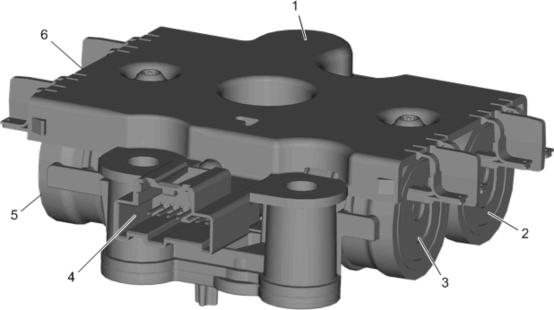
Fig. 21: Control Solenoid Valve Assembly
Courtesy of GENERAL MOTORS COMPANY
|
Callout
|
Component Name
|
|
1
|
Transmission Fluid Temperature Sensor
|
|
2
|
Pressure Control Solenoid Valve 2
|
|
3
|
Pressure Control Solenoid Valve 5
|
|
4
|
Electrical Connector - 8 Pins
|
|
5
|
Pressure Control Solenoid Valve 3
|
|
6
|
Pressure Control Solenoid Valve 4
|
1. Inspect the control solenoid valve assembly connectors and the 8 electrical connector pins for the following conditions:
 Damage
 Bent pins
 Debris
 Broken retaining tab
 Contamination
2. Ensure no metallic debris is inside the connectors near the terminal pins.
3. Inspect the control solenoid valve assembly solenoid leads for contamination or metallic debris.
4. Inspect the control solenoid valve assembly filter plate and retaining tabs for cracks and ensure proper tension when a new filter plate is attached.
OUTPUT SHAFT SPEED INPUT TEST
Special Tools
EL 38522 Variable Signal Generator
For equivalent regional tools, refer to Special Tools.
The purpose of this test is to provide a simulated output speed sensor signal to the control solenoid valve assembly Transmission Output Shaft Speed Sensor input circuits in order to verify the control solenoid valve assembly is able to process the output speed sensor signal.
1. Vehicle OFF, remove the control valve body cover. Refer to Control Valve Body Cover Removal.
2. Vehicle OFF, disconnect the Automatic Transmission Wiring Harness - Control Solenoid Valve from the OSS wiring harness.
3. Vehicle ON, test for 8.3 - 9.3 volts between terminals 1 and 2.
 If not within the specified range
Test the Automatic Transmission Wiring Harness - Control Solenoid Valve for an open, short to ground or short to voltage. If the harness tests OK, replace the T6 Power Inverter Module.
 If within the specified range
4. Vehicle OFF, using the EL 35616 terminal test kit, connect the EL 38522 variable signal generator red lead to the OSS signal circuit terminal 2 on the Automatic Transmission Wiring Harness - Control Solenoid Valve.
5. Connect the black lead from the EL 38522 variable signal generator to ground.
6. Set the EL 38522 variable signal generator to 8 volts, the frequency to 120 Hz, and the percent duty cycle to 50 or the normal position.
7. Vehicle ON, verify with a scan tool the Transmission OSS parameter is between 375 - 400 RPM.
 If not within the specified range
Replace the T6 Power Inverter Module.
 If within the specified range
8. Test the Automatic Transmission Wiring Harness - Control Solenoid Valve for an open, short to ground or short to voltage.
 If Automatic Transmission Wiring Harness - Control Solenoid Valve is shorted or open
Replace the Automatic Transmission Wiring Harness - Control Solenoid Valve harness.
 If all circuits test normal
9. Test or replace the B14A Transmission Output Shaft Speed Sensor.
Repair Instructions
Perform the Diagnostic Repair Verification
after completing the repair.
 Refer to
Control Valve Assembly and Transmission Wiring Harness Removal, and Control Valve
Assembly and Transmission Wiring Harness Installation.
Refer to
Control Valve Assembly and Transmission Wiring Harness Removal, and Control Valve
Assembly and Transmission Wiring Harness Installation.
 Refer to
Drive Motor Removal - 2nd Position, and the Drive Motor Installation - 2nd Position
for OSS replacement.
Refer to
Drive Motor Removal - 2nd Position, and the Drive Motor Installation - 2nd Position
for OSS replacement.
 Refer to
Control Module References
for T6 Power Inverter Module replacement, programming, and setup.
Refer to
Control Module References
for T6 Power Inverter Module replacement, programming, and setup.
CONTROL SOLENOID VALVE PERFORMANCE TEST
The purpose of this procedure is to test the functionality of the control solenoid valve solenoids for a stuck open or stuck closed condition, or a faulty transmission fluid temperature sensor.
Preliminary Procedures
1. Raise and support the vehicle. Refer to Lifting and Jacking the Vehicle
.
2. Remove the control solenoid valve assembly from the transmission. Refer to Control Solenoid Valve
Replacement.
3. Perform the Control Solenoid Valve Inspection
procedure.
Solenoid Testing Procedure

Fig. 22: Control Solenoid Valve Assembly
Courtesy of GENERAL MOTORS COMPANY
Control Solenoid Valve
|
Callout
|
Component Name
|
Normal Resistance
|
Terminal
|
DTC/Symptom
|
|
1
|
Transmission Fluid Temperature Sensor
|
Temperature Versus
Resistance
(Transmission Fluid
Temperature Sensor)
|
X1 Terminal 3, X1 Terminal 4
|
P0711, P0712, or P0713
|
|
2
|
Pressure Control Solenoid Valve 2
|
23 - 24 Ω
|
X1 Terminal 2, X1 Terminal 7
|
P0964, P0966, or P0967
|
|
3
|
Pressure Control Solenoid Valve 5
|
23 - 24 Ω
|
X1 Terminal 5, X1 Terminal 7
|
P2727, P2729, or P2730
|
|
Callout
|
Component Name
|
Normal Resistance
|
Terminal
|
DTC/Symptom
|
|
4
|
Electrical Connector - 8 Pins
|
-
|
-
|
-
|
|
5
|
Pressure Control Solenoid Valve 3
|
23 - 24 Ω
|
X1 Terminal 8, X1 Terminal 7
|
P0968, P0970, or P0971
|
|
6
|
Pressure Control Solenoid Valve 4
|
23 - 24 Ω
|
X1 Terminal 6, X1 Terminal 7
|
P2718, P2720, or P2721
|
DTC P0711, P0712, or P0713
1. Measure the transmission fluid temperature sensor resistance between X1 Terminal 3 and X1 Terminal 4, refer to Temperature Versus Resistance (Transmission Fluid Temperature Sensor).
 If the resistance is not within the specified range
Replace the Q8 Control Solenoid Valve Assembly.
 If the resistance is within the specified range
2. Test the transmission internal harness for an open, short to ground, or short to voltage. If the transmission internal harness tests OK, replace the T6 Power Inverter Module.
DTC P079A, P079B, P079C, P07A3, P07A5, P179C, P179D
1. Measure each pressure control solenoid valve for 23 - 24 Ω.
 If the resistance is not within the specified range
Replace the Q8 Control Solenoid Valve Assembly.
 If the resistance is within the specified range
2. With a rubber tipped blow gun, pressurize the line pressure side of each solenoid fluid passage of the Q8 control solenoid valve assembly. When the solenoid is not energized, air should not leak out of the exhaust port.
3. One at a time, energize each solenoid with a 12 V source. With a rubber tipped blow gun, pressurize the line pressure side of each solenoid fluid passage of the Q8 control solenoid valve assembly. When the solenoid is energized, air should leak out of the exhaust port.
 If the Q8 control solenoid valve assembly fails any of the above tests
Replace the Q8 Control Solenoid Valve Assembly.
 If the Q8 control solenoid valve assembly passes the above tests
The concern is internal to the transmission.
4. Repair as necessary.
Repair Instructions
Perform the Diagnostic Repair Verification
after completing the repair.
 Refer to
Control Valve Assembly and Transmission Wiring Harness Removal
for Q8 Control Solenoid Valve replacement.
Refer to
Control Valve Assembly and Transmission Wiring Harness Removal
for Q8 Control Solenoid Valve replacement.
 Refer to
Control Module References
for T6 Power Inverter Module, often referred to as the Drive Motor Generator Power Inverter Module, replacement, programming and setup.
Refer to
Control Module References
for T6 Power Inverter Module, often referred to as the Drive Motor Generator Power Inverter Module, replacement, programming and setup.
 Perform the
Reset Transmission Adapts
following all transmission related repairs.
Perform the
Reset Transmission Adapts
following all transmission related repairs.
RESET TRANSMISSION ADAPTS
Reset Transmission Adapts is a procedure for automatic transmissions in which a series of tests are run to allow the hybrid/EV powertrain control module 1 to learn individual clutch characteristics. Once the clutch data is learned, Reset Transmission Adapts translates it into the adaptive data cells, which the hybrid/EV powertrain control module 1 uses for clutch control during shifts. The scan tool provides initiation of the Reset Transmission Adapts procedure. This procedure is to be used following transmission repair.
The Reset Transmission Adapts procedure must be performed when one of the following repairs have been made to the vehicle. Failure to perform the procedure after one of the following repairs may result in poor transmission performance, as well as transmission DTCs being set:
 Transmission internal service/overhaul
 Valve body repair or replacement
 Control solenoid valve assembly replacement
 Hybrid/EV powertrain control module 1 software/calibration update
 Any service in response to a shift quality concern
NOTE: Ensure the following conditions are met before performing the Reset Transmission Adapts procedure:
 Drive wheels are blocked
 Parking brake is applied
 Service brake is applied
 Zero percent throttle and no external engine RPM control
 Transmission fluid temperature is between 70 - 115°C (158 - 239°F)
 Transmission gear selector has been cycled from Park to Reverse 3 times in order to purge air from the clutches.
NOTE: If at any time during the procedure, required conditions are not met, Reset Transmission Adapts may abort and the process may need to be started again from the beginning. If this occurs, the transmission will be left in a neutral state until the controller is shut down, vehicle OFF and remove the scan tool and wait for more than 30 seconds prior to re-try procedure. If the procedure repeatedly fails, a limit that engineering set is being exceeded and there is possibly a transmission hardware issue.
1. Use the scan tool to perform the Reset Transmission Adapts procedure. As the procedure is being performed, the scan tool data display will provide operator instructions. Follow the scan tool instructions as required.
2. Once the procedure is complete, vehicle OFF and power down the hybrid/EV powertrain control module 1. You will lose communication to the scan tool.
Ensure you exit back to the main screen in the scan tool, shut the scan tool OFF, and unplug it from the DLC or the hybrid/EV powertrain control module 1 may not shut down leaving the vehicle in a neutral state.
NOTE: When the Reset Transmission Adapts procedure is completed, the transmission will remain in a neutral state until the controller shuts down. If after 1 - 2 minutes of sitting, with the vehicle OFF and scan tool removed, the vehicle remains in a neutral state, disconnect the battery and wait 5 - 10 minutes and then connect the battery. Reverse and drive should return.
3. Vehicle ON. This will complete the Reset Transmission Adapts procedure.
4. Perform the Road Test.
Troubleshooting
If the Reset Transmission Adapts will not run and the above stated conditions have been met, ensure the following:
 Transmission Fluid Temperature parameter is between 40 - 60°C (104 - 140°F).
 Brakes and brake switch are functioning properly.
 No active DTCs.
 Park/Neutral position switch is properly adjusted and functioning.
 Line pressure control is able to provide 1000 kPa and is within specifications.
 Vehicle is not moving, or vibrating excessively.
 Clutches are properly assembled.
CONTROL VALVE BODY DIAGNOSTIC INSPECTION
The purpose of this inspection procedure is to determine if the control valve body assembly is the cause of a transmission DTC or symptom concern. The table will assist you in identifying which component within the control valve body is associated with a particular DTC or symptom. The components within the control valve body are not serviced separately.
Component Testing
WARNING: Valve springs can be tightly compressed. Use care when removing retainers and plugs. Personal injury could result.
CAUTION: After cleaning the transmission components, allow to air dry. Do not use cloth or paper towels in order to dry any transmission components. Lint from the towels can cause component failure.
CAUTION: Do not reuse cleaning solvents. Previously used solvents may deposit sediment which may damage the component.
1. Remove the control valve body assembly. Refer to Control Valve Body Replacement.
2. Clean and inspect all control valve body assembly components for the following conditions listed below:
 Stuck or scored control valve
 Scored or damaged control valve body bore
 Broken, weak, or damaged control valve return spring
 Missing, damaged, or stuck check ball
 Missing, restricted, or out of position modulated fluid pressure orifice
 Missing or damaged control valve retainer
 Debris or sediment
 If a condition is found, and cannot be repaired by cleaning
Replace the control valve body assembly.
 If a condition is not found
3. All OK
Control Valve Body Assembly

Fig. 23: Control Valve Body Assembly
Courtesy of GENERAL MOTORS COMPANY
|
Callout
|
Component Name
|
|
400
|
Pressure Regulator Valve Bore Plug Retainer
|
|
401
|
Pressure Regulator Valve Bore Plug
|
|
402
|
Pressure Regulator Valve
|
|
403
|
Pressure Regulator Valve Spring
|
|
404
|
Lube Regulator Valve Spring
|
|
405
|
Lube Regulator Valve
|
|
406
|
Lube Regulator Valve Bore Plug
|
|
407
|
Lube Regulator Valve Bore Plug Retainer
|
|
Callout
|
Component Name
|
|
408
|
Variable Low Clutch Accumulator Piston Spring Retainer
|
|
409
|
Variable Low Clutch Accumulator Piston Spring
|
|
410
|
Variable Low Clutch Accumulator Piston
|
|
411
|
Automatic Transmission Torque Dampener Bypass Clutch Valve Bore Plug Retainer
|
|
412
|
Automatic Transmission Torque Dampener Bypass Clutch Spring
|
|
413
|
Variable Low Clutch Valve
|
|
414
|
Line Pressure Control Solenoid Valve Accumulator Piston
|
|
415
|
Line Pressure Control Solenoid Valve Accumulator Piston Spring
|
|
416
|
Control Valve Body
|
|
417
|
Automatic Transmission Torque Dampener Bypass Clutch Valve
|
|
418
|
Variable Low Clutch Regulator Valve Spring
|
|
419
|
Variable Low Clutch Regulator Valve Bore Plug Retainer
|
|
420
|
Variable High Clutch Valve
|
|
421
|
Variable Low Clutch Regulator Valve Spring
|
|
422
|
Variable Low Clutch Regulator Valve Bore Plug Retainer
|
|
423
|
Variable High Clutch Dam Feed Regulator Valve
|
|
424
|
Variable High Clutch Dam Feed Regulator Valve Spring
|
|
425
|
Variable High Clutch Dam Feed Regulator Valve Bore Plug Retainer
|
|
426
|
Line Pressure Control Solenoid Valve Retainer
|
|
427
|
Line Pressure Control Solenoid Valve
|
|
428
|
Pressure Relief Ball Valve Spring Pin
|
|
429
|
Pressure Relief Ball Valve Spring
|
|
430
|
Pressure Relief Ball Valve
|
Control Valve Body Diagnostic Inspection
|
Callout
|
Component Name
|
DTC/Symptom Associated with Component
|
|
402 - A Bore
|
Pressure Regulator Valve
|
P079A, P079B, P179C, P179D
|
|
405 - B Bore
|
Lube Regulator Valve
|
Transmission/Drive Motor Overheating
|
|
410 - C Bore
|
Variable Low Clutch Accumulator Piston
|
P079A, P179C
|
|
413 - D Bore
|
Variable Low Clutch Valve
|
P079A, P07A3, P179C
|
|
417 - E Bore
|
Automatic Transmission Torque Dampener Bypass Clutch Valve
|
Engine start/stop transitions
|
|
420 - F Bore
|
Variable High Clutch Valve
|
P079B, P07A5, P179D
|
|
423 - G Bore
|
Variable High Clutch Dam Feed Regulator Valve
|
P079B, P179D
|
|
427 - H Bore
|
Line Pressure Control Solenoid Valve
|
P079A, P079B, P179C, P179D
|
|
430 -
|
Pressure Relief Ball Valve
|
P079A, Low Line Pressure
|
Repair Instructions
 Refer to
Control Valve Body Replacement
Refer to
Control Valve Body Replacement
 Refer to
Solenoid Valve Characterization Reprogramming
when the T6 Power Inverter Module, Valve Body, or Q23 Line Pressure Control Solenoid is replaced.
Refer to
Solenoid Valve Characterization Reprogramming
when the T6 Power Inverter Module, Valve Body, or Q23 Line Pressure Control Solenoid is replaced.
TRANSMISSION FLUID LEVEL AND CONDITION CHECK
This procedure checks both the transmission fluid level, as well as the condition of the fluid itself.
CAUTION: The transmission fluid level must be checked when the transmission fluid temperature is at 45 - 55°C (113 - 131°F). If the transmission fluid temperature is not at this range, operate the vehicle or allow the fluid to cool as required. Setting the transmission fluid level with fluid temperature outside this range will result in either an under or over-filled transmission. Fluid temperature higher than 55°C will result in an under-filled condition. Fluid temperature lower than 45°C will result in an over-filled condition. An under-filled transmission will cause premature component damage. An over-filled transmission may cause fluid to discharge out the vent tube, fluid foaming, pump cavitation, or overheating. Transmission overheating may result in loss of vehicle propulsion without warning.
Initial Fluid Level Confirmation

Fig. 24: Transmission Fluid Filler Cap And Fluid Level Hole Plug
Courtesy of GENERAL MOTORS COMPANY
NOTE: Ensure the transmission has enough fluid in it to safely start the vehicle without damaging the transmission. With the vehicle off and the transmission fluid temperature at approximately 20 - 25°C (68 - 77°F), there must be at least enough fluid to drain out of the fluid level hole.
1. Verify if transmission service has been performed.
2. If no transmission repair has been performed and no leaks are evident, proceed directly to the Final Level Checking Procedure below.
3. Following any transmission service, remove the fluid filler cap (1) and the fluid level hole plug (2).
 If the fluid is flowing as a steady stream, wait until the fluid begins to drip.
NOTE: Service replacement transmissions may come shipped with up to 3L (3.2 Q) of fluid.
 If no fluid comes out, add fluid until fluid drips out. Refer to
Adhesives, Fluids, Lubricants, and
Sealers
, and
Wire to Wire Repair - Engine Controls and Fuel
.
If no fluid comes out, add fluid until fluid drips out. Refer to
Adhesives, Fluids, Lubricants, and
Sealers
, and
Wire to Wire Repair - Engine Controls and Fuel
.
4. Install the fluid level hole plug. Refer to Fastener Specifications (Off-Vehicle)Fastener Specifications (On-
Vehicle).
NOTE: You must confirm fluid level at the proper temperature range.
5. Perform the Final Level Checking Procedure below.
Final Level Checking Procedure
NOTE: You may have to open the hood to maintain engine operation.
1. Start the engine.
2. Allow the engine to idle in Park (P).
NOTE: If the transmission fluid temperature reading is not at the required temperature, allow the vehicle to cool, or operate the vehicle until the appropriate range is reached. If the fluid temperature is below the specified range, driving the vehicle will raise the fluid temperature to the specification quicker than engine idling.
3. Keep the engine running and observe the transmission fluid temperature using the scan tool.
4. When the transmission fluid temperature is in the 45 - 55°C (113 - 131°F) range, move the shift lever through Park (P), Neutral (N) and Drive (D) 2 times and back to Park (P).
5. Raise the vehicle on a hoist. The vehicle must be level, with the engine running and the shift lever in the PARK range.
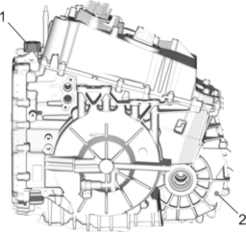
Fig. 25: Transmission Fluid Filler Cap And Fluid Level Hole Plug
Courtesy of GENERAL MOTORS COMPANY
6. While the vehicle is idling, remove the fluid level hole plug (2). Allow any fluid to drain.
 If the fluid is flowing as a steady stream, wait until the fluid begins to drip.
 If no fluid comes out, add fluid until fluid drips out.
 Proper level is achieved when fluid slowly drips at a rate of 3 drips per second.
 Reinstall the fluid level hole plug. Refer to
Fastener Specifications (Off-Vehicle)Fastener
Specifications (On-Vehicle)
.
Reinstall the fluid level hole plug. Refer to
Fastener Specifications (Off-Vehicle)Fastener
Specifications (On-Vehicle)
.
7. Inspect the fluid color. The fluid should be red or dark brown.
 If the fluid color is very dark or black and has a burnt odor, inspect the fluid for excessive metal particles or other debris. Refer to
Road Test
to verify transmission operation. Change the transmission fluid if no other conditions are found.
If the fluid color is very dark or black and has a burnt odor, inspect the fluid for excessive metal particles or other debris. Refer to
Road Test
to verify transmission operation. Change the transmission fluid if no other conditions are found.
 Fluid that is cloudy or milky or appears to be contaminated with water indicates engine coolant or water contamination. Refer to
Engine Coolant/Water in Transmission
.
Fluid that is cloudy or milky or appears to be contaminated with water indicates engine coolant or water contamination. Refer to
Engine Coolant/Water in Transmission
.
8. Inspect for external leaks. Refer to Fluid Leak Diagnosis
9. If the fluid was changed, reset the transmission oil life monitor if applicable.
LINE PRESSURE CHECK
Special Tools
EN 21867-A Pressure Gauge
For equivalent regional tools refer to Special Tools
Main Line Pressure Check

Fig. 26: Transmission Fluid Pressure Test Hole Plug
Courtesy of GENERAL MOTORS COMPANY
WARNING: Keep the brakes applied at all times in order to prevent unexpected vehicle motion. Personal injury may result if the vehicle moves unexpectedly.
1. Install a scan tool.
NOTE: Depending on the hybrid/EV battery state of charge the engine may not start.
To start or keep the engine running open the hood.
2. Start the engine.
3. If the engine will not start, refer to Engine Will Not Crank - Crankshaft Will Not Rotate
.
4. Inspect the transmission for the proper fluid level. Refer to Transmission Fluid Level and Condition Check.
5. Inspect the manual linkage at the transmission for proper function.
6. Turn the engine OFF.
NOTE: You may need to remove or disconnect components in order to gain access to the transmission line pressure test hole plug.
7. Remove the line pressure test hole plug.
8. Install the EN 21867-A pressure gauge.
9. Access the Scan Tool Transmission Output Controls for the Line Pressure Control Solenoid.
10. Start the engine.
NOTE: In order to achieve accurate line pressure readings, the following procedure must be performed at least 3 times in order to gather uniform pressure readings. Also if you do not have the hood open the engine may go in to AutoStop.
The scan tool is only able to control the line Pressure Control solenoid in PARK and NEUTRAL with engine speeds below 1500 RPM. This protects the clutches from extreme high or low line pressures.
11. Use the scan tool to increase and decrease the Line Pressure Control Solenoid in increments of approximately 100 KPa (15 psi). The scan tool commands the increment values automatically.
12. Allow the pressure to stabilize between increments.
13. Compare your pressure readings on the scan tool to those indicated on the EN 21867 - A pressure gauge.
14. If the pressure readings vary greatly, refer to Automatic Transmission Fluid Pump Pressure High or Low
15. Install the pressure test hole plug. Tighten the pressure plug to 11 N.m (97 lb in).
DRIVE MOTOR POWER INVERTER MODULE FLUID SEAL PRESSURE TEST

Fig. 27: Drive Motor Power Inverter Module Fluid Seal Pressure Test
Courtesy of GENERAL MOTORS COMPANY
|
Callout
|
Component Name
|
|
Preliminary Procedure
Install Drive Motor Power Inverter Module. Refer to:Drive Motor Power Inverter Module Installation.
|
|
1
|
Drive Motor Power Inverter Module Coolant Pipe
CAUTION:
Refer to
Fastener
Caution
.
Procedure
1. Install the drive motor power inverter module coolant pipe and bolts. Tighten the bolts to 9
N.m (80 lb in).
2. Clamp GE-48494 adapter kit components to the coolant outlet pipe.
3. Plug the coolant inlet pipe with the GE-48494 adapter kit plug and clamp.
4. Apply 20 psi (138 kPa) pressure with J-24460-01 pressure tester.
5. Monitor the pressure tester gauge for 5 minutes and ensure that pressure remains at the specified value.
 If the specified pressure cannot be maintained, check the coolant hose and connections for leaks. If the coolant hose and connections check good, remove the drive motor power inverter module and replace the fluid seal.
 If pressure remains at the specified value, proceed to the next step.
6. Remove all GE-48494 adapter kit components.
Special Tools
 GE-48494
Power Electronics Pressure Test Adapter Kit
GE-48494
Power Electronics Pressure Test Adapter Kit
 GE-48494-10
Pressure Tester Kit
GE-48494-10
Pressure Tester Kit
 J-24460-01
Cooling System Pressure Tester
J-24460-01
Cooling System Pressure Tester
For equivalent regional tools, refer to Special Tools.
|
ROAD TEST
NOTE: The Road Test Procedure should be performed only as part of the Symptom Diagnosis. Refer to Symptoms - Automatic Transmission.
The following test provides a method of evaluating the condition of the automatic transmission. The test is divided into the following parts:
 Low Voltage Electrical Function Check
 Hydraulic Control Function Check
 High Voltage Electric Machine Control Function Check
NOTE: Complete the test in the sequence given.
Before the road test, ensure the following:
 The engine is performing properly.
 Transmission fluid level is correct. Refer to
Transmission Fluid Level and Condition Check.
Transmission fluid level is correct. Refer to
Transmission Fluid Level and Condition Check.
 Tire pressure is correct.
 The high voltage battery is above 30% state of charge.
During the road test:
 Perform the test only when traffic conditions permit.
 Operate the vehicle in a controlled, safe manner.
 Observe all traffic regulations.
 To view the scan tool data while conducting this test, take along qualified help in order to operate the vehicle safely, or review the data after the drive audit.
 Observe any unusual sounds or smells.
After the road test, check the following:
 Inspect for proper transmission fluid level. Refer to
Transmission Fluid Level and Condition Check
.
Inspect for proper transmission fluid level. Refer to
Transmission Fluid Level and Condition Check
.
 Inspect for any diagnostic trouble codes (DTCs) that may have set during the testing. Refer to the applicable DTC.
 Monitor the scan tool data for any abnormal readings or data.
 Inspect for fluid leaks. Refer to Fluid Leak Diagnosis
.
Inspect for fluid leaks. Refer to Fluid Leak Diagnosis
.
Low Voltage Electrical Function Check
Perform this procedure first in order to ensure the electronic transmission components are functioning properly. If these components are not checked, a simple electrical condition could be misdiagnosed.
1. Connect the scan tool.
2. Ensure the gear selector is in PARK and set the parking brake.
3. Start the vehicle. To ensure the engine starts, open the hood.
4. With a scan tool, monitor the transmission data parameters and compare them to typical scan tool data definitions.
Refer to Hybrid Powertrain Control Module Scan Tool Information
for typical data values. Data that is questionable may indicate a concern.
5. Monitor transmission range on the scan tool data list.
1. Apply the brake pedal and ensure the parking brake is set.
2. Move the gear selector through all ranges.
3. Pause 2 to 3 seconds in each range.
4. Return gear selector to PARK.
5. Verify that all selector positions match the scan tool display.
6. Check accelerator position sensor input.
1. Apply the brake pedal and ensure the parking brake is set while monitoring accelerator pedal data.
2. Ensure the gear selector is in PARK.
3. Monitor the scan tool Accelerator Pedal Position while increasing and decreasing engine speed with the accelerator pedal. The scan tool Accelerator Pedal Position percentage should increase and decrease with engine speed.
If any of the above checks do not perform properly, record the result for reference after completion of the road test.
Hydraulic and Electric Machine Control Function Checks
NOTE: If in the above steps you opened the hood to start the engine make sure it is closed before driving the vehicle.
Charge vehicle to greater than 25% state of charge to enter EV only mode, if not already done. Perform the following steps while monitoring Hybrid/EV data list:
1. Drive vehicle at 35 mph at steady state.
2. Accelerate safely with 100% accelerator pedal to 55 mph, then drive at or above 55 mph.
1. Monitor for any excessive variable low clutch slip speed during acceleration.
3. Slow vehicle by shifting to LOW or pressing the regenerative braking button.
4. Switch vehicle to Hold Mode to start the engine (if needed) by pressing the Drive Mode Button 4 times.
5. Drive vehicle below 35 mph with stop-and-go city driving.
1. The engine will stop and start as needed.
2. Ensure smooth operation free of excessive vibrations.
6. Accelerate safely with 100% accelerator pedal to 55 mph, then drive at or above 55 mph.
1. Monitor for any excessive variable low clutch slip speed during acceleration.
2. Ensure variable high clutch engages during 55 mph steady state driving and monitor for slip.
7. Slow vehicle by shifting to LOW or pressing the regenerative braking button.
1. Ensure smooth deceleration as variable low clutch re-engages at lower vehicle speeds.
Reverse
Perform the following test safely:
1. With the vehicle stopped, move the gear selector to REVERSE.
2. Slowly accelerate the vehicle.
3. Verify that there is no noticeable slip, noise or vibration.
4. This test ensures the control system is properly applying torque in the reverse direction.
This procedure checks general functionality of the transmission. For diagnosing intermittent problems, try to duplicate the conditions of the original complaint. Refer to freeze frame records if a DTC set to determine the conditions.
CLUTCH PLATE DIAGNOSIS
Composition Plates
Dry the plates and inspect the plates for the following conditions:
 Pitting
 Flaking
 Delamination - splitting or separation of bonded clutch material
 Wear
Wear
 Glazing
 Cracking
 Charring
 Chips or metal particles embedded in the lining
Replace a composition plate which shows any of these conditions.
Steel Plates
Wipe the plates dry and check the plates for heat discoloration. If the surfaces are smooth, even if color smear is indicated, you can reuse the plate. If the plate is discolored with heat spots or if the surface is scuffed, replace the plate.
Causes of Burned Clutch Plates
The following conditions can result in a burned clutch plate:
 Incorrect usage of clutch or apply plates
 Engine coolant or water in the transmission fluid
 A cracked clutch piston
 Damaged or missing seals
 Low line pressure
 Valve body conditions
 The valve body face is not flat.
 Porosity is between channels.
 The valve bushing clips are improperly installed.
 The checkballs are misplaced.
 The Teflon® seal rings are worn or damaged.
ENGINE COOLANT/WATER IN TRANSMISSION
CAUTION: The antifreeze or water will deteriorate the seals, gaskets and the glue that bonds the clutch material to the pressure plate. Both conditions may cause damage to the transmission.
If antifreeze or water has entered the transmission, perform the following:
1. Disassemble the transmission.
2. Replace all of the rubber type seals. The coolant will attack the seal material which will cause leakage.
3. Replace the composition-faced clutch plate assemblies. The facing material may separate from the steel center portion.
4. Replace all of the nylon parts - washers.
5. Replace the torque dampener.
6. Thoroughly clean and rebuild the transmission, using new gaskets and oil filter.
7. Flush the cooler lines after the transmission cooler has been properly repaired or replaced.
CASE POROSITY REPAIR
Some external leaks are caused by case porosity in non-pressurized areas. You can usually repair these leaks with the transmission in the vehicle.
1. Thoroughly clean the area to be repaired with a cleaning solvent. Air dry the area.
WARNING: Epoxy adhesive may cause skin irritations and eye damage. Read and follow all information on the container label as provided by the manufacturer.
2. Using instructions from the manufacturer, mix a sufficient amount of an epoxy to make the repair.
3. While the transmission case is still hot, apply the epoxy. You can use a clean, dry soldering acid brush to clean the area and also to apply the epoxy cement. Make certain that the area to be repaired is fully covered.
4. Allow the epoxy cement to cure for three hours before starting the engine.
5. Repeat the fluid leak diagnosis procedures.
BUSHING AND MATING SHAFT INSPECTION
NOTE: Proper bushing and corresponding mating shaft inspection should be performed before replacing the bushing, shaft, and in some cases, the component which houses the bushing. Thoroughly clean and dry the bushing and shaft surfaces before inspecting for damage.
Any of the following bushing conditions require replacement of the bushing and/or housing:
 Discoloration due to heat distress
 Misalignment or displacement of bushing as a result of spinning in housing
 Medium to heavy scoring that can be easily detected with fingernail. Light scoring is a normal condition.
 Debris embedded into the bushing lining material
 Obvious damage, including excessive and uneven wear
 Excessive polishing. Minor polishing of the bushing is an indication of normal wear and does not require replacement.
Any of the following conditions require replacement of the bushing's mating shaft:
 Discoloration due to heat distress
 Rough surface finish that can be easily detected with finger
 Obvious shaft abnormalities, including warping or uneven surfaces
 Obvious damage or cracking
AUTOMATIC TRANSMISSION FLUID PUMP PRESSURE HIGH OR LOW
|
Checks
|
Causes
|
|
Automatic Transmission Fluid Pump Motor
|
 Faulty fluid pump motor assembly
 Faulty fluid pump motor wiring
 Low fluid level
 Inspect for leaking or damaged fluid pump outlet seal and fluid filter seal
|
|
Checks
|
Causes
|
|
|
 Inspect for improperly installed or damaged fluid filter
|
|
Control Solenoid Valve
|
 Inspect for leaking or damaged control solenoid valve seals
 Inoperable control solenoid valve
 Inspect for damaged control solenoid electrical connector or wiring
 Inspect for damaged or worn control solenoid valve accumulator or accumulator bore
|
|
Control Valve Assembly
|
 Inspect for leaking or damaged control valve body spacer plate
 Inspect for damaged or stuck open line pressure blow-off ball
valve
 Inspect for a sticky or stuck line pressure regulator valve
 Inspect solenoid module assembly for damage to plastic body or seal plate
 Inspect for other sticky or stuck valves within the control valve assembly
 Inspect for other leak paths within the line pressure hydraulic circuit or control valve solenoid hydraulic circuitry
|
AUTOMATIC TRANSMISSION FLUID LEAKS
|
Checks
|
Causes
|
|
Torque Dampener
|
Inspect for damage.
|
|
Case Assembly
|
 Inspect for porosity or damage on the sealing surfaces
 Inspect for loose oil cooler line bolts or damaged oil cooler line seals
 Inspect for damaged manual shift shaft seal
 Inspect for damaged or worn drive shaft oil seals on the axle shafts
 Inspect for loose pressure test plug and fluid level hole plug
|
|
Torque Dampener and Differential Housing Assembly
|
 Inspect for damaged torque dampener and differential housing assembly
 Inspect for porosity or damage on the sealing surfaces
 Inspect for damaged torque dampener and differential housing gasket
 Inspect for loose torque dampener and differential housing bolts
 Inspect for damaged or worn drive shaft oil seals on the axle
shafts
|
|
Checks
|
Causes
|
|
Control Valve Body Cover
|
 Inspect for damaged or warped control valve body cover
 Inspect for damaged fluid level control valve seal - gasket
 Inspect for loose control valve body cover bolts.
|
FLUID LEAK DIAGNOSIS
General Method
1. Verify that the leak is transmission fluid.
CAUTION: Do not clean using brake cleaner or other reactive solvents as these solvents can damage rubber gaskets, seals and bushings.
2. Thoroughly clean the suspected leak area using a rag.
3. Operate the vehicle for 24 km (15 mi), or until normal operating temperatures are reached.
4. Park the vehicle over clean paper or cardboard.
5. Shut OFF the engine.
6. Look for fluid spots on the paper.
7. Make the necessary repairs.
Powder Method
CAUTION: Do not clean using brake cleaner or other reactive solvents as these solvents can damage rubber gaskets, seals and bushings.
1. Thoroughly clean the suspected leak area using a rag.
2. Apply an aerosol type leak tracing powder to the suspected leak area.
3. Operate the vehicle for 24 km (15 mi), or until normal operating temperatures are reached.
4. Shut OFF the engine.
5. Inspect the suspected leak area.
6. Trace the leak path through the powder in order to find the source of the leak.
7. Make the necessary repairs.
Dye and Black Light Method
A fluid dye and black light kit is available from various tool manufacturers.
1. Follow the manufacturer's instructions in order to determine the amount of dye to use.
2. Operate the vehicle for 24 km (15 mi) or until normal operating temperatures are reached.
3. Detect the leak with the black light.
4. Make the necessary repairs.
Find the Cause of the Leak
Pinpoint the leak and trace the leak back to the source. You must determine the cause of the leak in order to repair the leak properly. For example, if you replace a gasket, but the sealing flange is bent, the new gasket will not repair the
leak. You must also repair the bent flange. Before you attempt to repair a leak, check for the following conditions, and make repairs as necessary:
Gaskets
 Fluid level/pressure is too high
 Plugged vent or drain-back holes
 Improperly tightened fasteners
 Dirty or damaged threads
 Warped flanges or sealing surface
 Scratches, burrs, or other damage to the sealing surface
 Damaged or worn gasket
 Cracking or porosity of the component
 Improper sealant used, where applicable
 Incorrect gasket
Seals
 Fluid level/pressure is too high
 Plugged vent or drain-back holes
 Damaged seal bore
 Damaged or worn seal
 Improper installation
 Cracks in component
 Manual shaft or output shaft surface is scratched, nicked, or damaged
 Loose or worn bearing causing excess seal wear
Possible Points of Fluid Leaks
Control Valve Body Cover
 Incorrectly tightened bolts
 Improperly installed or damaged gasket/seal
 Damaged mounting face
 Incorrect gasket seal
Case Leak
 Damaged manual shift shaft seal
 Loose or damaged oil cooler lines/seals
 Worn or damaged drive shaft oil seal
 Loose line pressure plug or fluid level hole plug
 Porous casting
 Warped torque dampener and differential housing
 Damaged torque dampener and differential housing gasket
Torque Dampener and Differential Housing
 Damaged torque dampener and differential housing gasket.
 Worn or damaged drive shaft oil seal
 Porous casting of the torque dampener and differential housing
Leak at the Vent
 Overfilled system
 Water or coolant in the fluid; The fluid will appear milky
 Transmission case porous
 Incorrect fluid level indicator causing an overfilled system
 Plugged vent
WHINE/GROWL NOISE THAT CHANGES WITH VEHICLE SPEED
|
Checks
|
Causes
|
|
Input Internal Gear Thrust Bearing
|
Inspect the bearing for wear or damage.
|
|
Output Carrier Thrust Bearing
|
 Inspect the carrier assembly for damaged pinion gears, pins, and rollers.
 Inspect for damaged thrust bearings.
 Inspect for damaged sun gears.
 Inspect for damaged or stripped splines on the output carrier assembly.
|
|
Output Carrier Internal Gear Hub Thrust Bearing
|
Inspect the bearing for wear or damage.
|
|
Front Differential Carrier
|
Inspect for damaged gears and bearings.
|
|
Front Differential Carrier Bearing
|
Inspect the bearing for wear or damage.
|
|
Drive Link Assembly
|
Inspect for damaged sprockets, bearings, and drive link.
|
NOISE IN DRIVE OR REVERSE GEAR
|
Checks
|
Causes
|
|
Variable Low Clutch Assembly
|
 Inspect for damaged or worn variable low clutch plates.
 Inspect for damaged variable low clutch backing plate.
 Inspect for damaged variable low clutch backing plate retaining ring.
 Inspect for damaged variable low clutch piston assembly and spring.
|
|
Front Differential Carrier
|
Inspect for damaged gears and bearings.
|
|
Drive Link Assembly
|
Inspect for damaged sprockets, bearings, and drive link.
|
VIBRATION
|
Checks
|
Causes
|
|
Lug bolts for the Input Drive Flange
|
Inspect for loose bolts.
|
|
Input Internal Gear Thrust Bearing
|
Inspect for wear or damage.
|
|
Output Carrier Thrust Bearing
|
Inspect the bearing for wear or damage.
|
|
Output Carrier
|
 Inspect the carrier assembly for damaged pinion gears, thrust washers, pins, and rollers.
 Inspect for a worn or damaged center support roller bearing assembly.
 Inspect for damaged thrust bearings.
 Inspect the carrier assembly for damaged output carrier rear sun gear thrust bearing (captured).
|
|
Front Differential Carrier
|
Inspect for damaged gears and bearings.
|
NOISE AND VIBRATION ANALYSIS
A noise or vibration that is noticeable when the vehicle is in motion MAY NOT be the result of the transmission.
If noise or vibration is noticeable in PARK and NEUTRAL with the engine at idle, but is less noticeable as RPM increases, the cause may be from poor engine performance.
 Inspect the tires for the following conditions:
 Uneven wear
 Imbalance
 Mixed sizes
 Mixed radial and bias ply
 Inspect the suspension components for the following conditions:
 Alignment wear or damage
 Loose fasteners
 Driveline damage or wear
 Inspect the engine and transmission mounts for damage and loose bolts.
 Inspect the transmission case mounting holes for the following conditions:
 Missing bolts, nuts, and studs
 Stripped threads
 Cracks
 Inspect the flywheel for the following conditions:
 Missing or loose bolts
 Cracks
 Imbalance
 Inspect the input drive flange for the following conditions:
 Missing or loose bolts or lugs
 Missing or loose balance weights
 Imbalance caused by heat distortion or fluid contamination
NO PARK OR DRIVE
|
Checks
|
Causes
|
|
Front Differential Carrier
|
Inspect for damaged gears and bearings.
|
|
Drive Link Assembly
|
Inspect for damaged sprockets, bearings, and drive link.
|
NO DRIVE IN ALL RANGES
|
Checks
|
Causes
|
|
Output Carrier
|
 Inspect the carrier assembly for damaged pinion gears, thrust washers, pins, and rollers.
 Inspect for damaged thrust bearings.
 Inspect for damaged sun gears.
 Inspect the carrier assembly for damaged output carrier rear sun gear thrust bearing (captured).
|
|
Drive Motor - 2nd Position
|
Motor Failure
 Inspect connections at motor
 Inspect motor end bearings
|
|
Thrust Bearing
|
Inspect the bearing for wear or damage.
|
|
Front Differential Carrier
|
Inspect for damaged gears and bearings.
|
|
Drive Link Assembly
|
Inspect for damaged sprockets, bearings, and drive link.
|
|
Front Differential Carrier Sun Gear
|
Inspect for spline wear or damage.
|
|
Automatic Transmission Fluid Filter
|
 Inspect for damaged or restricted fluid filter.
 Inspect for damaged fluid filter seal or improper sealing interface, leaks, and fluid aeration.
|
|
Automatic Transmission Fluid Pump Outlet Seal
|
Inspect for worn or damaged seal.
|
NO REVERSE GEAR
|
Checks
|
Causes
|
|
Output Carrier
|
 Inspect the carrier assembly for damaged pinion gears, thrust washers, pins, and rollers.
 Inspect for damaged thrust bearings.
 Inspect for damaged sun gears.
 Inspect the carrier assembly for damaged output carrier rear sun gear thrust bearing (captured).
|
|
Drive Motor - 2nd Position
|
Motor Failure
 Inspect connections at motor
 Inspect motor end bearings
|
|
Checks
|
Causes
|
|
Thrust Bearing
|
Inspect the bearing for wear or damage.
|
|
Front Differential Carrier
|
Inspect for damaged gears and bearings.
|
|
Drive Link Assembly
|
Inspect for damaged sprockets, bearings, and drive link.
|
|
Front Differential Carrier Sun Gear
|
Inspect for spline wear or damage.
|
|
Automatic Transmission Fluid Filter
|
 Inspect for damaged or restricted fluid filter.
 Inspect for damaged fluid filter seal or improper sealing interface, leaks, and fluid aeration.
|
|
Automatic Transmission Fluid Pump Outlet Seal
|
Inspect for worn or damaged seal.
|
NO DRIVE OR REVERSE GEAR
|
Checks
|
Causes
|
|
Variable Low Clutch Assembly
|
 Inspect for damaged or distorted clutch housing.
 Inspect for damaged or distorted clutch plates.
|
|
Variable High Clutch Assembly
|
 Inspect for damaged or distorted clutch housing.
 Inspect for damaged or distorted clutch plates.
|
HARSH, SOFT, DELAYED OR SLIPPING DRIVE OR REVERSE GEAR
|
Checks
|
Causes
|
|
Variable Low Clutch Assembly
|
 Inspect for damaged or worn variable low clutch plates.
 Inspect for damaged variable low clutch backing plate.
 Inspect for damaged variable low clutch backing plate retaining ring.
 Inspect for damaged variable low clutch piston assembly and spring.
|
|
Variable High Clutch Assembly
|
 Inspect for damaged or worn variable high clutch plates.
 Inspect for damaged variable high clutch backing plate.
 Inspect for damaged variable high clutch backing plate retaining ring.
 Inspect for damaged variable high clutch piston assembly and spring.
|
|
Control Valve Assembly
|
 Inspect solenoid module assembly for damage to plastic body, electrical connections and wire harness, or seal plate.
 Inspect low variable shift valve for stickiness or stuck condition.
 Inspect for stuck or sticky compensator feed valve.
 Inspect for leak paths within the variable high or compensator feed hydraulic circuits.
|
|
Checks
|
Causes
|
|
|
 Inspect for leaking or damaged control valve body spacer plate.
 Inspect for plugged control valve body spacer plate orifice(s).
|
STUCK IN DRIVE OR REVERSE GEAR
|
Checks
|
Causes
|
|
Variable Low Clutch Assembly
|
 Inspect for damaged or worn variable low clutch plates.
 Inspect for damaged variable low clutch backing plate.
 Inspect for damaged variable low clutch backing plate retaining ring.
 Inspect for damaged variable low clutch piston assembly and spring.
|
HARSH GARAGE SHIFT
|
Checks
|
Causes
|
|
Variable Low Clutch Assembly
|
Inspect for damaged or worn variable low clutch plates.
|
SEIZED ENGINE OR TRANSMISSION SEPARATION
Removal Procedure
WARNING: Do not use a service jack in locations other than those specified to lift this vehicle. Lifting the vehicle with a jack in those other locations could cause the vehicle to slip off the jack and roll; this could cause injury or death.
1. Ensure that the vehicle is properly supported and squarely positioned. Refer to
Lifting and Jacking the
Vehicle
.
WARNING: Always perform the High Voltage Disabling procedure prior to servicing any High Voltage component or connection. Personal Protection Equipment (PPE) and proper procedures must be followed.
The High Voltage Disabling procedure will perform the following tasks:
 Identify how to disable high voltage.
 Identify how to test for the presence of high voltage.
 Identify condition under which high voltage is always present and personal protection equipment (PPE) and proper procedures must be followed.
Failure to follow the procedures exactly as written may result in serious injury or death.
2. Disconnect the battery negative cable. Refer to Battery Negative Cable Disconnection and Connection
3. Disable the high voltage system and disconnect the A4 Hybrid/EV Battery Pack high voltage harness connector at the T6 Power Inverter Module. Refer to High Voltage Disabling
.
4. Set the parking brake.
5. Remove the engine and transmission assembly from the vehicle. Refer to Engine Replacement
, and
Transmission Replacement.
6. With the engine and transmission assembly on the cradle, support both the engine and transmission.

Fig. 28: Drive Motor Power Inverter Module Cover And Water Outlet
Courtesy of GENERAL MOTORS COMPANY
7. Remove Drive Motor Power Inverter Module Cover (1). Refer to Drive Motor Power Inverter Module
Cover Removal
8. Remove Water Outlet (2). Refer to Water Outlet Replacement


9. Install Drive Motor Power Inverter Module Cover (1). Refer to Drive Motor Power Inverter Module Cover
Installation

Fig. 29: Hidden Torque Dampener And Differential Housing Bolts
Courtesy of GENERAL MOTORS COMPANY
10. Mark the location of the three hidden torque dampener and differential housing bolts 1 to 3.
11. With an air chisel, remove the torque dampener and differential housing material in order to gain access to the three hidden bolts.
12. With a 13 mm box end wrench, remove the torque dampener and differential housing bolts including the now exposed hidden bolts. (Qty: 16)

Fig. 30: Transmission Case And Torque Dampener And Differential Housing
Courtesy of GENERAL MOTORS COMPANY
13. With an appropriate hoist, separate the transmission case (1) from the torque dampener and differential housing (2).

Fig. 31: Input Internal Gear, Retaining Ring And Transmission Torque Dampener Bolts
Courtesy of GENERAL MOTORS COMPANY
14. Remove Input Internal Gear Retaining Ring (1)
15. Remove Input Internal Gear (2)
16. Remove Automatic Transmission Torque Dampener Bolts (3) (Qty: 6)
17. Remove the torque dampener and differential housing to engine bolts.
18. Remove the torque dampener and differential housing from the engine.
19. Remove the input drive flange from the automatic transmission flex plate.
Installation Procedure
1. Determine the correct torque dampener thrust washer. Refer to Automatic Transmission Torque Dampener
Thrust Washer Measurement.
2. Using a NEW torque dampener and differential housing assembly, install the torque dampener and differential housing to the transmission case. Refer to Automatic Transmission Torque Dampener and Differential
Housing Installation.
REPAIR INSTRUCTIONS - ON VEHICLE
TRANSMISSION CONTROL LEVER KNOB REPLACEMENT

Fig. 32: Transmission Control Lever Knob
Courtesy of GENERAL MOTORS COMPANY
|
Callout
|
Component Name
|
|
1
|
Transmission Control Lever Knob
Procedure
1. Release the lever boot from the 6 retainers (arrows).
2. Pull the knob with both hands upward with a twisting motion of max. 1 - 2 degrees to release from the transmission control lever.
3. Remove transmission control lever knob from the transmission control.
NOTE:
Considerable effort may be necessary to release the
|
|
Callout
|
Component Name
|
|
|
knob from the control lever.
|
TRANSMISSION CONTROL REPLACEMENT (WITH BASE)

Fig. 33: Transmission Control (With Base)
Courtesy of GENERAL MOTORS COMPANY
|
Callout
|
Component Name
|
|
Preliminary Procedures
1. Remove Transmission Control Lever Knob. Refer to Transmission Control Lever Knob Replacement
2. Remove Front Floor Console. Refer to Front Floor Console Replacement
WARNING:
After installing the transmission range selector shift cable, pull up and push down on ALL
connections to verify that
|
|
Callout
|
Component Name
|
|
the connections are fully seated and properly engaged.
Failure to perform this task can result in the vehicle not being able to shift into PARK
causing potential vehicle damage and bodily injury.
3. Disconnect Range Selector Lever Cable @ Transmission Control. Refer to Range Selector Lever
Cable Replacement
4. Disconnect the wiring harness connector and the wiring harness retainers.
|
|
1
|
Transmission Control Lever Housing Bracket Nut (Qty: 5)
CAUTION:
Refer to Fastener
Caution
Tighten
9 N.m (80 lb in)
|
|
2
|
Transmission Control
Procedure
1. Transfer parts as needed.
2. After the installation is complete perform a range selector lever cable adjustment. Refer to
Range Selector Lever Cable Adjustment.
|
TRANSMISSION CONTROL REPLACEMENT (WITHOUT BASE)
Removal Procedure
1. Set the park brake.
2. Remove Front Floor Console. Refer to Front Floor Console Replacement

Fig. 34: Range Selector Lever Cable And Transmission Control
Courtesy of GENERAL MOTORS COMPANY
3. Remove the range selector lever cable (1) from the transmission control. Release the cable from the bracket by pushing the retainer (arrow).
4. Disconnect the transmission control electrical connector.

Fig. 35: Nut And Washer
Courtesy of GENERAL MOTORS COMPANY
5. Remove the nut and washer (1) from the control assembly.

Fig. 36: Main Shaft Bolt
Courtesy of GENERAL MOTORS COMPANY
6. Remove the main shaft bolt (1).

Fig. 37: Transmission Control Assembly
Courtesy of GENERAL MOTORS COMPANY
7. Pull the transmission control assembly (1) rearward and upward to unseat it from the transmission control base.
8. Remove the transmission control assembly from the vehicle.
Installation Procedure
1. Position the transmission control assembly to the transmission control base.

Fig. 38: Transmission Control Assembly
Courtesy of GENERAL MOTORS COMPANY
2. Push the transmission control assembly (1) downward and forward to seat it to the transmission control base.
NOTE: Ensure the flats of the bolt align with the transmission control assembly flat points inside the base before tightening the nut.

Fig. 39: Main Shaft Bolt
Courtesy of GENERAL MOTORS COMPANY
3. Install the main shaft bolt (1).
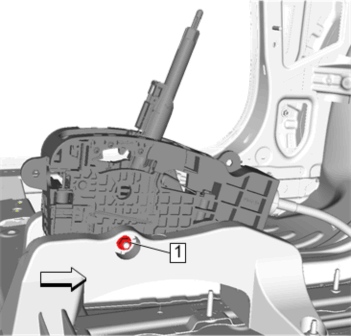

Fig. 40: Nut And Washer
Courtesy of GENERAL MOTORS COMPANY
CAUTION: Refer to Fastener Caution .

NOTE: When installing the transmission control main shaft bolt, the face of the bolt must be held in the slot of the mounting bracket as the nut is torqued to ensure it remains seated and doesn't rotate out of the slot. Failure to perform this task can result in a loose shifter feel, squeaks & rattles, or excessive cross car lash resulting in a customer's poor perceived quality of the system.
4. Install the nut and washer (1) to the control assembly and tighten to 7 N.m (62 lb in).
5. Connect the transmission control electrical connector.

Fig. 41: Range Selector Lever Cable And Transmission Control
Courtesy of GENERAL MOTORS COMPANY
WARNING: After installing the transmission range selector shift cable, pull up and push down on ALL connections to verify that the connections are fully seated and properly engaged. Failure to perform this task can result in the vehicle not being able to shift into PARK causing potential vehicle damage and bodily injury.
6. Install the range selector lever cable (1) to the transmission control.
7. Install Front Floor Console. Refer to Front Floor Console Replacement
8. Release the park brake.
9. Adjust the automatic transmission range selector lever cable. Refer to Range Selector Lever Cable
Adjustment
DRIVE MOTOR GENERATOR POWER INVERTER MODULE REPLACEMENT
Removal Procedure

Fig. 42: Drive Motor Power Inverter Module Cover And Components
Courtesy of GENERAL MOTORS COMPANY
1. Remove Drive Motor Power Inverter Module Cover (2). Refer to Drive Motor Power Inverter Module
Cover Replacement
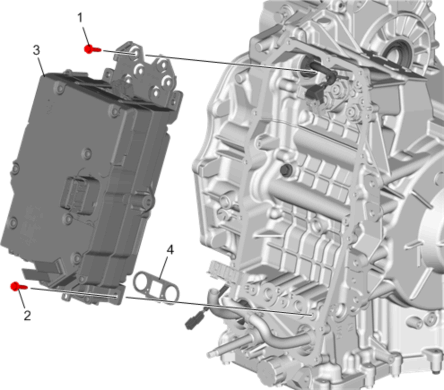
Fig. 43: Drive Motor Power Inverter Module And Components
Courtesy of GENERAL MOTORS COMPANY
2. Remove Drive Motor Power Inverter Module (3). Refer to Drive Motor Power Inverter Module Removal
Installation Procedure

Fig. 44: Drive Motor Power Inverter Module And Components
Courtesy of GENERAL MOTORS COMPANY
1. Install Drive Motor Power Inverter Module (3). Refer to Drive Motor Power Inverter Module Installation

Fig. 45: Drive Motor Power Inverter Module Cover And Components
Courtesy of GENERAL MOTORS COMPANY
2. Install Drive Motor Power Inverter Module Cover (2). Refer to Drive Motor Power Inverter Module Cover
Replacement
3. Program the power inverter module and the immobilizer control module. Refer to Control Module
References
DRIVE MOTOR POWER INVERTER MODULE COVER REPLACEMENT
Special Tools
BO-38185 Hose Clamp Pliers Equivalent regional tools:
Special Tools
Removal Procedure
WARNING: Always perform the High Voltage Disabling procedure prior to servicing any High Voltage component or connection. Personal Protection Equipment (PPE) and proper procedures must be followed.
The High Voltage Disabling procedure will perform the following tasks:
 Identify how to disable high voltage.
 Identify how to test for the presence of high voltage.
 Identify condition under which high voltage is always present and personal protection equipment (PPE) and proper procedures must be followed.
Failure to follow the procedures exactly as written may result in serious injury or death.
1. Set the parking brake.
2. Disconnect the battery negative cable. Refer to Battery Negative Cable Disconnection and Connection
3. Disable the high voltage system and disconnect the A4 Hybrid/EV Battery Pack high voltage harness connector at the T6 Power Inverter Module. Refer to High Voltage Disabling
.

Fig. 46: Radiator Surge Tank, Bracket And Clips
Courtesy of GENERAL MOTORS COMPANY
4. Remove Radiator Surge Tank Clip (1)
NOTE: To remove the radiator surge tank from the radiator surge tank bracket move it in driving direction.
5. Move the radiator surge tank (4) in arrow direction to release the radiator surge tank clip (2) from the radiator surge tank bracket (3).
6. Relocate the radiator surge tank out of the way of the Drive Motor Power Inverter Module Cover and secure with tie strap.
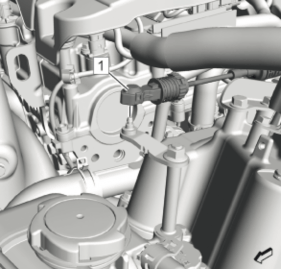
Fig. 47: Range Selector Lever Cable And Range Selector Lever Cable Lever
Courtesy of GENERAL MOTORS COMPANY
7. Remove Range Selector Lever Cable (1) @ Range Selector Lever Cable Lever

Fig. 48: Range Selector Lever Cable And Transmission Range Selector Lever Cable Bracket
Courtesy of GENERAL MOTORS COMPANY
8. Remove the range selector lever cable (1) from the range selector lever cable bracket.
Release the cable from the bracket by pushing the retainer (arrow).

Fig. 49: Drive Motor Battery Positive And Negative Cable Connector
Courtesy of GENERAL MOTORS COMPANY
9. Place a shop towel over the drive motor battery positive and negative cable connector (1) to prevent coolant from entering the cover.
10. Raise and support the vehicle. Refer to Lifting and Jacking the Vehicle
11. Remove Front Wheelhouse Liner. Refer to Front Wheelhouse Liner Replacement (Left Side) Front
Wheelhouse Liner Replacement (Right Side)
12. Drain Drive Motor Generator Power Inverter Module Cooling System. Refer to Drive Motor Generator
Power Inverter Module Cooling System Draining and Filling

Fig. 50: Coolant Hose And Clamp
Courtesy of GENERAL MOTORS COMPANY
NOTE: The following 2 steps are necessary to prevent contamination of other components while removing residual coolant with shop air.
13. Loosen Clamp (2)
14. Disconnect Drive Motor Generator Control Module Cooling Outlet Hose (1)
15. Lower the vehicle.

Fig. 51: Drive Motor Generator Power Inverter Module Outlet Hose And Clamp
Courtesy of GENERAL MOTORS COMPANY
16. Loosen the drive motor generator power inverter module outlet hose clamp (2), using the BO-38185 pliers.
17. Remove the drive motor generator power inverter module outlet hose (1).
18. Using shop air, blow air through the drive motor power inverter module cooling outlet hose to remove residual coolant from the drive motor power inverter module.

Fig. 52: Drive Motor Battery Positive And Negative Cable Connector And Bolts
Courtesy of GENERAL MOTORS COMPANY
19. Remove Drive Motor Battery Positive and Negative Cable Connector Bolts (1) (Qty: 4)
20. Remove Drive Motor Battery Positive and Negative Cable Connector (2)

Fig. 53: Engine Wiring Harness Bracket Nut And Stud
Courtesy of GENERAL MOTORS COMPANY
21. Remove Engine Wiring Harness Bracket Nut (1)
22. Remove the engine wiring harness stud (2).

Fig. 54: Drive Motor Power Inverter Module Cover And Components
Courtesy of GENERAL MOTORS COMPANY
23. Remove Drive Motor Power Inverter Module Cover (2). Refer to Drive Motor Power Inverter Module
Cover Removal
Installation Procedure

Fig. 55: Drive Motor Power Inverter Module Cover And Components
Courtesy of GENERAL MOTORS COMPANY
1. Install Drive Motor Power Inverter Module Cover (2). Refer to Drive Motor Power Inverter Module Cover
Installation

Fig. 56: Engine Wiring Harness Bracket Nut And Stud
Courtesy of GENERAL MOTORS COMPANY
CAUTION: Refer to Fastener Caution
2. Install the engine wiring harness stud (2) and tighten to 9 N.m (80 lb in).
3. Install and tighten Engine Wiring Harness Bracket Nut (1) to 9 N.m (80 lb in)

Fig. 57: Drive Motor Battery Positive And Negative Cable Connector And Bolts (With Bolt Tightening
Sequence)
Courtesy of GENERAL MOTORS COMPANY
4. Install Drive Motor Battery Positive and Negative Cable Connector (2)
5. Tighten Drive Motor Battery Positive and Negative Cable Connector Bolts (1) (Qty: 4) in sequence to 9 N.m (80 lb in)

Fig. 58: Drive Motor Generator Power Inverter Module Outlet Hose And Clamp
Courtesy of GENERAL MOTORS COMPANY
6. Install the drive motor generator power inverter module outlet hose (1).
7. Install the drive motor generator power inverter module outlet hose clamp (2), using the BO-38185 pliers.

Fig. 59: Range Selector Lever Cable And Transmission Range Selector Lever Cable Bracket
Courtesy of GENERAL MOTORS COMPANY
8. Install the range selector lever cable (1) to the range selector lever cable bracket.
The retainer snaps automatically in.
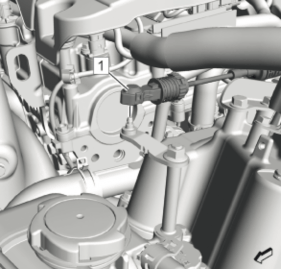
Fig. 60: Range Selector Lever Cable And Range Selector Lever Cable Lever
Courtesy of GENERAL MOTORS COMPANY
9. Install Range Selector Lever Cable (1) @ Range Selector Lever Cable Lever
10. Adjust Range Selector Lever Cable. Refer to Range Selector Lever Cable Adjustment

Fig. 61: Radiator Surge Tank, Bracket And Clips
Courtesy of GENERAL MOTORS COMPANY
11. Remove the tie strap holding the radiator surge tank.
NOTE: To install the radiator surge tank to the radiator surge tank bracket move it against driving direction.
12. Move the radiator surge tank (4) in arrow direction to clip in the radiator surge tank clip (2) into the radiator surge tank bracket (3).
13. Install Radiator Surge Tank Clip (1)
14. Raise the vehicle.

Fig. 62: Coolant Hose And Clamp
Courtesy of GENERAL MOTORS COMPANY
15. Connect Drive Motor Generator Control Module Cooling Outlet Hose (1)
16. Install Clamp (2)
17. Install Front Wheelhouse Liner. Refer to Front Wheelhouse Liner Replacement (Left Side) Front
Wheelhouse Liner Replacement (Right Side)
18. Fill Drive Motor Generator Power Inverter Module Cooling System. Refer to Drive Motor Generator Power
Inverter Module Cooling System Draining and Filling
19. Lower the vehicle.
20. Enable the high voltage system and connect the A4 Hybrid/EV Battery Pack high voltage harness connector at the T6 Power Inverter Module. Refer to High Voltage Enabling
.
21. Connect the battery negative cable. Refer to Battery Negative Cable Disconnection and Connection
AUTOMATIC TRANSMISSION RANGE SELECTOR LEVER REPLACEMENT

Fig. 63: Automatic Transmission Range Selector Lever
Courtesy of GENERAL MOTORS COMPANY
|
Callout
|
Component Name
|
|
Preliminary Procedures
1. Set the parking brake.
WARNING:
After installing the transmission range selector shift cable, pull up and push down on ALL
connections
|
|
Callout
|
Component Name
|
|
to verify that the connections are fully seated and properly engaged.
Failure to perform this task can result in the vehicle not being able to shift into PARK
causing potential vehicle damage and bodily injury.
2. Remove Range Selector Lever Cable @ Automatic Transmission Range Selector Lever. Refer to Range
Selector Lever Cable Replacement
|
|
1
|
Transmission Range Selector Lever Nut
WARNING:
Hold the transmission range selector lever while removing or installing the lever retaining nut. Failure to hold the lever can cause damage to the transmission internal park system components which could allow the vehicle to
|
|
Callout
|
Component Name
|
|
|
roll when placed in the park position.
CAUTION:
Refer to Fastener
Caution
Tighten
30 N.m (22 lb ft)
|
|
2
|
Automatic Transmission Range Selector Lever
Procedure
After the installation is complete perform a range selector lever cable adjustment. Refer to
Range Selector Lever Cable Adjustment.
|
RANGE SELECTOR LEVER CABLE REPLACEMENT
Removal Procedure
1. Set the parking brake.

Fig. 64: Range Selector Lever Cable And Range Selector Lever Cable Lever
Courtesy of GENERAL MOTORS COMPANY
2. Remove Range Selector Lever Cable (1) @ Range Selector Lever Cable Lever

Fig. 65: Range Selector Lever Cable And Transmission Range Selector Lever Cable Bracket
Courtesy of GENERAL MOTORS COMPANY
3. Remove the range selector lever cable (1) from the range selector lever cable bracket.
Release the cable from the bracket by pushing the retainer (arrow).
4. Remove Front Floor Console. Refer to Front Floor Console Replacement

Fig. 66: Range Selector Lever Cable And Transmission Control
Courtesy of GENERAL MOTORS COMPANY
5. Remove the range selector lever cable (1) from the transmission control.
Release the cable from the bracket by pushing the retainer (arrow).
6. Note the routing of the range selector lever cable.

Fig. 67: Range Selector Lever Cable And Grommet
Courtesy of GENERAL MOTORS COMPANY
7. Gently pry the grommet out, then remove the range selector lever cable (1) from the inside of the vehicle.
Installation Procedure

Fig. 68: Range Selector Lever Cable And Grommet
Courtesy of GENERAL MOTORS COMPANY
1. Position the range selector lever cable in the vehicle.
2. Install the range selector lever cable grommet (1) into the panel.

Fig. 69: Range Selector Lever Cable And Transmission Control
Courtesy of GENERAL MOTORS COMPANY
3. Install the range selector lever cable (1) to the transmission control.
The retainer snaps automatically in.
4. Install Front Floor Console. Refer to Front Floor Console Replacement

Fig. 70: Range Selector Lever Cable And Transmission Range Selector Lever Cable Bracket
Courtesy of GENERAL MOTORS COMPANY
5. Install the range selector lever cable (1) to the range selector lever cable bracket.
The retainer snaps in automatically.

Fig. 71: Range Selector Lever Cable And Range Selector Lever Cable Lever
Courtesy of GENERAL MOTORS COMPANY
WARNING: After installing the transmission range selector shift cable, pull up and push down on ALL connections to verify that the connections are fully seated and properly engaged. Failure to perform this task can result in the vehicle not being able to shift into PARK causing potential vehicle damage and bodily injury.
6. Install Range Selector Lever Cable (1) @ Range Selector Lever Cable Lever
7. Adjust Range Selector Lever Cable. Refer to Range Selector Lever Cable Adjustment
RANGE SELECTOR LEVER CABLE ADJUSTMENT
1. Set the parking brake.

Fig. 72: Retaining Collar And Range Select Cable Adjuster Clip
Courtesy of GENERAL MOTORS COMPANY
2. Pull the retaining collar (1) forward, then release the range select cable adjuster clip (2) by pushing out on the adjuster clip from the underneath.

Fig. 73: Range Selector Lever
Courtesy of GENERAL MOTORS COMPANY
NOTE: Adjust the automatic transmission range selector lever cable while the transmission and the transmission control are in the Park position only. Failure to do so may cause false adjustment.
3. Verify the range selector lever (1) is in the park position.
Rotate the lever counterclockwise till the stop (arrow).

Fig. 74: Transmission Control Lever
Courtesy of GENERAL MOTORS COMPANY
NOTE: Adjust the automatic transmission range selector lever cable while the transmission and the transmission control are in the park position only. Failure to do so may cause false adjustment.
4. Verify the transmission control lever (1) is in the park position.

Fig. 75: Retaining Collar And Adjuster Clip
Courtesy of GENERAL MOTORS COMPANY
5. Depress the adjuster clip (2) locking the adjuster clip completely, then release the retaining collar (1).
WARNING: After installing the transmission range selector shift cable, pull up and push down on ALL connections to verify that the connections are fully seated and properly engaged. Failure to perform this task can result in the vehicle not being able to shift into PARK causing potential vehicle damage and bodily injury.
6. Ensure that the cable adjuster is secured.
7. Check the transmission control lever in all gear selections for proper operation.
RANGE SELECTOR LEVER CABLE BRACKET REPLACEMENT

Fig. 76: Range Selector Lever Cable Bracket
Courtesy of GENERAL MOTORS COMPANY
|
Callout
|
Component Name
|
|
Preliminary Procedure
Remove Transmission Range Selector Lever Cable @ Automatic Transmission Range Selector Lever & Transmission Range Selector Lever Cable Bracket. Refer to Range Selector Lever Cable Replacement
|
|
1
|
Transmission Range Selector Lever Cable Bracket Bolt (Qty: 2)
CAUTION:
Refer to Fastener
Caution
Tighten
30 N.m (22 lb ft)
|
|
2
|
Transmission Range Selector Lever Cable Bracket
Procedure
After the installation is complete perform a range selector lever cable adjustment. Refer to
Range Selector Lever Cable Adjustment.
|
TRANSMISSION FLUID DRAIN AND FILL

Fig. 77: Transmission Fluid Drain and Fill
Courtesy of GENERAL MOTORS COMPANY
|
Callout
|
Component Name
|
|
Preliminary Procedure
Remove Front Compartment Splash Shield. Refer to Front Compartment Splash Shield Replacement
|
|
1
|
Transmission Fluid Drain Plug
CAUTION:
Refer to Fastener
Caution
Tighten
11 N.m (97 lb in)
|
|
2
|
Transmission Fluid Filler Cap
NOTE:
 Transmission will require approximately
6.5 - 7 liters (7
- 7.4 quarts) of fluid.
 Fill the transmission to the proper
|
|
Callout
|
Component Name
|
|
|
level with NEW
transmission fluid. Refer to:
Transmission
Fluid Level
and Condition
Check
|
AUTOMATIC TRANSMISSION FLUID PRESSURE TEST HOLE PLUG REPLACEMENT

Fig. 78: Automatic Transmission Fluid Pressure Test Hole Plug
Courtesy of GENERAL MOTORS COMPANY
|
Callout
|
Component Name
|
|
Preliminary Procedures
1. Remove Water Outlet. Refer to Water Outlet Replacement
2. Remove Front Underbody Air Deflector. Refer to Front Underbody Air Deflector Replacement
3. Remove Front Wheelhouse Liner (Left Side). Refer to Front Wheelhouse Liner Replacement (Left
Side)
|
|
1
|
Automatic Transmission Fluid Pressure Test Hole Plug (Qty: 3)
CAUTION:
|
|
Callout
|
Component Name
|
|
|
Refer to Fastener
Caution
Tighten
11 N.m (97 lb in)
|
FRONT WHEEL DRIVE SHAFT SEAL REPLACEMENT - LEFT SIDE

Fig. 79: Front Wheel Drive Shaft Seal - Left Side
Courtesy of GENERAL MOTORS COMPANY
|
Callout
|
Component Name
|
|
Preliminary Procedure
Remove Front Wheel Drive Shaft - Left Side. Refer to Front Wheel Drive Shaft Replacement
|
|
1
|
Front Wheel Drive Shaft Seal
Procedure
Push the steering knuckle aside.
NOTE:
 For pushing the steering knuckle aside a 2nd
|
|
Callout
|
Component Name
|
|
|
technician is required.
 For seal removal use
GE-6125-1B
Slide Hammer with Adapter. with
GE-23129
Universal Seal Remover.
 For seal installation use
GE-8092
Driver Handle with DT-50301
Seal Installer.
Special Tools
 DT-50301
Seal Installer
DT-50301
Seal Installer
 GE-6125-1B
Slide Hammer with Adapter
GE-6125-1B
Slide Hammer with Adapter
 GE-8092
Driver Handle
GE-8092
Driver Handle
 GE-23129
Universal Seal Remover
GE-23129
Universal Seal Remover
Equivalent regional tools: Special Tools
|
FRONT WHEEL DRIVE SHAFT SEAL REPLACEMENT - RIGHT SIDE

Fig. 80: Front Wheel Drive Shaft Seal - Right Side
Courtesy of GENERAL MOTORS COMPANY
|
Callout
|
Component Name
|
|
Preliminary Procedures
1. Remove Front Compartment Air Deflector. Refer to Front Compartment Air Deflector Replacement
2. Remove Front Wheel Drive Shaft - Right Side. Refer to Front Wheel Drive Shaft Replacement
|
|
1
|
Front Wheel Drive Shaft Seal
NOTE:
 For seal removal use
GE-6125-1B
Slide Hammer with Adapter. with
GE-23129
Universal Seal Remover.
 For seal installation use
|
|
Callout
|
Component Name
|
|
|
GE-8092
Driver Handle with DT-50301
Seal Installer.
Special Tools
 DT-50301
Seal Installer
DT-50301
Seal Installer
 GE-6125-1B
Slide Hammer with Adapter
GE-6125-1B
Slide Hammer with Adapter
 GE-8092
Driver Handle
GE-8092
Driver Handle
 GE-23129
Universal Seal Remover
GE-23129
Universal Seal Remover
Equivalent regional tools: Special Tools
|
MANUAL SHIFT SHAFT SEAL REPLACEMENT
Removal Procedure
1. Set the parking brake.
2. Remove Automatic Transmission Range Selector Lever. Refer to Automatic Transmission Range Selector
Lever Replacement
3. Remove Manual Shift Shaft Seal
Installation Procedure
1. Install Manual Shift Shaft Seal

2. Install Automatic Transmission Range Selector Lever. Refer to Automatic Transmission Range Selector
Lever Replacement
MANUAL SHIFT SHAFT AND SEAL REPLACEMENT
Special Tools
 DT-45201
Seal Remover
DT-45201
Seal Remover
 DT-51672
Seal Installer
DT-51672
Seal Installer

Equivalent regional tools: Special Tools
Removal Procedure
1. Set the parking brake.
2. Remove Automatic Transmission Range Selector Lever. Refer to Automatic Transmission Range Selector
Lever Replacement
3. Remove Control Valve Body Cover. Refer to Control Valve Body Cover Replacement


Fig. 81: Manual Shift Detent Lever Pin And Shaft Courtesy of GENERAL MOTORS COMPANY

4. Remove Manual Shift Detent Lever Pin (7). Refer to Manual Shift Detent Lever with Shaft Position Switch
Assembly and Park Pawl Actuator Removal
5. Remove Manual Shift Detent Lever Shaft (9). Refer to Manual Shift Detent Lever with Shaft Position
Switch Assembly and Park Pawl Actuator Removal

Fig. 82: Manual Shift Shaft Seal And Removal Tools
Courtesy of GENERAL MOTORS COMPANY
6. Install the DT-45201 remover intermediate part (2) to the manual shift shaft seal (3)
7. Install the DT-45201 remover inner part (1) to the intermediate part and tighten carefully.

Fig. 83: Removal Tool Outer Part
Courtesy of GENERAL MOTORS COMPANY
8. Install the DT-45201 remover outer part (1) to the DT-45201 remover and tighten carefully in order to pull out the manual shift shaft seal.

Fig. 84: Manual Shift Shaft Seal And Removal Tool Outer Part
Courtesy of GENERAL MOTORS COMPANY
9. Remove the DT-45201 remover (1) along with the manual shift shaft seal (2).
10. Remove Manual Shift Shaft Seal @ DT-45201 remover.
Installation Procedure

Fig. 85: Manual Shift Shaft Seal
Courtesy of GENERAL MOTORS COMPANY
1. Install Manual Shift Shaft Seal (1) using DT-51672 installer


Fig. 86: Manual Shift Detent Lever Shaft And Pin Courtesy of GENERAL MOTORS COMPANY

2. Install Manual Shift Detent Lever Shaft (3). Refer to Manual Shift Detent Lever with Shaft Position Switch
Assembly and Park Pawl Actuator Installation
3. Install Manual Shift Detent Lever Pin (5). Refer to Manual Shift Detent Lever with Shaft Position Switch
Assembly and Park Pawl Actuator Installation
4. Install Control Valve Body Cover. Refer to Control Valve Body Cover Replacement
5. Install Automatic Transmission Range Selector Lever. Refer to Automatic Transmission Range Selector
Lever Replacement
MANUAL SHIFT DETENT LEVER SHAFT REPLACEMENT
Removal Procedure
1. Set the parking brake.
2. Remove Range Selector Lever Cable @ Automatic Transmission Range Selector Lever. Refer to Range
Selector Lever Cable Replacement
3. Remove Automatic Transmission Range Selector Lever. Refer to Automatic Transmission Range Selector
Lever Replacement
4. Remove Control Valve Body Cover. Refer to Control Valve Body Cover Replacement

Fig. 87: Manual Shift Detent Lever Pin And Shaft
Courtesy of GENERAL MOTORS COMPANY
5. Remove the manual shift detent lever pin (7) and the manual shift detent lever shaft (9). Refer to Manual Shift
Detent Lever with Shaft Position Switch Assembly and Park Pawl Actuator Removal.
Installation Procedure

Fig. 88: Manual Shift Detent Lever Shaft And Pin
Courtesy of GENERAL MOTORS COMPANY
1. Install the manual shift detent lever shaft (3) and the manual shift detent lever pin (5). Refer to Manual Shift
Detent Lever with Shaft Position Switch Assembly and Park Pawl Actuator Removal.
2. Install Control Valve Body Cover. Refer to Control Valve Body Cover Replacement
3. Install Automatic Transmission Range Selector Lever. Refer to Automatic Transmission Range Selector
Lever Replacement
4. Install Range Selector Lever Cable @ Automatic Transmission Range Selector Lever. Refer to Range Selector
Lever Cable Replacement
5. Adjust Range Selector Lever Cable. Refer to Range Selector Lever Cable Adjustment
- Adjust
MANUAL SHIFT SHAFT AND MANUAL SHIFT DETENT LEVER REPLACEMENT
Removal Procedure
1. Set the parking brake.
2. Remove Range Selector Lever Cable @ Automatic Transmission Range Selector Lever. Refer to Range
Selector Lever Cable Replacement
3. Remove Automatic Transmission Range Selector Lever. Refer to Automatic Transmission Range Selector
Lever Replacement
4. Remove Control Valve Body Cover. Refer to Control Valve Body Cover Replacement
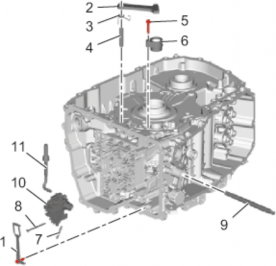
Fig. 89: Manual Shift Detent Lever Pin And Shaft
Courtesy of GENERAL MOTORS COMPANY
5. Remove the manual shift detent lever pin (7) and the manual shift detent lever shaft (9). Refer to Manual Shift
Detent Lever with Shaft Position Switch Assembly and Park Pawl Actuator Removal.

Fig. 90: Manual Shift Detent Lever, Spring And Manual Shift Shaft Pin
Courtesy of GENERAL MOTORS COMPANY
6. Remove Manual Shift Detent Lever Spring (1)
7. Remove Manual Shift Shaft Pin (2)
8. Remove Manual Shift Detent Lever (3)
Installation Procedure

Fig. 91: Manual Shift Detent Lever, Spring And Manual Shift Shaft Pin
Courtesy of GENERAL MOTORS COMPANY
1. Install Manual Shift Detent Lever (3)
2. Install Manual Shift Shaft Pin (2)
3. Install and tighten Manual Shift Detent Lever Spring (1) to 12 N.m (106 lb in)

Fig. 92: Manual Shift Detent Lever Pin And Shaft
Courtesy of GENERAL MOTORS COMPANY
4. Install the manual shift detent lever pin (7) and the manual shift detent lever shaft (9). Refer to Manual Shift
Detent Lever with Shaft Position Switch Assembly and Park Pawl Actuator Installation.
5. Install Manual Shift Detent Lever Pin
6. Install Control Valve Body Cover. Refer to Control Valve Body Cover Replacement
7. Install Automatic Transmission Range Selector Lever. Refer to Automatic Transmission Range Selector
Lever Replacement
8. Install Range Selector Lever Cable @ Automatic Transmission Range Selector Lever. Refer to Range Selector
Lever Cable Replacement
9. Adjust Range Selector Lever Cable. Refer to Range Selector Lever Cable Adjustment
CONTROL VALVE BODY COVER REPLACEMENT
Special Tools
BO-38185 Hose Clamp Pliers Equivalent regional tools:
Special Tools
Removal Procedure
1. Drain Engine Cooling System. Refer to Cooling System Draining and Filling
2. Remove Radiator Inlet Hose. Refer to Radiator Inlet Hose Replacement
3. Remove Radiator Surge Tank (Drive Motor Battery Radiator Surge Tank). Refer to Radiator Surge Tank
Replacement (Drive Motor Battery Radiator Surge Tank)
4. Remove Radiator Surge Tank (Drive Motor Generator Power Inverter Module Surge Tank). Refer to Radiator
Surge Tank Replacement (Drive Motor Generator Power Inverter Module Surge Tank)

Fig. 93: Radiator Inlet Hose, Hose Clamps And Retainer
Courtesy of GENERAL MOTORS COMPANY
5. Loosen Radiator Inlet Hose Clamps (1) (Qty: 3) using BO-38185 pliers
6. Disconnect Retainer (3)
7. Remove Radiator Inlet Hose (2)

Fig. 94: Radiator Inlet Hoses And Retainer
Courtesy of GENERAL MOTORS COMPANY
8. Disconnect Retainer (2)
9. Position the 2 radiator inlet hoses (1) aside to gain access.

Fig. 95: Heater Water Shutoff Valve Inlet Hose And Bolt
Courtesy of GENERAL MOTORS COMPANY
10. Remove Heater Water Shutoff Valve Inlet Hose Bolt (1)
11. Position the heater water shutoff inlet hose (2) aside to gain access.
12. Drain the transmission fluid. Refer to Transmission Fluid Drain and Fill
13. Remove the front wheelhouse liner - left side. Refer to Front Wheelhouse Liner Replacement (Left Side)

Fig. 96: Transmission Fluid Cooler Inlet And Outlet Pipe Clip
Courtesy of GENERAL MOTORS COMPANY
14. Remove Transmission Fluid Cooler Inlet and Outlet Pipe Clip (1)

Fig. 97: Transmission Fluid Cooler Inlet Pipe, Bolt And Sealing Washer
Courtesy of GENERAL MOTORS COMPANY
15. Remove Transmission Fluid Cooler Pipe Bolt (1)
16. Disconnect Transmission Fluid Cooler Inlet Pipe (3)
17. Remove and DISCARD Sealing Washer (2)
18. Position the transmission fluid cooler inlet pipe aside to gain access to the control valve body cover bolts.

Fig. 98: Control Valve Body Cover, Bolts And Gasket
Courtesy of GENERAL MOTORS COMPANY
19. Place a container beneath the control valve body cover (2) to catch spilling transmission fluid.
20. Remove Control Valve Body Cover Bolts (3) (Qty: 16)
21. Remove Control Valve Body Cover (2)
NOTE: The gasket is reusable, inspect the gasket and replace if damaged.
22. Remove Control Valve Body Cover Gasket (1)
Installation Procedure

Fig. 99: Control Valve Body Cover, Bolts And Gasket
Courtesy of GENERAL MOTORS COMPANY
NOTE: The gasket is reusable, inspect the gasket and replace if damaged.
1. Install Control Valve Body Cover Gasket (1)
2. Install Control Valve Body Cover (2)
CAUTION: Refer to Fastener Caution
3. Install Control Valve Body Cover Bolts (3) (Qty: 16) and Hand tighten only.

Fig. 100: Control Valve Body Cover Bolts Tightening Sequence
Courtesy of GENERAL MOTORS COMPANY
4. Tighten Control Valve Body Cover Bolts in sequence (Qty: 16) to 9 N.m (80 lb in)

Fig. 101: Transmission Fluid Cooler Inlet Pipe, Bolt And Sealing Washer
Courtesy of GENERAL MOTORS COMPANY
5. Reposition Transmission Fluid Cooler Inlet Pipe (3)
6. Install a NEW sealing washer (2).
7. Connect Transmission Fluid Cooler Inlet Pipe (3)
8. Install and tighten Transmission Fluid Cooler Pipe Bolt (1) to 22 N.m (16 lb ft)

Fig. 102: Transmission Fluid Cooler Inlet And Outlet Pipe Clip
Courtesy of GENERAL MOTORS COMPANY
9. Install Transmission Fluid Cooler Inlet and Outlet Pipe Clip (1)
10. Install the front wheelhouse liner - left side. Refer to Front Wheelhouse Liner Replacement (Left Side)

Fig. 103: Heater Water Shutoff Valve Inlet Hose And Bolt
Courtesy of GENERAL MOTORS COMPANY
11. Position the heater water shutoff inlet hose (2) into original position.
12. Install and tighten Heater Water Shutoff Valve Inlet Hose Bolt (1) to 22 N.m (16 lb ft)

Fig. 104: Radiator Inlet Hoses And Retainer
Courtesy of GENERAL MOTORS COMPANY
13. Position the 2 radiator inlet hoses (1) into original position.
14. Connect Retainer (2)

Fig. 105: Radiator Inlet Hose, Hose Clamps And Retainer
Courtesy of GENERAL MOTORS COMPANY
15. Install Radiator Inlet Hose (2)
16. Connect Retainer (3)
17. Tighten Radiator Inlet Hose Clamps (1) (Qty: 3) using BO-38185 pliers
18. Install Radiator Surge Tank (Drive Motor Generator Power Inverter Module Surge Tank). Refer to Radiator
Surge Tank Replacement (Drive Motor Generator Power Inverter Module Surge Tank)
19. Install Radiator Surge Tank (Drive Motor Battery Radiator Surge Tank). Refer to Radiator Surge Tank
Replacement (Drive Motor Battery Radiator Surge Tank)
20. Install Radiator Inlet Hose. Refer to Radiator Inlet Hose Replacement
21. Fill Engine Cooling System. Refer to Cooling System Draining and Filling
22. Fill the transmission to the proper level with NEW transmission fluid. Refer to Transmission Fluid Level and
Condition Check
CONTROL VALVE BODY REPLACEMENT
Special Tools
BO-38185 Hose Clamp Pliers Equivalent regional tools:
Special Tools
Removal Procedure
1. Remove Control Valve Body Cover. Refer to Control Valve Body Cover Replacement

Fig. 106: Control Valve Body Bolts, Control Solenoid Valve And Filter Plate
Courtesy of GENERAL MOTORS COMPANY
2. Disconnect the control solenoid valve wiring harness.
3. Remove Control Valve Body Bolts (1) (Qty: 4)
4. Remove Control Solenoid Valve (2)
5. Remove Control Solenoid Valve Filter Plate (3)

Fig. 107: Control Valve Body Components
Courtesy of GENERAL MOTORS COMPANY
6. Disconnect the control valve body wiring harness.
7. Remove Fluid Transfer Pipe Bolt (1)
8. Remove Fluid Transfer Pipe (2)
9. Remove Control Valve Body Bolts (3) (Qty: 13)
10. Remove Control Valve Body (4)
11. Remove Control Valve Body Spacer Plate Retainer (5) (Qty: 2)
12. Remove and DISCARD Control Valve Lower Body Spacer Plate (6)
13. Remove and DISCARD Variable Low Clutch Fluid Passage Seal (7)
Installation Procedure

Fig. 108: Control Valve Body Components
Courtesy of GENERAL MOTORS COMPANY
NOTE: Install a NEW seal.
1. Install NEW Variable Low Clutch Fluid Passage Seal (7)
NOTE: Install a NEW spacer plate.
2. Install NEW Control Valve Lower Body Spacer Plate (6)
3. Install Control Valve Body Spacer Plate Retainer (5) (Qty: 2)
4. Install Control Valve Body (4)
CAUTION: Refer to Fastener Caution
5. Install and hand tighten Control Valve Body Bolts (3) (Qty: 13). Hand tighten only.
6. Install Fluid Transfer Pipe (2)
7. Install and hand tighten Fluid Transfer Pipe Bolt (1). Hand tighten only.
8. Connect the control valve body wiring harness.

Fig. 109: Control Valve Body Bolt And Fluid Transfer Pipe Bolt Tightening Sequence
Courtesy of GENERAL MOTORS COMPANY
9. Tighten Control Valve Body Bolts @ Fluid Transfer Pipe Bolt in sequence to 9 N.m (80 lb in)

Fig. 110: Control Valve Body Bolts, Control Solenoid Valve And Filter Plate
Courtesy of GENERAL MOTORS COMPANY
10. Install Control Solenoid Valve Filter Plate (3)
11. Install Control Solenoid Valve (2)
12. Install and hand tighten Control Valve Body Bolts (1) (Qty: 4). Hand tighten only.
13. Connect the control solenoid valve wiring harness.

Fig. 111: Control Valve Body Bolts Tightening Sequence
Courtesy of GENERAL MOTORS COMPANY
14. Tighten Control Valve Body Bolts in sequence to 9 N.m (80 lb in)
15. Install Control Valve Body Cover. Refer to Control Valve Body Cover Replacement
LINE PRESSURE CONTROL SOLENOID VALVE REPLACEMENT
Special Tools
BO-38185 Hose Clamp Pliers Equivalent regional tools:
Special Tools
Removal Procedure
1. Remove Control Valve Body. Refer to Control Valve Body Replacement

Fig. 112: Line Pressure Control Solenoid Valve And Retainer
Courtesy of GENERAL MOTORS COMPANY
2. Remove Line Pressure Control Solenoid Valve Retainer (2)
3. Remove Line Pressure Control Solenoid Valve (1)
Installation Procedure

Fig. 113: Line Pressure Control Solenoid Valve And Retainer
Courtesy of GENERAL MOTORS COMPANY
1. Install Line Pressure Control Solenoid Valve (1)
2. Install Line Pressure Control Solenoid Valve Retainer (2)
3. Install Control Valve Body. Refer to Control Valve Body Replacement
CONTROL SOLENOID VALVE REPLACEMENT
Special Tools
BO-38185 Hose Clamp Pliers Equivalent regional tools:
Special Tools
Removal Procedure
1. Remove Control Valve Body. Refer to Control Valve Body Cover Replacement

Fig. 114: Control Valve Body Bolts, Control Solenoid Valve And Filter Plate
Courtesy of GENERAL MOTORS COMPANY
2. Disconnect Control Solenoid Valve Wiring Harness
3. Remove Control Valve Body Bolts (1) (Qty: 4)
4. Remove Control Solenoid Valve (2)
5. Remove Control Solenoid Valve Filter Plate (3)
Installation Procedure

Fig. 115: Control Valve Body Bolts, Control Solenoid Valve And Filter Plate
Courtesy of GENERAL MOTORS COMPANY
1. Install Control Solenoid Valve Filter Plate (3)
2. Install Control Solenoid Valve (2)
CAUTION: Refer to Fastener Caution
3. Install and hand tighten Control Valve Body Bolts (1) (Qty: 4). Hand tighten only.
4. Connect Control Solenoid Valve Wiring Harness

Fig. 116: Control Valve Body Bolts Tightening Sequence
Courtesy of GENERAL MOTORS COMPANY
5. Tighten Control Valve Body Bolts in sequence to 9 N.m (80 lb in)
6. Install Control Valve Body Cover. Refer to Control Valve Body Cover Replacement
AUTOMATIC TRANSMISSION WIRING HARNESS REPLACEMENT
Special Tools
BO-38185 Hose Clamp Pliers Equivalent regional tools:
Special Tools
Removal Procedure
1. Disconnect Battery Negative Cable. Refer to Battery Negative Cable Disconnection and Connection
2. Remove Control Valve Body. Refer to Control Valve Body Replacement

Fig. 117: Automatic Transmission Wiring Harness And Seals
Courtesy of GENERAL MOTORS COMPANY
NOTE: Remove the manual shift detent lever spring to aid in removal of the transmission wiring harness.
3. Remove Automatic Transmission Wiring Harness - Control Solenoid Valve (1)
4. Remove Automatic Transmission Wiring Connector Seal (2)
5. Remove Automatic Transmission Wiring Harness - Shift Shaft Position Switch (3)
6. Remove Automatic Transmission Wiring Connector Seal (4)
Installation Procedure

Fig. 118: Automatic Transmission Wiring Harness And Seals
Courtesy of GENERAL MOTORS COMPANY
1. Install Automatic Transmission Wiring Connector Seal (4)
2. Install Automatic Transmission Wiring Harness - Shift Shaft Position Switch (3)
3. Install Automatic Transmission Wiring Connector Seal (2)
NOTE: Install the manual shift detent lever spring previously removed to aid the removal of the transmission wiring harness.
4. Install Automatic Transmission Wiring Harness - Control Solenoid Valve (1)
5. Install Control Valve Body. Refer to Control Valve Body Replacement
6. Connect Battery Negative Cable. Refer to Battery Negative Cable Disconnection and Connection
TRANSMISSION MOUNT STRUT BRACKET REPLACEMENT

Fig. 119: Transmission Mount Strut Bracket
Courtesy of GENERAL MOTORS COMPANY
|
Callout
|
Component Name
|
|
Preliminary Procedure
Using a suitable jack stand, support the rear of the powertrain.
|
|
1
|
Transmission Mount Strut Bolt
CAUTION:
Refer to Fastener
Caution
CAUTION:
Refer to
Torque-to-
Yield
Fastener
Caution
Procedure
Always use NEW bolts. - Do NOT reuse old bolts.
Tighten
 First Pass: 100 N.m (74 lb ft)
 Final Pass: 60 - 75 degrees
|
|
Callout
|
Component Name
|
|
|
Special Tools
EN-45059 Angle Meter
Equivalent regional tools: Special Tools
|
|
2
|
Transmission Mount Strut Bracket Bolt (Qty: 3)
CAUTION:
Refer to
Torque-to-
Yield
Fastener
Caution
Procedure
Always use NEW bolts. - Do NOT reuse old bolts.
Tighten
 First Pass: 75 N.m (55 lb ft)
 Final Pass: 45 - 60 degrees
Special Tools
EN-45059 Angle Meter
Equivalent regional tools: Special Tools
|
|
3
|
Transmission Mount Strut Bracket
|
TRANSMISSION MOUNT TRANSMISSION-SIDE BRACKET REPLACEMENT

Fig. 120: Transmission Mount Transmission-Side Bracket
Courtesy of GENERAL MOTORS COMPANY
|
Callout
|
Component Name
|
|
Preliminary Procedure
Remove Transmission Mount. Refer to Transmission Mount Replacement
|
|
1
|
Transmission Mount Transmission Side Bracket Bolt (Qty: 3)
CAUTION:
Refer to Fastener
Caution
CAUTION:
Refer to
Torque-to-
Yield
Fastener
Caution
Procedure
Always use NEW bolts. - Do NOT reuse old bolts.
Tighten
 First Pass: 58 N.m (43 lb ft)
 Final Pass: 60 - 75 degrees
|
|
Callout
|
Component Name
|
|
|
Special Tools
EN-45059 Angle Meter
Equivalent regional tools: Special Tools
|
|
2
|
Transmission Mount Transmission Side Bracket
|
TRANSMISSION MOUNT REPLACEMENT
Special Tools
EN-45059 Angle Meter
Equivalent regional tools: Special Tools
Removal Procedure
1. Remove Engine Wiring Harness Junction Block. Refer to Engine Wiring Harness Junction Block
Replacement

Fig. 121: Wiring Harness Connectors
Courtesy of GENERAL MOTORS COMPANY
2. Remove Wiring Harness Connectors (1) (Qty: 3)
Unclip (Qty: 6)

Fig. 122: Wiring Harness Retainers
Courtesy of GENERAL MOTORS COMPANY
3. Remove Wiring Harness Retainers (1) (Qty: 2)

Fig. 123: Wiring Harness Connector And Retainers
Courtesy of GENERAL MOTORS COMPANY
4. Remove Wiring Harness Connector (2) @ Retainers (1)
5. Unclip Wiring Harness Retainer (3)

Fig. 124: Engine Wiring Harness Fuse Block Bracket And Bolt
Courtesy of GENERAL MOTORS COMPANY
6. Remove Engine Wiring Harness Fuse Block Bracket Bolt (1)
7. Remove Engine Wiring Harness Fuse Block Bracket (2)

Fig. 125: Engine Lifting Chain And Engine Lift Rear Bracket
Courtesy of GENERAL MOTORS COMPANY
8. Install the engine lifter (1) to the engine lift rear bracket (2).
9. Apply tension to the chain.

Fig. 126: Transmission Mount And Bolts
Courtesy of GENERAL MOTORS COMPANY
10. Prior to removing the mount, mark the mount location using paint pent or a marker for correct positioning during installation.
11. Remove and DISCARD Transmission Mount Bolts (2) (Qty: 3)
12. Remove Transmission Mount Transmission Side Bolt (4)
13. Remove and DISCARD Transmission Mount Bolt (1) (Qty: 3)
14. Remove Transmission Mount (3)
Installation Procedure

Fig. 127: Transmission Mount And Bolts
Courtesy of GENERAL MOTORS COMPANY
1. Install Transmission Mount (3)
CAUTION: Refer to Fastener Caution
CAUTION: Refer to Torque-to-Yield Fastener Caution
NOTE: Install NEW bolts.
2. Install NEW Transmission Mount Bolts (1) (Qty: 3). Hand tighten only.
CAUTION: Refer to Torque-to-Yield Fastener Caution
NOTE: Install NEW bolts.
3. Install NEW Transmission Mount Bolts (2) (Qty: 3). Hand tighten only.
4. Align the transmission mount and the powertrain unit to the previously made marks.
5. Tighten Transmission Mount Bolts (1) (Qty: 3)
1. First Pass: 100 N.m (74 lb ft)
2. Final Pass: 60 - 75 degrees, use the EN-45059 meter
6. Tighten Transmission Mount Bolts (2) (Qty: 3)
1. First Pass: 100 N.m (74 lb ft)
2. Final Pass: 60 - 75 degrees, use the EN-45059 meter
7. Install and tighten Transmission Mount Transmission Side Bolt (4) to 58 N.m (43 lb ft)

Fig. 128: Engine Lifting Chain And Engine Lift Rear Bracket
Courtesy of GENERAL MOTORS COMPANY
8. Remove the engine lifter (1) from the engine lift rear bracket (2).

Fig. 129: Engine Wiring Harness Fuse Block Bracket And Bolt
Courtesy of GENERAL MOTORS COMPANY
9. Install Engine Wiring Harness Fuse Block Bracket (2)
10. Install and tighten Engine Wiring Harness Fuse Block Bracket Bolt (1) to 22 N.m (16 lb ft).

Fig. 130: Wiring Harness Connector And Retainers
Courtesy of GENERAL MOTORS COMPANY
11. Install Wiring Harness Retainer (3)
12. Install Wiring Harness Connector (2) @ Retainer (1)

Fig. 131: Wiring Harness Retainers
Courtesy of GENERAL MOTORS COMPANY
13. Install Wiring Harness Retainers (1) (Qty: 2)

Fig. 132: Wiring Harness Connectors
Courtesy of GENERAL MOTORS COMPANY
14. Install Wiring Harness Connectors (1) (Qty: 3)
Install (Qty: 6)
15. Install Engine Wiring Harness Junction Block. Refer to Engine Wiring Harness Junction Block
Replacement
TRANSMISSION REAR MOUNT REPLACEMENT
Special Tools
CH-51999 Volt Cradle Bushing Remover/Installer Equivalent regional tools:
Special Tools
Removal Procedure
1. Remove the drivetrain and front suspension cradle from the vehicle. Refer to Drivetrain and Front
Suspension Cradle Replacement

Fig. 133: Volt Cradle Bushing Remover/Installer Components
Courtesy of GENERAL MOTORS COMPANY
2. Assemble the CH-51999 Volt Cradle Bushing Remover/Installer (1 through 8) onto the transmission rear mount and the drivetrain and front suspension cradle.
3. Turning the nut (8), release the transmission rear mount from the drivetrain and front suspension cradle.

Fig. 134: Transmission Rear Mount, Drivetrain And Front Suspension Cradle
Courtesy of GENERAL MOTORS COMPANY
4. Remove the transmission rear mount (1) from the drivetrain and front suspension cradle (2).
Installation Procedure

Fig. 135: Cradle Bushing Remover/Installer Receiver Cup, Transmission Mount And Alignment Mark
Courtesy of GENERAL MOTORS COMPANY
1. Clean the CH-51999 Volt Cradle Bushing Remover/Installer receiver cup (3) free from oil and grease.
2. Position the transmission mount (2) into the receiver cup with the arrow on the transmission mount aligning with the alignment mark (5).

Fig. 136: Upper Tool Rim With Top Of Receiver Cup
Courtesy of GENERAL MOTORS COMPANY
NOTE: The transmission mount will be at the correct depth in the receiver cup, when the upper tool rim (a) is in the contact with the top of the receiver cup (b).
IMPORTANT: No lubricant is allowed.
3. Using a press or the threaded rod assembly, and the components (1, 4) shown from the CH-51999 Volt Cradle Bushing Remover/Installer kit. Compress the transmission mount (2) into the receiver cup (3).
4. Clean the hole for the transmission rear mount in the drivetrain and front suspension frame cradle.

Fig. 137: Cradle Bushing Remover/Installer Components
Courtesy of GENERAL MOTORS COMPANY
NOTE: Insure the transmission mount inside the receiver cup (6) is in the correct orientation before proceeding.
5. Assemble the CH-51999 Volt Cradle Bushing Remover/Installer (1 through 9) onto the drivetrain and front suspension cradle.
NOTE: When the rim on the tool (5) contacts the top edge of tool (6) completely, the transmission mount will be at it's correct depth in the drivetrain and front suspension cradle.
6. Turning the nut (1), install the transmission rear mount to the drivetrain and front suspension cradle.
7. Remove the CH-51999 Volt Cradle Bushing Remover/Installer (1 through 9) from the drivetrain and front suspension cradle.
8. If the transmission rear mount is not positioned correctly, remove the transmission rear mount from the drivetrain and front suspension frame cradle and reinstall it.
9. Install the drivetrain and front suspension cradle to the vehicle. Refer to Drivetrain and Front Suspension
Cradle Replacement
TRANSMISSION MOUNT STRUT REPLACEMENT

Fig. 138: Transmission Mount Strut
Courtesy of GENERAL MOTORS COMPANY
|
Callout
|
Component Name
|
|
Preliminary Procedures
1. Using a suitable jack stand, support the rear of the powertrain.
2. Remove Transmission Mount Strut Bracket. Refer to Transmission Mount Strut Bracket
Replacement
|
|
1
|
Transmission Mount Strut Bolt
CAUTION:
Refer to Fastener
Caution
CAUTION:
Refer to
Torque-to-
Yield
Fastener
Caution
Procedure
Always use NEW bolts. - Do NOT reuse old bolts.
Tighten
|
|
Callout
|
Component Name
|
|
|
 First Pass: 100 N.m (74 lb ft)
 Final Pass: 60 - 75 degrees
Special Tools
EN-45059 Angle Meter
Equivalent regional tools: Special Tools
|
|
2
|
Transmission Mount Strut
|
TRANSMISSION REPLACEMENT
Special Tools
 BO-38185
Hose Clamp Pliers
BO-38185
Hose Clamp Pliers
 DT-51504
Seal Protector
DT-51504
Seal Protector
 EN-45059
Angle Meter
EN-45059
Angle Meter
Equivalent regional tools: Special Tools
Removal Procedure
WARNING: Do not use a service jack in locations other than those specified to lift this vehicle. Lifting the vehicle with a jack in those other locations could cause the vehicle to slip off the jack and roll; this could cause injury or death.
WARNING: Always perform the High Voltage Disabling procedure prior to servicing any High Voltage component or connection. Personal Protection Equipment (PPE) and proper procedures must be followed.
The High Voltage Disabling procedure will perform the following tasks:
 Identify how to disable high voltage.
 Identify how to test for the presence of high voltage.
 Identify condition under which high voltage is always present and personal protection equipment (PPE) and proper procedures must be followed.
Failure to follow the procedures exactly as written may result in serious injury or death.
1. Ensure that the vehicle is properly supported and squarely positioned. Refer to
Lifting and Jacking the
Vehicle
.
2. Disable the high voltage system and disconnect the A4 Hybrid/EV Battery Pack high voltage harness connector at the T6 Power Inverter Module. Refer to High Voltage Disabling
.
3. Set the parking brake.

Fig. 139: Radiator Surge Tank And Bracket Clip
Courtesy of GENERAL MOTORS COMPANY
4. Remove Radiator Surge Tank Bracket Clip (2)
5. Remove the radiator surge tank (1) from the vehicle. Refer to Radiator Surge Tank Replacement

Fig. 140: Range Selector Lever Cable And Range Selector Lever Cable Lever
Courtesy of GENERAL MOTORS COMPANY
6. Remove Range Selector Lever Cable (1) @ Range Selector Lever Cable Lever

Fig. 141: Range Selector Lever Cable And Transmission Range Selector Lever Cable Bracket
Courtesy of GENERAL MOTORS COMPANY
7. Remove the range selector lever cable (1) from the range selector lever cable bracket.
Release the cable from the bracket by pushing the retainer (arrow).
8. Remove Radiator Inlet Hose. Refer to Radiator Inlet Hose Replacement
9. Drain Drive Motor Generator Power Inverter Module Cooling System. Refer to Drive Motor Generator
Power Inverter Module Cooling System Draining and Filling
10. Remove the drive motor generator control module cooling outlet hose. Refer to
Drive Motor Generator
Control Module Cooling Outlet Hose Replacement (Underbody Line) Drive Motor Generator Control
Module Cooling Outlet Hose Replacement (Underbody Line to Traction Power Inverter Module Inlet)

Fig. 142: Wiring Harness Bracket And Nut
Courtesy of GENERAL MOTORS COMPANY
11. Remove Nut (2)
12. Remove Wiring Harness Bracket (1)

Fig. 143: Electrical Connector
Courtesy of GENERAL MOTORS COMPANY
13. Disconnect Electrical Connector (1)

Fig. 144: Wiring Harness Bracket And Bolts
Courtesy of GENERAL MOTORS COMPANY
14. Remove Bolts (1) (Qty: 2)
15. Remove Wiring Harness Bracket (2)

Fig. 145: Ground Cable And Bolt
Courtesy of GENERAL MOTORS COMPANY
16. Remove Ground Cable Bolt (1)
17. Remove Ground Cable (2)
18. Install Engine Support Fixture. Refer to Engine Support Fixture

Fig. 146: Transmission Mount Bolts
Courtesy of GENERAL MOTORS COMPANY
19. Remove and DISCARD Transmission Mount Bolts (1) (Qty: 3)

Fig. 147: Heater Inlet Hose Bracket And Bolt
Courtesy of GENERAL MOTORS COMPANY
20. Remove Bolt (1)
21. Remove Heater Inlet Hose Bracket (2)
22. Remove Drivetrain and Front Suspension Cradle. Refer to Drivetrain and Front Suspension Cradle
Replacement
23. Drain Transmission Fluid. Refer to Transmission Fluid Drain and Fill
24. Remove the left and right wheel drive shafts. Refer to Front Wheel Drive Shaft Replacement

Fig. 148: Transmission Fluid Cooler Inlet And Outlet Pipe Clip
Courtesy of GENERAL MOTORS COMPANY
25. Remove Clip (1)

Fig. 149: Transmission Fluid Cooler Outlet Pipe, Bolt And Sealing Washer
Courtesy of GENERAL MOTORS COMPANY
26. Place a container beneath the transmission fluid cooler outlet pipe (2) to catch spilling transmission fluid.
27. Remove Transmission Fluid Cooler Pipe Bolt (1)
28. Disconnect Transmission Fluid Cooler Outlet Pipe (2)
29. Remove and DISCARD Sealing Washer (3)

Fig. 150: Transmission Fluid Cooler Inlet Pipe, Bolt And Sealing Washer
Courtesy of GENERAL MOTORS COMPANY
30. Place a container beneath the transmission fluid cooler inlet pipe (3) to catch spilling transmission fluid.
31. Remove Transmission Fluid Cooler Pipe Bolt (1)
32. Disconnect Transmission Fluid Cooler Inlet Pipe (3)
33. Remove and DISCARD Sealing Washer (2)

Fig. 151: Heater Water Auxiliary Pump Inlet Hose, Clamp, Heater Water Shutoff Valve Inlet Hose
Bracket And Bolt
Courtesy of GENERAL MOTORS COMPANY
34. Loosen Heater Water Auxiliary Pump Inlet Hose Clamp (3) using BO-38185 pliers
35. Remove Heater Water Auxiliary Pump Inlet Hose (4)
36. Remove Heater Water Shutoff Valve Inlet Hose Bracket Bolt (1)
37. Remove the heater water shutoff valve inlet hose and bracket (2) from the front side of the vehicle.

Fig. 152: Heater Water Shutoff Valve Electrical Connector, Inlet Hose, Retainer, Heater Water Shutoff
Valve Outlet Hose And Clamp
Courtesy of GENERAL MOTORS COMPANY
38. Disconnect the heater water shutoff valve electrical connector (4).
39. Loosen Retainer (5)

Fig. 153: Bracket And Bolt
Courtesy of GENERAL MOTORS COMPANY
40. Remove Bolt (1)
41. Loosen the bracket (2).

Fig. 154: Heater Water Shutoff Valve Electrical Connector, Inlet Hose, Retainer, Heater Water Shutoff
Valve Outlet Hose And Clamp
Courtesy of GENERAL MOTORS COMPANY
42. Remove Heater Water Shutoff Valve Inlet Hose (1) @ Heater Water Shutoff Valve
43. Loosen the heater water shutoff valve outlet hose clamp (2), using the BO-38185 pliers.
44. Remove the heater water shutoff valve outlet hose (3) with the heater water shutoff valve.

Fig. 155: Heater Water Shutoff Valve Inlet Hose And Clip
Courtesy of GENERAL MOTORS COMPANY
45. Remove Heater Water Shutoff Valve Inlet Hose (2) @ Clip (1)
46. Remove Heater Water Shutoff Valve @ Vehicle
47. Remove Heater Coolant Pump. Refer to Heater Coolant Pump Replacement

Fig. 156: Starter Opening Cover And Bolts
Courtesy of GENERAL MOTORS COMPANY
48. Remove Bolts (2) (Qty: 2)
49. Remove the starter opening cover (1).

Fig. 157: Torque Converter Bolts
Courtesy of GENERAL MOTORS COMPANY
50. Remove the torque converter bolts. (1) (Qty: 4)

Fig. 158: Upper Front Transmission Bolts
Courtesy of GENERAL MOTORS COMPANY
51. Remove the upper front transmission bolts (1) (Qty: 2).

Fig. 159: Upper Rear Transmission Bolts
Courtesy of GENERAL MOTORS COMPANY
52. Remove the upper rear transmission bolts (1) (Qty: 2).
53. Support the transmission with a suitable jack.
54. Using a suitable straps or chains, secure the transmission to the transmission jack.

Fig. 160: Transmission Cover And Bolts
Courtesy of GENERAL MOTORS COMPANY
55. Remove the transmission bolts. (1) (Qty: 2)
56. Remove Transmission Cover (2)

Fig. 161: Transmission Bolts
Courtesy of GENERAL MOTORS COMPANY
57. Remove the transmission bolts. (1) (Qty: 2)
58. Carefully lower the transmission along with the jack, closely watching hoses and wiring harnesses to not disturb.

Fig. 162: Transmission Locating Pins
Courtesy of GENERAL MOTORS COMPANY
59. Ensure the transmission locating pins (1) are properly seated in the engine block and not damaged.
60. Transfer parts as needed.
61. Flush and flow test the fluid cooler and lines. Refer to Transmission Fluid Cooler Flow Test and Flushing
Installation Procedure
NOTE: The alignment hole is oblong and is slightly smaller than the other holes in the engine flex plate.
1. Set engine to any top dead center (TDC). This puts the alignment hole in the starter pocket.
Do not tighten bell housing bolts at this time. There must be a small 1 mm (0.039 in) to 2
IMPORTANT: mm (0.079 in) mm gap between the engine and transmission to allow rotation for input flange alignment.
2. Install 2 guide pins into the lower engine block holes where the locating pins are to guide the transmission into place.
3. Position the transmission in the vehicle on the locating pins leaving a small gap between the engine and transmission.
CAUTION: Refer to Fastener Caution

Fig. 163: Transmission Bolts
Courtesy of GENERAL MOTORS COMPANY
4. Remove the guide pins, then Install the 2 transmission bolts (1) (Qty: 2) and hand tighten, allowing a small 1 mm (0.039 in) to 2 mm (0.079 in) mm gap between the engine and transmission.

Fig. 164: Transmission Cover And Bolts
Courtesy of GENERAL MOTORS COMPANY
5. Install Transmission Cover (2)
6. Install the 2 transmission bolts (1) (Qty: 2) and hand tighten, allowing a small 1 mm (0.039 in) to 2 mm (0.079 in) mm gap between the engine and transmission.

Fig. 165: Transmission Bolt
Courtesy of GENERAL MOTORS COMPANY
7. Remove the guide pin, then install the transmission bolt (1) and hand tighten, allowing a small 1 mm (0.039 in) to 2 mm (0.079 in) mm gap between the engine and transmission.

Fig. 166: Torque Converter Bolts
Courtesy of GENERAL MOTORS COMPANY
NOTE: Once the Loctite® has been applied to the bolts it will 'SET IN APPROXIMATELY IN 10 MINUTES' and will fully cure in 24 hours.
8. Apply blue Loctite® on the torque converter bolt (1). Hand start bolt a few threads in the oblong alignment hole.
9. Tighten all lower transmission bolts to 58 N.m (43 lb ft).
10. Install Heater Coolant Pump. Refer to Heater Coolant Pump Replacement

Fig. 167: Upper Front Transmission Bolts
Courtesy of GENERAL MOTORS COMPANY
11. Install the upper front transmission bolts (1) (Qty: 2) and tighten to 58 N.m (43 lb ft).

Fig. 168: Upper Rear Transmission Bolts
Courtesy of GENERAL MOTORS COMPANY
12. Install the upper rear transmission bolts (1) (Qty: 2) and tighten to 58 N.m (43 lb ft).
13. Tighten torque converter bolt to 60 N.m (44 lb ft). Rotate the engine to the next hole. Apply blue Loctite® on the three remaining torque converter bolts. Install and tighten the bolts to 60 N.m (44 lb ft).

Fig. 169: Starter Opening Cover And Bolts
Courtesy of GENERAL MOTORS COMPANY
14. Install the starter opening cover (1) and the 2 bolts (2) (Qty: 2).

Fig. 170: Bracket And Bolt
Courtesy of GENERAL MOTORS COMPANY
15. Install the bracket (2).
16. Install and tighten Bolt (1) to 9 N.m (80 lb in)

Fig. 171: Heater Water Shutoff Valve Inlet Hose And Clip
Courtesy of GENERAL MOTORS COMPANY
17. Install Heater Water Shutoff Valve Inlet Hose (2) @ Vehicle
18. Install Heater Water Shutoff Valve Inlet Hose (2) @ Clip (1)

Fig. 172: Heater Water Shutoff Valve Electrical Connector, Inlet Hose, Retainer, Heater Water Shutoff
Valve Outlet Hose And Clamp
Courtesy of GENERAL MOTORS COMPANY
19. Install the heater water shutoff valve outlet hose (3) with the heater water shutoff valve.
20. Install the heater water shutoff valve outlet hose clamp (2), using the BO-38185 pliers.
21. Install Heater Water Shutoff Valve Inlet Hose (1) @ Heater Water Shutoff Valve
22. Install Retainer (5)
23. Connect the heater water shutoff valve electrical connector (4).

Fig. 173: Heater Water Auxiliary Pump Inlet Hose, Clamp, Heater Water Shutoff Valve Inlet Hose
Bracket And Bolt
Courtesy of GENERAL MOTORS COMPANY
24. Install Heater Water Shutoff Valve Inlet Hose Bracket (2)
25. Install and tighten Heater Water Shutoff Valve Inlet Hose Bracket Bolt (1) to 22 N.m (16 lb ft)
26. Install Heater Water Auxiliary Pump Inlet Hose (4)
27. Install Heater Water Auxiliary Pump Inlet Hose Clamp (3) using BO-38185 pliers

Fig. 174: Transmission Fluid Cooler Inlet Pipe, Bolt And Sealing Washer
Courtesy of GENERAL MOTORS COMPANY
28. Install a NEW sealing washer. (2)
29. Connect Transmission Fluid Cooler Inlet Pipe (3) - Connect
30. Install and tighten Transmission Fluid Cooler Pipe Bolt (1) to 22 N.m (16 lb ft)
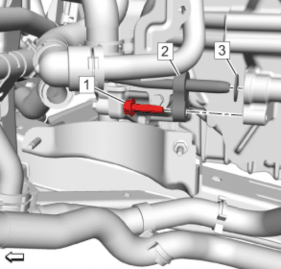
Fig. 175: Transmission Fluid Cooler Outlet Pipe, Bolt And Sealing Washer
Courtesy of GENERAL MOTORS COMPANY
31. Install a NEW sealing washer. (3)
32. Connect Transmission Fluid Cooler Outlet Pipe (2)
33. Install and tighten Transmission Fluid Cooler Pipe Bolt (1) to 22 N.m (16 lb ft)
34. Install the left and right wheel drive shafts. Refer to Front Wheel Drive Shaft Replacement

Fig. 176: Transmission Fluid Cooler Inlet And Outlet Pipe Clip
Courtesy of GENERAL MOTORS COMPANY
35. Install Clip (1)
36. Install Drivetrain and Front Suspension Cradle. Refer to Drivetrain and Front Suspension Cradle
Replacement
37. Install Radiator Inlet Hose. Refer to Radiator Inlet Hose Replacement

Fig. 177: Heater Inlet Hose Bracket And Bolt
Courtesy of GENERAL MOTORS COMPANY
38. Install Heater Inlet Hose Bracket (2)
39. Install and tighten Bolt (1) to 9 N.m (80 lb in)

Fig. 178: Transmission Mount Bolts
Courtesy of GENERAL MOTORS COMPANY
CAUTION: Refer to Torque-to-Yield Fastener Caution
NOTE: Install NEW bolts.
40. Install NEW Transmission Mount Bolts (1) (Qty: 3). Hand tighten only.
41. Tighten Transmission Mount Bolts (1) (Qty: 3)
1. First Pass: 100 N.m (74 lb ft)
2. Final Pass: 60 - 75 degrees, use the EN-45059 meter
42. Remove Engine Support Fixture. Refer to Engine Support Fixture

Fig. 179: Ground Cable And Bolt
Courtesy of GENERAL MOTORS COMPANY
43. Install Ground Cable (2)
44. Install and tighten Ground Cable Bolt (1) to 9 N.m (80 lb in)

Fig. 180: Wiring Harness Bracket And Bolts
Courtesy of GENERAL MOTORS COMPANY
45. Install Wiring Harness Bracket (2)
46. Install and tighten Bolts (1) (Qty: 2) to 9 N.m (80 lb in)
47. Lower the vehicle.

Fig. 181: Electrical Connector
Courtesy of GENERAL MOTORS COMPANY
48. Connect Electrical Connector (1)

Fig. 182: Wiring Harness Bracket And Nut
Courtesy of GENERAL MOTORS COMPANY
49. Install Wiring Harness Bracket (1)
50. Install and tighten Nut (2) to 9 N.m (80 lb in)

Fig. 183: Drive Motor Generator Control Module Cooling Outlet Hose And Bolts
Courtesy of GENERAL MOTORS COMPANY
51. Install the drive motor generator control module cooling outlet hose. Refer to
Drive Motor Generator
Control Module Cooling Outlet Hose Replacement (Underbody Line) Drive Motor Generator Control
Module Cooling Outlet Hose Replacement (Underbody Line to Traction Power Inverter Module Inlet)
52. Fill Drive Motor Generator Power Inverter Module Cooling System. Refer to Drive Motor Generator Power
Inverter Module Cooling System Draining and Filling
53. Fill Transmission Fluid. Refer to Transmission Fluid Drain and Fill
54. Fill Cooling System. Refer to Cooling System Draining and Filling

Fig. 184: Range Selector Lever Cable And Transmission Range Selector Lever Cable Bracket
Courtesy of GENERAL MOTORS COMPANY
55. Install the range selector lever cable (1) to the range selector lever cable bracket.
The retainer snaps automatically in.

Fig. 185: Range Selector Lever Cable And Range Selector Lever Cable Lever
Courtesy of GENERAL MOTORS COMPANY
56. Install Range Selector Lever Cable (1) @ Range Selector Lever Cable Lever
57. Adjust Range Selector Lever Cable. Refer to Range Selector Lever Cable Adjustment

Fig. 186: Radiator Surge Tank And Bracket Clip
Courtesy of GENERAL MOTORS COMPANY
58. Install Radiator Surge Tank (1)
59. Install Radiator Surge Tank Bracket Clip (2)
60. Enable the high voltage system and connect the A4 Hybrid/EV Battery Pack high voltage harness connector at the T6 Power Inverter Module. Refer to High Voltage Disabling
61. Connect the battery negative cable. Refer to Battery Negative Cable Disconnection and Connection
62. Program the power inverter module and the immobilizer control module. Refer to Control Module
References
REPAIR INSTRUCTIONS - OFF VEHICLE
HOLDING FIXTURE INSTALLATION

Fig. 187: Holding Fixture Assembly
Courtesy of GENERAL MOTORS COMPANY
|
Callout
|
Component Name
|
|
1
|
Â
WARNING:
Handle with care, the transmission assembly weighs over 183 Kg (403
lbs). Bodily injury could occur if not handled properly.
CAUTION:
Refer to
Fastener
Caution
.
Procedure
1. Use the supplied template to relocate holes on the fixture for mounting blocks.
2. Adjust mounting blocks on DT-46625 Holding Fixture to match bosses on case and
|
|
Callout
|
Component Name
|
|
|
tighten to 13 N.m (115 lb in).
Special Tools
 DT-03289-20
Holding Fixture Base Assembly
DT-03289-20
Holding Fixture Base Assembly
 DT-46625
Holding Fixture
DT-46625
Holding Fixture
 DT-46625-20
Holding Fixture Adapters
DT-46625-20
Holding Fixture Adapters
For equivalent regional tools, refer to Special Tools.
|
DRIVE MOTOR POWER INVERTER MODULE COVER REMOVAL
Drive Motor Battery Positive and Negative Cable Connector Removal

Fig. 188: Drive Motor Battery Positive And Negative Cable Connector
Courtesy of GENERAL MOTORS COMPANY
Drive Motor Battery Positive and Negative Cable Connector Removal
|
Callout
|
Component Name
|
|
1
|
Drive Motor Battery Positive and Negative Cable Connector Bolt (Qty: 4)
|
|
2
|
Drive Motor Battery Positive and Negative Cable Connector
|
Drive Motor Power Inverter Module Cover Removal

Fig. 189: Drive Motor Power Inverter Module Cover And Components
Courtesy of GENERAL MOTORS COMPANY
Drive Motor Power Inverter Module Cover Removal
|
Callout
|
Component Name
|
|
1
|
Drive Motor Power Inverter Module Cover Bolt (Qty: 17)
|
|
2
|
Drive Motor Power Inverter Module Cover
Procedure
Use the DT-51626 protector when removing the cover to avoid damaging the connector seal.
Special Tools
DT-51626 Seal Protector
For equivalent regional tools, refer to Special Tools.
|
|
3
|
Drive Motor Power Inverter Module Cover Gasket
NOTE:
The gasket is reusable, inspect the gasket and replace if damaged.
|
|
4
|
Drive Motor Power Inverter Module Cover Vent
|
|
5
|
Drive Motor Power Inverter Module Electrical Connector Seal
NOTE:
The seal is reusable,
|
|
Callout
|
Component Name
|
|
|
inspect the seal and replace if damaged.
|
DRIVE MOTOR POWER INVERTER MODULE REMOVAL

Fig. 190: Drive Motor Power Inverter Module And Components
Courtesy of GENERAL MOTORS COMPANY
|
Callout
|
Component Name
|
|
Preliminary Procedure
1. Disconnect the 3 drive motor power inverter module connectors.
2. Using shop air, blow air through the drive motor power inverter module cooling passage on the transmission to remove residual coolant.
|
|
1
|
Drive Motor Power Inverter Module 3-Phase Buss Bar Bolt (Qty: 6)
|
|
2
|
Drive Motor Power Inverter Module Bolt (Qty: 7)
|
|
3
|
Drive Motor Power Inverter Module
|
|
4
|
Drive Motor Power Inverter Module Fluid Seal
NOTE:
DISCARD
the seal.
|
CONTROL VALVE BODY COVER REMOVAL

Fig. 191: Control Valve Body Cover
Courtesy of GENERAL MOTORS COMPANY
|
Callout
|
Component Name
|
|
1
|
Control Valve Body Cover Bolt (Qty: 16)
|
|
2
|
Control Valve Body Cover
|
|
3
|
Automatic Transmission Fluid Level Control Valve Seal
NOTE:
The gasket is reusable, inspect the gasket and replace if damaged.
|
|
4
|
Automatic Transmission Fluid Level Control Valve Seal - O-ring
NOTE:
The seal is reusable, inspect the seal and replace if damaged.
|
CONTROL VALVE ASSEMBLY AND TRANSMISSION WIRING HARNESS REMOVAL
Control Solenoid Valve Removal
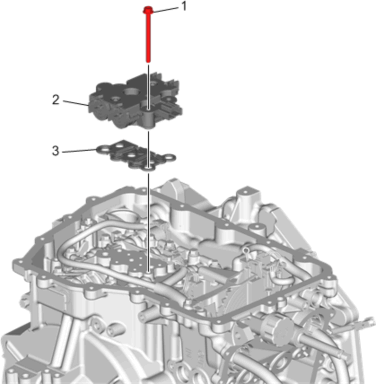
Fig. 192: Control Solenoid Valve
|
Callout
|
Component Name
|
|
Preliminary Procedure
1. Disconnect the control solenoid valve wiring harness.
2. Remove the connectors from the wiring harness brackets and shift detent lever.
|
|
1
|
Control Valve Body Bolt (Qty: 4)
|
|
2
|
Control Solenoid Valve
|
|
3
|
Control Solenoid Valve Filter Plate
NOTE:
The filter plate is reusable, inspect the filter plate and replace if damaged.
|
|
Callout
|
Component Name
|
|
Preliminary Procedure
1. Disconnect the control solenoid valve wiring harness.
2. Remove the connectors from the wiring harness brackets and shift detent lever.
|
|
1
|
Control Valve Body Bolt (Qty: 4)
|
|
2
|
Control Solenoid Valve
|
|
3
|
Control Solenoid Valve Filter Plate
NOTE:
The filter plate is reusable, inspect the filter plate and replace if damaged.
|
|
Callout
|
Component Name
|
|
Preliminary Procedure
1. Disconnect the control solenoid valve wiring harness.
2. Remove the connectors from the wiring harness brackets and shift detent lever.
|
|
1
|
Control Valve Body Bolt (Qty: 4)
|
|
2
|
Control Solenoid Valve
|
|
3
|
Control Solenoid Valve Filter Plate
NOTE:
The filter plate is reusable, inspect the filter plate and replace if damaged.
|
Courtesy of GENERAL MOTORS COMPANY Control Solenoid Valve Removal
Control Valve (with Body and Valve) Removal

Fig. 193: Control Valve (With Body And Valve)
Courtesy of GENERAL MOTORS COMPANY
Control Valve (with Body and Valve) Removal
|
Callout
|
Component Name
|
|
Preliminary Procedure
Disconnect the transmission wiring harness from the control valve body.
|
|
1
|
Fluid Transfer Pipe Bolt
|
|
2
|
Fluid Transfer Pipe
|
|
3
|
Control Valve Body Bolt (Qty: 13)
|
|
4
|
Control Valve (with Body and Valve)
|
|
5
|
Control Valve Body Spacer Plate Retainer (Qty: 2)
|
|
6
|
Control Valve Lower Body Spacer Plate
|
|
7
|
Variable Low Clutch Fluid Passage Seal
|
Automatic Transmission Wiring Harness Removal

Fig. 194: Automatic Transmission Wiring Harness
Courtesy of GENERAL MOTORS COMPANY
Automatic Transmission Wiring Harness Removal
|
Callout
|
Component Name
|
|
Preliminary Procedure
1. Disconnect the wiring harness connector from the manual shift detent lever and remove the connectors from the wiring harness brackets noting location for installation.
2. Remove the manual shift detent lever spring to aid in removal of the transmission wiring harness.
|
|
1
|
Automatic Transmission Wiring Harness - Control Solenoid Valve
|
|
2
|
Automatic Transmission Wiring Connector Seal
|
|
3
|
Automatic Transmission Wiring Harness - Shift Shaft Position Switch
|
|
4
|
Automatic Transmission Wiring Connector Seal
|
AUTOMATIC TRANSMISSION TORQUE DAMPENER AND DIFFERENTIAL HOUSING REMOVAL

Fig. 195: Automatic Transmission Torque Dampener And Differential Housing
Courtesy of GENERAL MOTORS COMPANY
|
Callout
|
Component Name
|
|
1
|
Torque Converter and Differential Housing Bolt (Qty: 16)
|
|
2
|
Automatic Transmission Torque Dampener and Differential Housing
NOTE:
The input internal gear assembly could stick to the torque dampener and differential housing.
|
|
3
|
Automatic Transmission Torque Dampener and Differential Housing Gasket
NOTE:
DISCARD
the gasket.
|
FRONT DIFFERENTIAL CARRIER REMOVAL
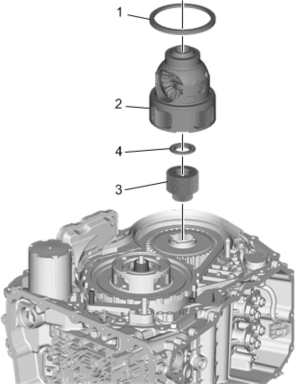
Fig. 196: Front Differential Carrier
Courtesy of GENERAL MOTORS COMPANY
|
Callout
|
Component Name
|
|
1
|
Front Differential Carrier Bearing
|
|
2
|
Front Differential Carrier
|
|
3
|
Front Differential Carrier Sun Gear
|
|
4
|
Differential Carrier Sun Gear Thrust Bearing
|
INPUT SUN GEAR SHAFT REMOVAL

Fig. 197: Input Sun Gear Shaft
Courtesy of GENERAL MOTORS COMPANY
|
Callout
|
Component Name
|
|
1
|
Input Internal Gear Thrust Bearing
|
|
2
|
Input Sun Gear Shaft Assembly
|
|
3
|
Input Sun Gear Retaining Ring
|
|
4
|
Input Sun Gear
|
|
5
|
Input Sun Gear Shaft
|
|
6
|
Variable High Clutch Housing Seal
NOTE:
DISCARD
the seal.
|
FRONT DIFFERENTIAL CARRIER BAFFLE REMOVAL

Fig. 198: Front Differential Carrier Baffle
Courtesy of GENERAL MOTORS COMPANY
|
Callout
|
Component Name
|
|
1
|
Front Differential Carrier Baffle Bolt (Qty: 2)
|
|
2
|
Front Differential Carrier Baffle
|
|
3
|
Automatic Transmission Fluid Chip Collector Magnet
|
DRIVE SPROCKET, DRIVEN SPROCKET, AND DRIVE LINK REMOVAL

Fig. 199: Drive Sprocket, Driven Sprocket And Drive Link
Courtesy of GENERAL MOTORS COMPANY
|
Callout
|
Component Name
|
|
1
|
Drive Sprocket, Driven Sprocket, and Drive Link
NOTE:
Inspect the bearing that is pressed into the driven sprocket. If the bearing is loose, replace the driven sprocket.
|
|
2
|
Driven Sprocket Bearing
|
DRIVE LINK SNUBBER REMOVAL

Fig. 200: Drive Link Snubber
Courtesy of GENERAL MOTORS COMPANY
|
Callout
|
Component Name
|
|
1
|
Drive Link Snubber Bolt (Qty: 2)
|
|
2
|
Drive Link Snubber
|
|
3
|
NOTE:
A plastic washer is used on the bolts during initial assembly.
These washers may come loose after bolt removal. Ensure that the washers do not drop into the transmission case.
Discard the washers.
Drive Link Snubber Bolt (Coast Side) (Qty: 2)
|
|
Callout
|
Component Name
|
|
4
|
Drive Link Snubber (Coast Side)
|
AUTOMATIC TRANSMISSION FLUID PUMP AND FLUID FILTER REMOVAL

Fig. 201: Automatic Transmission Fluid Pump And Fluid Filter
Courtesy of GENERAL MOTORS COMPANY
|
Callout
|
Component Name
|
|
Preliminary Procedure
Disconnect the fluid pump pass thru connector from the case.
|
|
1
|
Automatic Transmission Fluid Pump Bolt (Qty: 3)
|
|
2
|
NOTE:
Guide the fluid pump wiring harness from the case.
Automatic Transmission Fluid Pump
|
|
3
|
NOTE:
DISCARD
the seal.
Automatic Transmission Pump Fluid Outlet Seal
|
|
4
|
Automatic Transmission Fluid Filter Bolt
|
|
Callout
|
Component Name
|
|
5
|
Automatic Transmission Fluid Filter
|
|
6
|
NOTE:
DISCARD
the seal.
Automatic Transmission Fluid Filter Seal
|
MANUAL SHIFT DETENT LEVER WITH SHAFT POSITION SWITCH ASSEMBLY AND PARK PAWL ACTUATOR REMOVAL
Automatic Transmission Wiring Harness Bracket Removal

Fig. 202: Automatic Transmission Wiring Harness Bracket
Courtesy of GENERAL MOTORS COMPANY
Automatic Transmission Wiring Harness Bracket Removal
|
Callout
|
Component Name
|
|
Preliminary Procedure
Remove the drive motor wiring harness connectors from the wiring harness connector brackets.
|
|
1
|
Automatic Transmission Wiring Harness Connector Bracket Bolt (Qty: 1)
|
|
2
|
Automatic Transmission Wiring Harness Bracket
|
|
3
|
Automatic Transmission Wiring Harness Connector Bracket Bolt (Qty: 1)
|
|
4
|
Automatic Transmission Wiring Harness Bracket
|
Manual Shift Detent Lever with Shaft Position Switch Assembly and Park Pawl Actuator Removal

Fig. 203: Manual Shift Detent Lever With Shaft Position Switch Assembly And Park Pawl Actuator
Courtesy of GENERAL MOTORS COMPANY
Manual Shift Detent Lever with Shaft Position Switch Assembly and Park Pawl Actuator Removal
|
Callout
|
Component Name
|
|
1
|
Manual Shift Detent Lever Spring
|
|
2
|
Park Pawl
|
|
3
|
Park Pawl Spring
|
|
4
|
Park Pawl Shaft
|
|
5
|
Park Pawl Actuator Guide Bolt
|
|
6
|
Park Pawl Actuator Guide
|
|
7
|
Manual Shift Detent Lever Pin
|
|
8
|
Manual Shift Shaft Pin
NOTE:
DISCARD
the manual
shift shaft pin.
|
|
9
|
Manual Shift Detent Lever Shaft
|
|
10
|
Manual Shift Detent Lever
|
|
11
|
Park Pawl Actuator
|
DRIVE MOTOR REMOVAL - 2ND POSITION
Drive Motor Stator Cooling Tube Removal
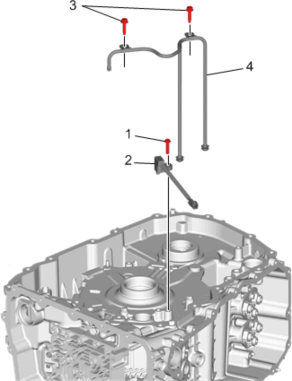
Fig. 204: Drive Motor Stator Cooling Tube
Courtesy of GENERAL MOTORS COMPANY
Drive Motor Stator Cooling Tube Removal
|
Callout
|
Component Name
|
|
1
|
Automatic Transmission Output Speed Sensor Bolt
|
|
2
|
Automatic Transmission Output Speed Sensor
|
|
3
|
Drive Motor Stator Cooling Tube Bolt (Qty: 2)
NOTE:
A plastic washer is used on the bolts during initial assembly.
These washers may come loose after bolt removal. Ensure that the washers do not drop into the transmission case.
Discard the
|
|
Callout
|
Component Name
|
|
|
washers.
|
|
4
|
Drive Motor Stator Cooling Tube
|
Drive Motor - 2nd Position Bolt Removal

Fig. 205: Drive Motor - 2nd Position Bolts
Courtesy of GENERAL MOTORS COMPANY
Drive Motor - 2nd Position Bolt Removal
|
Callout
|
Component Name
|
|
1
|
Automatic Transmission Case Extension Bolt (Qty: 2)
|
|
2
|
Automatic Transmission Case Extension Bolt (Qty: 1)
NOTE:
DISCARD
the bolt.
|
|
3
|
Automatic Transmission Case Extension Bolt (Qty: 1)
NOTE:
DISCARD
the bolt.
|
|
4
|
Drive Motor Power Inverter Module 3-Phase Cable Bolt (Qty: 3)
|
Drive Motor - 2nd Position Removal

Fig. 206: Drive Motor - 2nd Position
|
Callout
|
Component Name
|
|
1
|
Drive Motor - 2nd Position
WARNING:
The generator motor weighs approximately 23 kg (50 lbs). Personal injury may result if you lift the generator motor improperly.
CAUTION:
DO NOT
contact or
rest the drive motor stator on the copper end coils.
|
|
Callout
|
Component Name
|
|
1
|
Drive Motor - 2nd Position
WARNING:
The generator motor weighs approximately 23 kg (50 lbs). Personal injury may result if you lift the generator motor improperly.
CAUTION:
DO NOT
contact or
rest the drive motor stator on the copper end coils.
|
|
Callout
|
Component Name
|
|
1
|
Drive Motor - 2nd Position
WARNING:
The generator motor weighs approximately 23 kg (50 lbs). Personal injury may result if you lift the generator motor improperly.
CAUTION:
DO NOT
contact or
rest the drive motor stator on the copper end coils.
|
Courtesy of GENERAL MOTORS COMPANY Drive Motor - 2nd Position Removal
|
Callout
|
Component Name
|
|
|
Damage to the copper end coils may cause a high voltage short during vehicle operation, resulting in component damage.
Procedure
1. Install the DT-51623 motor lift bar.
2. Attach a lift assist hook through the DT-51623 motor lift bar.
3. Guide the drive motor resolver wire through the transmission case while lifting the drive motor using a lift assist.
4. Set the drive motor on its side on a clean lint free cloth. DO NOT rest the drive motor on the stator end coils.
5. Detach the lift assist hook and remove the DT-51623 motor lift bar.
6. Carefully tip over the drive motor flat onto the work surface resting on it cast aluminum support.
Special Tools
DT-51623 Motor Lift Bar
For equivalent regional tools, refer to Special Tools.
|
Drive Motor Power Inverter Module Connector Removal

Fig. 207: Drive Motor Power Inverter Module Connector
Courtesy of GENERAL MOTORS COMPANY
Drive Motor Power Inverter Module Connector Removal
|
Callout
|
Component Name
|
|
1
|
Drive Motor Power Inverter Module Connector Bolt
NOTE:
DISCARD
the bolt.
|
|
2
|
Drive Motor Power Inverter Module Connector
NOTE:
DISCARD
the
connector.
|
OUTPUT CARRIER AND OUTPUT CARRIER INTERNAL GEAR REMOVAL

Fig. 208: Output Carrier And Output Carrier Internal Gear
Courtesy of GENERAL MOTORS COMPANY
|
Callout
|
Component Name
|
|
1
|
Output Carrier
|
|
2
|
Output Carrier Thrust Bearing
|
|
3
|
Output Carrier Internal Gear
|
|
4
|
Output Carrier Internal Gear Hub Thrust Bearing
|
DRIVE MOTOR REMOVAL - 1ST POSITION
Drive Motor - 1st Position Removal

Fig. 209: Drive Motor - 1st Position
|
Callout
|
Component Name
|
|
1
|
Drive Motor Power Inverter Module 3-Phase Cable Bolt (Qty: 3)
|
|
2
|
Automatic Transmission Case Extension Bolt (Qty: 4)
|
|
3
|
Drive Motor - 1st Position
WARNING:
The generator motor weighs approximately 23 kg (50 lbs). Personal injury may result if you lift the generator motor improperly.
CAUTION:
DO NOT
contact or
rest the drive motor stator on the
|
|
Callout
|
Component Name
|
|
1
|
Drive Motor Power Inverter Module 3-Phase Cable Bolt (Qty: 3)
|
|
2
|
Automatic Transmission Case Extension Bolt (Qty: 4)
|
|
3
|
Drive Motor - 1st Position
WARNING:
The generator motor weighs approximately 23 kg (50 lbs). Personal injury may result if you lift the generator motor improperly.
CAUTION:
DO NOT
contact or
rest the drive motor stator on the
|
|
Callout
|
Component Name
|
|
1
|
Drive Motor Power Inverter Module 3-Phase Cable Bolt (Qty: 3)
|
|
2
|
Automatic Transmission Case Extension Bolt (Qty: 4)
|
|
3
|
Drive Motor - 1st Position
WARNING:
The generator motor weighs approximately 23 kg (50 lbs). Personal injury may result if you lift the generator motor improperly.
CAUTION:
DO NOT
contact or
rest the drive motor stator on the
|
Courtesy of GENERAL MOTORS COMPANY Drive Motor - 1st Position Removal
|
Callout
|
Component Name
|
|
|
copper end coils.
Damage to the copper end coils may cause a high voltage short during vehicle operation, resulting in component damage.
Procedure
1. Install the DT-51623 motor lift bar.
2. Attach a lift assist hook through the DT-51623 motor lift bar.
3. Guide the drive motor resolver wire through the transmission case while lifting the drive motor using a lift assist.
4. Set the drive motor on its side on a clean lint free cloth. DO NOT rest the drive motor on the stator end coils.
5. Detach the lift assist hook and remove the DT-51623 motor lift bar.
6. Carefully tip over the drive motor flat onto the work surface resting on it cast aluminum support.
Special Tools
DT-51623 Motor Lift Bar
For equivalent regional tools, refer to Special Tools.
|
Drive Motor Power Inverter Module Connector Removal

Fig. 210: Drive Motor Power Inverter Module Connector
Courtesy of GENERAL MOTORS COMPANY
Drive Motor Power Inverter Module Connector Removal
|
Callout
|
Component Name
|
|
1
|
Drive Motor Power Inverter Module Connector Bolt
NOTE:
DISCARD
the bolt.
|
|
2
|
Drive Motor Power Inverter Module Connector
NOTE:
DISCARD
the
connector.
|
VARIABLE HIGH CLUTCH FLUID TRANSFER SUPPORT SEAL OVERHAUL
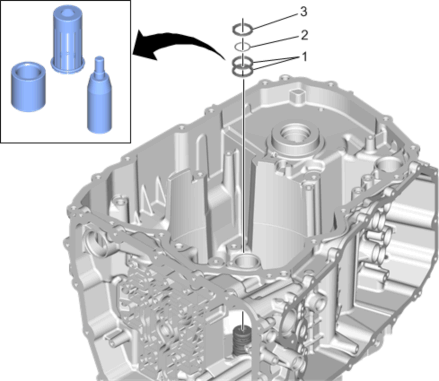
Fig. 211: Variable High Clutch Fluid Transfer Support Seal
Courtesy of GENERAL MOTORS COMPANY
|
Callout
|
Component Name
|
|
CAUTION:
Refer to
Seal
Reuse
Caution
.
|
|
1
|
Variable High Clutch Fluid Transfer Support Seal (Qty: 2)
CAUTION:
Size the fluid seal rings for at least 5 minutes after installation to obtain proper seal ring size.
Failure to do so may cause internal transmission leaks and transmission damage.
|
|
Callout
|
Component Name
|
|
|
Procedure
1. Use the DT-50911-2 pusher and adjustment screw from DT-50911-3 with DT-51700
installer to install the seals.
2. Adjust the turn screw on the protector and install the bottom seal ring first.
3. Use the large taper side of DT-51700 seal sizer for initial seal sizing, then flip the tool over for final sizing.
4. Leave DT-51700 seal sizer in place until the drive motor is ready to be installed.
NOTE:
Use NEW seals.
Special Tools
 DT-50911
Seal Installer
DT-50911
Seal Installer
 DT-51700
Seal Installer
DT-51700
Seal Installer
For equivalent regional tools, refer to Special Tools.
|
|
2
|
Variable High Clutch Fluid Transfer Support Seal - O-Ring
NOTE:
Use a NEW seal.
|
|
3
|
Variable High Clutch Fluid Seal Ring
NOTE:
Use a NEW seal.
|
FRONT WHEEL DRIVE SHAFT OIL SEAL REMOVAL - LEFT SIDE

Fig. 212: Front Wheel Drive Shaft Oil Seal - Left Side
Courtesy of GENERAL MOTORS COMPANY
|
Callout
|
Component Name
|
|
1
|
Front Wheel Drive Shaft Oil Seal
Special Tools
 DT-23129
Universal Seal Remover
DT-23129
Universal Seal Remover
 GE-6125-1B
Slide Hammer
GE-6125-1B
Slide Hammer
For equivalent regional tools, refer to Special Tools.
|
TRANSMISSION CASE CLEANING AND INSPECTION
Transmission Case Inspection (1 of 2)

Fig. 213: Transmission Case Inspection (1 Of 2)
Courtesy of GENERAL MOTORS COMPANY
Transmission Case Inspection (1 of 2)
|
Callout
|
Component Name
|
|
CAUTION:
Do not use abrasive pads or bristle devices to clean the sealing surfaces. Abrasive pads produce a fine grit that can effect transmission function.
Abrasive pads can also remove enough metal to create oil leaks.
|
|
Callout
|
Component Name
|
|
CAUTION:

After CAUTION: e
tDroannsomt irsesuisoen cloemanpionngents, aslololvwentotsa. ir dPre.vDioounsloyt
usedcloth or spoalpveernttoswels imnaoyr derptoosit dserydiamneynt twrahnicshmmisasyion dcoampagoenethnets. Lcoinmt pfroonmentht.e towels can
Pcraeulismeinary Procedures
component
fail1u.rTeh. oroughly clean the transmission case assembly, including case threads, with clean solvent.
2. Clean gasket sealing surfaces. Remove all residual gasket material.
3. Inspect all threaded holes. If necessary, repair any thread damage.
|
|
1
|
Drive Motor Power Inverter Module Cover Pin
|
|
2
|
Transmission Case Locating Pin
|
|
3
|
Automatic Transmission Fluid Pump Locating Pin
|
|
4
|
Driven Sprocket Bearing Mating Surface
|
|
5
|
Transmission Case to Torque Dampener and Differential Housing Sealing Surface
|
|
6
|
Drive Motor Power Inverter Module Pin
|
|
7
|
Transmission Fluid Filler Cap
|
cleaning th
cleaning th
cleaning th
Transmission Case Inspection (2 of 2)

Fig. 214: Transmission Case Inspection (2 Of 2)
Courtesy of GENERAL MOTORS COMPANY
Transmission Case Inspection (2 of 2)
|
Callout
|
Component Name
|
|
1
|
Transmission Fluid Cooler Pipe Sealing Surface (Qty: 2)
|
|
2
|
Automatic Transmission Case Plug
|
|
3
|
Automatic Transmission Fluid Level Hole Plug
|
|
4
|
Transmission Fluid Drain Plug
|
|
5
|
Transmission Case to Control Valve Body Cover Sealing Surface
|
FRONT WHEEL DRIVE SHAFT OIL SEAL INSTALLATION - LEFT SIDE
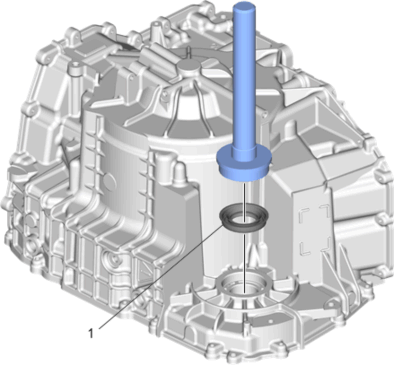
Fig. 215: Front Wheel Drive Shaft Oil Seal - Left Side
Courtesy of GENERAL MOTORS COMPANY
|
Callout
|
Component Name
|
|
1
|
Front Wheel Drive Shaft Oil Seal
Special Tools
 DT-46629-A
Axle Seal Installer
DT-46629-A
Axle Seal Installer
 GE-8092
Driver Handle
GE-8092
Driver Handle
For equivalent regional tools, refer to Special Tools.
|
MANUAL SHIFT SHAFT SEAL REMOVAL

Fig. 216: Manual Shift Shaft Seal
Courtesy of GENERAL MOTORS COMPANY
|
Callout
|
Component Name
|
|
1
|
Manual Shift Shaft Seal
Special Tools
DT-45201 Seal Remover
For equivalent regional tools, refer to Special Tools.
|
VARIABLE LOW CLUTCH PLATE REMOVAL

Fig. 217: Variable Low Clutch Plate
Courtesy of GENERAL MOTORS COMPANY
|
Callout
|
Component Name
|
|
Preliminary Procedure
CAUTION:
DO NOT
contact or
rest the drive motor stator on the copper end coils.
Damage to the copper end coils may cause a high voltage short during vehicle
|
|
Callout
|
Component Name
|
|
operation, resulting in component damage.
Service the variable low clutch with the variable high clutch installed onto the drive motor rotor. This will prevent contact of the drive motor stator copper end coils with the work surface.
|
|
1
|
Variable Low Clutch Backing Plate Retaining Ring
Procedure
Use DT-47694 compressor and a suitable press to remove the retaining ring.
NOTE:
DISCARD
the retaining ring.
Special Tools
DT-47694 Piston Spring Compressor
For equivalent regional tools, refer to Special Tools.
|
|
2
|
Variable Low Clutch Backing Plate
|
|
3
|
Variable Low Clutch Plate - Friction (Qty: 3)
|
|
4
|
Variable Low Clutch Plate (Qty: 3)
|
|
5
|
Variable Low Clutch Spring
|
|
6
|
Variable Low Clutch Piston
Procedure
Use compressed air in the drive motor fluid feed passage to remove the piston.
|
VARIABLE HIGH CLUTCH REMOVAL

Fig. 218: Variable High Clutch
Courtesy of GENERAL MOTORS COMPANY
|
Callout
|
Component Name
|
|
CAUTION:
DO NOT
contact or
rest the drive motor stator on the copper end coils.
Damage to the copper end coils may cause a high voltage short during vehicle operation, resulting in component damage.
|
|
1
|
Variable High Clutch Housing Bolt (Qty: 8)
|
|
2
|
Variable High Clutch Housing
|
|
3
|
Variable High Clutch Hub Thrust Washer
|
|
4
|
Variable High Clutch Hub
|
|
5
|
Variable High Clutch Hub Thrust Washer
|
DRIVE MOTOR DISASSEMBLE - 1ST POSITION
Drive Motor Stator and Rotor Removal

Fig. 219: Drive Motor Stator And Rotor
Courtesy of GENERAL MOTORS COMPANY
Drive Motor Stator and Rotor Removal
|
Callout
|
Component Name
|
|
1
|
Drive Motor Rotor Bearing Retaining Ring
NOTE:
DISCARD
the retaining
ring.
|
|
2
|
Drive Motor Rotor
NOTE:
The drive motor rotor is strongly magnetic. DO NOT
place within 6 inches of ferrous metallic components.
|
|
Callout
|
Component Name
|
|
|
NOTE:
Place the drive motor SrpoetociraloTnoaols
DliTn-t5f1r6e2e1 Rotor Remove/Installer
Fcolor tehqutiovalent regional tools, refer to Special Tools.
|
|
3
|
DprrievveeMnot tor Stator Bolt (Qty: 4)

metallic NOTE:
from aDdIShCerAinRgDto
the obuotltesr.
diameter.
|
|
4
|
DMreivtealMlicotor Stator

debris can CAUTION:d
fDrOomNtOhTe mcoonttoarcot uotrer rdeiasmt tehteer by dbrloivtetinmgowtoitrh satdahtoesr iovne the tcaoppep.er end coils.
Damage to
the copper end coils may cause a high voltage short during vehicle operation, resulting in component damage.
NOTE:
Place the drive motor stator on a lint free cloth over a piece of cardboard.
|
|
5
|
Drive Motor Position Sensor Bolt (Qty: 1)
NOTE:
DISCARD
the bolts.
|
|
6
|
Drive Motor Position Sensor Connector Clip
|
debris
debris
debris
be remove
be remove
be remove
|
Callout
|
Component Name
|
|
7
|
Drive Motor Position Sensor Bolt (Qty: 3)
NOTE:
DISCARD
the bolts.
|
|
8
|
Drive Motor Position Sensor Stator
|
Drive Motor Power Inverter Module Cable Guide Assembly Removal

Fig. 220: Drive Motor Power Inverter Module Cable Guide Assembly
Courtesy of GENERAL MOTORS COMPANY
Drive Motor Power Inverter Module Cable Guide Assembly Removal
|
Callout
|
Component Name
|
|
1
|
Drive Motor Power Inverter Module 3-Phase Cable Bolt (Qty: 3)
|
|
2
|
Drive Motor Power Inverter Module Cable Bolt Install Guide Retainer (Qty: 3)
|
|
3
|
Drive Motor Power Inverter Module Cable Bolt Install Guide Bushing (Qty: 3)
|
|
4
|
Drive Motor Power Inverter Module 3-Phase Cable Guide Assembly
|
DRIVE MOTOR ASSEMBLE - 1ST POSITION
Drive Motor Power Inverter Module Cable Guide Installation

Fig. 221: Drive Motor Power Inverter Module Cable Guide
Courtesy of GENERAL MOTORS COMPANY
Drive Motor Power Inverter Module Cable Guide Installation
|
Callout
|
Component Name
|
|
1
|
Drive Motor Power Inverter Module Cable Guide
|
|
2
|
Drive Motor Power Inverter Module Cable Bolt Install Guide Bushing (Qty: 3)
|
|
3
|
Drive Motor Power Inverter Module Cable Bolt Install Guide Retainer (Qty: 3)
|
|
4
|
Drive Motor Power Inverter Module 3-Phase Cable Bolt (Qty: 3)
|
Drive Motor Stator and Rotor Installation

Fig. 222: Drive Motor Stator And Rotor
Courtesy of GENERAL MOTORS COMPANY
Drive Motor Stator and Rotor Installation
|
Callout
|
Component Name
|
|
1
|
Drive Motor Position Sensor Stator
|
|
Callout
|
Component Name
|
|
2
|
Drive Motor Position Sensor Bolt (Qty: 3)
CAUTION:
Refer to
Fastener
Caution
.
CAUTION:
Refer to
Torque-to-
Yield
Fastener
Caution
.
Procedure
Use Threadlocker Red on the bolt threads. Refer to Adhesives, Fluids, Lubricants, and
Sealers.
NOTE:
Use NEW bolts.
Tighten
5 N.m (44 lb in)
|
|
3
|
Drive Motor Position Sensor Connector Clip
|
|
4
|
Drive Motor Position Sensor Bolt (Qty: 1)
CAUTION:
Refer to
Torque-to-
Yield
Fastener
Caution
.
Procedure
Use Threadlocker Red on the bolt threads. Refer to Adhesives, Fluids, Lubricants, and
Sealers.
NOTE:
Use NEW bolts.
Tighten
5 N.m (44 lb in)
|
|
Callout
|
Component Name
|
|
5
|
Drive Motor Stator
CAUTION:
DO NOT
contact or
rest the drive motor stator on the copper end coils.
Damage to the copper end coils may cause a high voltage short during vehicle operation, resulting in component damage.
|
|
6
|
Drive Motor Stator Bolt (Qty: 4)
CAUTION:
Refer to
Torque-to-
Yield
Fastener
Caution
.
NOTE:
Use NEW bolts.
Tighten
11 N.m (97 lb in)
|
|
7
|
Drive Motor Rotor
NOTE:
The drive motor rotor bearing retaining ring groove will be visible when the drive
|
|
Callout
|
Component Name
|
|
|
motor rotor is completely installed. It may be necessary to jiggle the
DT-51621
installer to allow the rotor to fully drop into position.
NOTE:
The drive motor rotor is strongly magnetic. DO NOT
place within 6 inches of ferrous metallic components. Metallic debris can be removed from the motor outer diameter by blotting with adhesive tape.
Special Tools
DT-51621 Rotor Remove/Installer
For equivalent regional tools, refer to Special Tools.
|
|
8
|
Drive Motor Rotor Bearing Retaining Ring
NOTE:
Install a NEW
retaining ring.
|
VARIABLE HIGH CLUTCH DISASSEMBLE
Variable High Clutch Plate Removal

Fig. 223: Variable High Clutch Plate
|
Callout
|
Component Name
|
|
1
|
Variable High Clutch Backing Plate Retaining Ring
|
|
2
|
Variable High Clutch Backing Plate
|
|
3
|
Variable High Clutch Plate (Qty: 3)
|
|
4
|
Variable High Clutch Plate (Qty: 3)
|
|
5
|
Variable High Clutch Waved Plate
|
|
Callout
|
Component Name
|
|
1
|
Variable High Clutch Backing Plate Retaining Ring
|
|
2
|
Variable High Clutch Backing Plate
|
|
3
|
Variable High Clutch Plate (Qty: 3)
|
|
4
|
Variable High Clutch Plate (Qty: 3)
|
|
5
|
Variable High Clutch Waved Plate
|
|
Callout
|
Component Name
|
|
1
|
Variable High Clutch Backing Plate Retaining Ring
|
|
2
|
Variable High Clutch Backing Plate
|
|
3
|
Variable High Clutch Plate (Qty: 3)
|
|
4
|
Variable High Clutch Plate (Qty: 3)
|
|
5
|
Variable High Clutch Waved Plate
|
Courtesy of GENERAL MOTORS COMPANY Variable High Clutch Plate Removal
Variable High Clutch Piston Removal
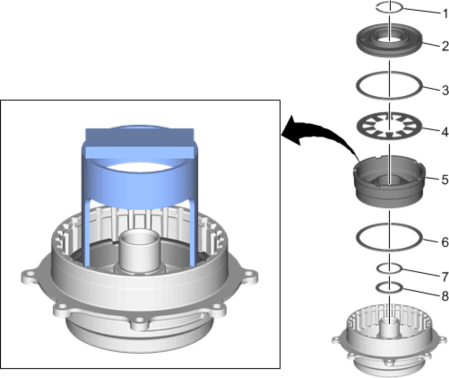
Fig. 224: Variable High Clutch Piston
|
Callout
|
Component Name
|
|
1
|
Variable High Clutch Piston Dam Retaining Ring
Procedure
Use a press and DT-48903 compressor against the variable high clutch piston dam to remove the retaining ring.
NOTE:
DO NOT
exceed 5.0
mm (0.20 in) of travel below the snap ring groove when compressing the variable high clutch piston dam.
DISCARD
the retaining ring.
|
|
Callout
|
Component Name
|
|
1
|
Variable High Clutch Piston Dam Retaining Ring
Procedure
Use a press and DT-48903 compressor against the variable high clutch piston dam to remove the retaining ring.
NOTE:
DO NOT
exceed 5.0
mm (0.20 in) of travel below the snap ring groove when compressing the variable high clutch piston dam.
DISCARD
the retaining ring.
|
|
Callout
|
Component Name
|
|
1
|
Variable High Clutch Piston Dam Retaining Ring
Procedure
Use a press and DT-48903 compressor against the variable high clutch piston dam to remove the retaining ring.
NOTE:
DO NOT
exceed 5.0
mm (0.20 in) of travel below the snap ring groove when compressing the variable high clutch piston dam.
DISCARD
the retaining ring.
|
Courtesy of GENERAL MOTORS COMPANY Variable High Clutch Piston Removal


|
Callout
|
Component Name
|
|
|
Special Tools
DT-48903 Spring Compressor
For equivalent regional tools, refer to Special Tools.
|
|
2
|
Variable High Clutch Piston Dam
|
|
3
|
Variable High Clutch Piston Outer Seal
|
|
4
|
Variable High Clutch Piston Spring
|
|
5
|
Variable High Clutch Piston
|
|
6
|
Variable High Clutch Piston Dam Outer Seal
|
|
7
|
Variable High Clutch Piston Dam Inner Seal
|
|
8
|
Variable High Clutch Piston Inner Seal
|
VARIABLE HIGH CLUTCH ASSEMBLE
Variable High Clutch Piston Installation

Fig. 225: Variable High Clutch Piston
Courtesy of GENERAL MOTORS COMPANY Variable High Clutch Piston Installation
|
Callout
|
Component Name
|
|
CAUTION:
Refer to Seal
PRreeulimseinary Procedure Lubricate all seals with automatic transmission fluid (ATF) prior to installation.
|
|
Caution
.
1
|
Variable High Clutch Piston Inner Seal
NOTE:
Use a NEW seal.
|
|
2
|
Variable High Clutch Piston Dam Inner Seal
NOTE:
Use a NEW seal.
|
|
3
|
Variable High Clutch Piston Dam Outer Seal
NOTE:
Use a NEW seal.
|
|
4
|
Variable High Clutch Piston
Special Tools
DT-48903 Spring Compressor
For equivalent regional tools, refer to Special Tools.
|
|
5
|
Variable High Clutch Piston Spring
|
|
6
|
Variable High Clutch Piston Outer Seal
NOTE:
Use a NEW seal.
|
|
7
|
Variable High Clutch Piston Dam
Special Tools
 DT-48903
Spring Compressor
DT-48903
Spring Compressor
 DT-51669
Protector
DT-51669
Protector
For equivalent regional tools, refer to Special Tools.
|
|
8
|
Variable High Clutch Piston Dam Retaining Ring
CAUTION:
Refer to
Retaining
Ring Reuse
Caution
.
Procedure
|
|
Callout
|
Component Name
|
|
|
Use a press and DT-48903 compressor against the variable high clutch piston dam to install the retaining ring.
NOTE:
DO NOT
exceed 5.0
mm (0.20 in) of travel below the snap ring groove when compressing the variable high clutch piston dam.
NOTE:
Use a NEW retaining ring.
Special Tools
DT-48903 Spring Compressor
For equivalent regional tools, refer to Special Tools.
|
Variable High Clutch Plate Installation

Fig. 226: Variable High Clutch Plate
|
Callout
|
Component Name
|
|
1
|
Variable High Clutch Waved Plate
|
|
2
|
Variable High Clutch Plate (Qty: 3)
|
|
3
|
Variable High Clutch Plate - Friction (Qty: 3)
|
|
4
|
Variable High Clutch Backing Plate
|
|
5
|
Variable High Clutch Backing Plate Retaining Ring
Procedure
Select the correct retaining ring. Refer to Variable High Clutch Backing Plate Retaining Ring
Measurement.
|
|
Callout
|
Component Name
|
|
1
|
Variable High Clutch Waved Plate
|
|
2
|
Variable High Clutch Plate (Qty: 3)
|
|
3
|
Variable High Clutch Plate - Friction (Qty: 3)
|
|
4
|
Variable High Clutch Backing Plate
|
|
5
|
Variable High Clutch Backing Plate Retaining Ring
Procedure
Select the correct retaining ring. Refer to Variable High Clutch Backing Plate Retaining Ring
Measurement.
|
|
Callout
|
Component Name
|
|
1
|
Variable High Clutch Waved Plate
|
|
2
|
Variable High Clutch Plate (Qty: 3)
|
|
3
|
Variable High Clutch Plate - Friction (Qty: 3)
|
|
4
|
Variable High Clutch Backing Plate
|
|
5
|
Variable High Clutch Backing Plate Retaining Ring
Procedure
Select the correct retaining ring. Refer to Variable High Clutch Backing Plate Retaining Ring
Measurement.
|
Courtesy of GENERAL MOTORS COMPANY Variable High Clutch Plate Installation
VARIABLE HIGH CLUTCH BACKING PLATE RETAINING RING MEASUREMENT

Fig. 227: Variable High Clutch Backing Plate Retaining Ring Measurement
Courtesy of GENERAL MOTORS COMPANY
|
Callout
|
Component Name
|
|
Preliminary Procedure
Assemble the variable high clutch. Refer to Variable High Clutch Assemble.
|
|
1
|
Variable High Clutch Backing Plate Retaining Ring
Procedure
1. Assemble the tools as shown and clamp the DT-50900 fixture to the bench.
2. Apply 20 pounds of pressure to the load gauge by turning the screw on the DT-50900
fixture clockwise.
3. Zero out the dial indicator.
4. Remove the pressure on the load gauge by turning the screw on the DT-50900 fixture one full turn counterclockwise.
5. Apply 50 PSI of compressed air and simultaneously adjust the screw on the DT-50900
fixture to apply 20 pounds of pressure to the load gauge.
6. Observe the dial indicator measurement. Refer to
Clutch Backing Plate Retaining Ring
Specifications
to determine the correct variable high clutch backing plate retaining ring.
Special Tools
 DT-50900
Clutch Travel Support Fixture
DT-50900
Clutch Travel Support Fixture
 DT-50903 Clutch Travel Load Gauge
 DT-50905 Clutch Travel Air Adapter
 DT-51627 Clutch Travel Air Adapter
|
|
Callout
|
Component Name
|
|
|
 GE-8001
Dial Indicator Set
GE-8001
Dial Indicator Set
 J-23327-1
Clutch Spring Compressor
J-23327-1
Clutch Spring Compressor
For equivalent regional tools, refer to Special Tools.
|
VARIABLE HIGH CLUTCH INSTALLATION

Fig. 228: Variable High Clutch
Courtesy of GENERAL MOTORS COMPANY
|
Callout
|
Component Name
|
|
1
|
Variable High Clutch Hub Thrust Washer
|
|
2
|
Variable High Clutch Hub
|
|
3
|
Variable High Clutch Hub Thrust Washer
|
|
4
|
Variable High Clutch Housing
Special Tools
DT-51628 Clutch Holder
For equivalent regional tools, refer to Special Tools.
|
|
5
|
Variable High Clutch Housing Bolt (Qty: 8)
CAUTION:
Refer to
Fastener
Caution
.
|
|
Callout
|
Component Name
|
|
|
Tighten
9 N.m (80 lb in)
|
VARIABLE LOW CLUTCH PLATE INSTALLATION

Fig. 229: Variable Low Clutch Plate
Courtesy of GENERAL MOTORS COMPANY
|
Callout
|
Component Name
|
|
CAUTION:
DO NOT
contact or
rest the drive motor stator on the copper end coils.
Damage to the copper end coils
|
|
Callout
|
Component Name
|
|
may cause a high voltage short during vehicle operation, resulting in component damage.
Preliminary Procedure Service the variable low clutch with the variable high clutch installed onto the drive motor rotor. This will prevent contact of the drive motor stator copper end coils with the work surface.
|
|
1
|
Variable Low Clutch Piston
|
|
2
|
Variable Low Clutch Spring
|
|
3
|
Variable Low Clutch Plate (Qty: 3)
|
|
4
|
Variable Low Clutch Plate - Friction (Qty: 3)
|
|
5
|
Variable Low Clutch Backing Plate
|
|
6
|
Variable Low Clutch Backing Plate Retaining Ring - Selective
Procedure
1. Select the correct retaining ring. Refer to: Variable Low Clutch Backing Plate Retaining
Ring Measurement.
2. Use DT-47694 compressor and a suitable press to install the retaining ring.
Special Tools
DT-47694 Piston Spring Compressor
For equivalent regional tools, refer to Special Tools.
|
VARIABLE LOW CLUTCH BACKING PLATE RETAINING RING MEASUREMENT

Fig. 230: Variable Low Clutch Backing Plate Retaining Ring Measurement
Courtesy of GENERAL MOTORS COMPANY
|
Callout
|
Component Name
|
|
Preliminary Procedure
1. Assemble the variable low clutch. Refer to Variable Low Clutch Plate Installation.
CAUTION:
DO NOT
contact or rest the drive motor stator on the copper end coils.
Damage to the copper end coils may cause a high voltage short during vehicle operation, resulting in component damage.
2. Service the variable low clutch with the variable high clutch installed onto the drive motor rotor. This will prevent contact of the drive motor stator copper end coils with the work surface.
|
DRIVE MOTOR INSTALLATION - 1ST POSITION
Drive Motor Power Inverter Module Connector Installation

Fig. 231: Drive Motor Power Inverter Module Connector
Courtesy of GENERAL MOTORS COMPANY
Drive Motor Power Inverter Module Connector Installation
|
Callout
|
Component Name
|
|
1
|
Drive Motor Power Inverter Module Connector
NOTE:
Use a NEW connector.
|
|
2
|
Drive Motor Power Inverter Module Connector Bolt
Procedure
Use Threadlocker Blue on the bolt threads. Refer to Adhesives, Fluids, Lubricants, and
Sealers.
NOTE:
Install a NEW bolt.
Tighten
9 N.m (80 lb in)
|
Drive Motor - 1st Position Installation

Fig. 232: Drive Motor - 1st Position
|
Callout
|
Component Name
|
|
1
|
Drive Motor - 1st Position
WARNING:
The generator motor weighs approximately 23 kg (50 lbs). Personal injury may result if you lift the generator motor improperly.
CAUTION:
|
|
Callout
|
Component Name
|
|
1
|
Drive Motor - 1st Position
WARNING:
The generator motor weighs approximately 23 kg (50 lbs). Personal injury may result if you lift the generator motor improperly.
CAUTION:
|
|
Callout
|
Component Name
|
|
1
|
Drive Motor - 1st Position
WARNING:
The generator motor weighs approximately 23 kg (50 lbs). Personal injury may result if you lift the generator motor improperly.
CAUTION:
|
Courtesy of GENERAL MOTORS COMPANY Drive Motor - 1st Position Installation
|
Callout
|
Component Name
|
|
|
DO NOT
contact or rest the drive motor stator on the copper end coils.
Damage to the copper end coils may cause a high voltage short during vehicle operation, resulting in component damage.
Procedure
1. Install the DT-51623 motor lift bar.
2. Install the DT-51624 alignment pins.
3. Carefully tip the drive motor onto its side, resting on the cast aluminum support. Never rest the drive motor on the stator copper end coils.
4. Attach a lift assist hook through the DT-51623 motor lift bar handle hole and carefully raise the drive motor while holding it to rotate into position for assembly.
5. Carefully lower the drive motor into the transmission case ensuring the copper end coils do not contact any metallic parts.
NOTE:
Ensure the seal sizer has been removed from the variable high clutch fluid transfer seals.
6. Use the DT-51624 alignment pins to guide the drive motor into position.
7. Guide the drive motor resolver wire through the transmission case while lowering the drive motor using a lift assist.
8. The drive motor should sit below the cast line in the transmission case when properly installed.
Special Tools
|
|
Callout
|
Component Name
|
|
|
 DT-51623
Motor Lift Bar
DT-51623
Motor Lift Bar
 DT-51624
Alignment Pins
DT-51624
Alignment Pins
For equivalent regional tools, refer to Special Tools.
|
|
2
|
Automatic Transmission Case Extension Bolt (Qty: 4)
CAUTION:
Refer to
Fastener
Caution
.
Tighten
26 N.m (19 lb ft)
|
|
3
|
Drive Motor Power Inverter Module 3-Phase Cable Bolt (Qty: 3)
Tighten
9 N.m (80 lb in)
|
OUTPUT CARRIER INTERNAL GEAR OVERHAUL

Fig. 233: Output Carrier Internal Gear
Courtesy of GENERAL MOTORS COMPANY
|
Callout
|
Component Name
|
|
1
|
Output Carrier Internal Gear Retaining Ring
|
|
2
|
Output Carrier Internal Gear Hub
|
|
Callout
|
Component Name
|
|
3
|
Output Carrier Internal Gear
|
OUTPUT CARRIER AND OUTPUT CARRIER INTERNAL GEAR INSTALLATION

Fig. 234: Output Carrier And Output Carrier Internal Gear
Courtesy of GENERAL MOTORS COMPANY
|
Callout
|
Component Name
|
|
1
|
Output Carrier Internal Gear Hub Thrust Bearing
|
|
2
|
Output Carrier Internal Gear
|
|
3
|
Output Carrier Thrust Bearing
|
|
4
|
Output Carrier
|
DRIVE MOTOR DISASSEMBLE - 2ND POSITION
Drive Motor Rotor Removal

Fig. 235: Drive Motor Rotor
|
Callout
|
Component Name
|
|
1
|
Output Sun Gear Retaining Ring
|
|
2
|
Output Sun Gear
|
|
3
|
Drive Motor Rotor Bearing Retaining Ring
NOTE:
DISCARD
the retaining
ring.
|
|
4
|
Drive Motor Rotor
NOTE:
The drive motor rotor is strongly magnetic. DO NOT
place within 6 inches of ferrous metallic components.
NOTE:
|
|
Callout
|
Component Name
|
|
1
|
Output Sun Gear Retaining Ring
|
|
2
|
Output Sun Gear
|
|
3
|
Drive Motor Rotor Bearing Retaining Ring
NOTE:
DISCARD
the retaining
ring.
|
|
4
|
Drive Motor Rotor
NOTE:
The drive motor rotor is strongly magnetic. DO NOT
place within 6 inches of ferrous metallic components.
NOTE:
|
|
Callout
|
Component Name
|
|
1
|
Output Sun Gear Retaining Ring
|
|
2
|
Output Sun Gear
|
|
3
|
Drive Motor Rotor Bearing Retaining Ring
NOTE:
DISCARD
the retaining
ring.
|
|
4
|
Drive Motor Rotor
NOTE:
The drive motor rotor is strongly magnetic. DO NOT
place within 6 inches of ferrous metallic components.
NOTE:
|
Courtesy of GENERAL MOTORS COMPANY Drive Motor Rotor Removal
|
Callout
|
Component Name
|
|
|
Place the drive motor rotor on a lint free cloth to prevent metallic debris from adhering to the outer diameter.
Metallic debris can be removed from the motor outer diameter by blotting with adhesive tape.
Special Tools
DT-51621 Rotor Remover/Installer
For equivalent regional tools, refer to Special Tools.
|
Drive Motor Stator Removal

Fig. 236: Drive Motor Stator
Courtesy of GENERAL MOTORS COMPANY Drive Motor Stator Removal
|
Callout
|
Component Name
|
|
1
|
Drive Motor Stator Bolt (Qty: 4)
NOTE:
DISCARD
the bolts.
|
|
2
|
Drive Motor Stator
CAUTION:
DO NOT
contact or
rest the drive motor stator on the copper end coils.
Damage to the copper end coils may cause a high voltage short during vehicle operation, resulting in component damage.
NOTE:
Place the drive motor stator on a lint free cloth over a piece of cardboard.
|
|
3
|
Drive Motor Position Sensor Bolt (Qty: 1)
NOTE:
DISCARD
the bolts.
|
|
4
|
Drive Motor Position Sensor Connector Clip
|
|
5
|
Drive Motor Position Sensor Bolt (Qty: 3)
NOTE:
|
|
Callout
|
Component Name
|
|
1
|
Drive Motor Stator Bolt (Qty: 4)
NOTE:
DISCARD
the bolts.
|
|
2
|
Drive Motor Stator
CAUTION:
DO NOT
contact or
rest the drive motor stator on the copper end coils.
Damage to the copper end coils may cause a high voltage short during vehicle operation, resulting in component damage.
NOTE:
Place the drive motor stator on a lint free cloth over a piece of cardboard.
|
|
3
|
Drive Motor Position Sensor Bolt (Qty: 1)
NOTE:
DISCARD
the bolts.
|
|
4
|
Drive Motor Position Sensor Connector Clip
|
|
5
|
Drive Motor Position Sensor Bolt (Qty: 3)
NOTE:
|
|
Callout
|
Component Name
|
|
1
|
Drive Motor Stator Bolt (Qty: 4)
NOTE:
DISCARD
the bolts.
|
|
2
|
Drive Motor Stator
CAUTION:
DO NOT
contact or
rest the drive motor stator on the copper end coils.
Damage to the copper end coils may cause a high voltage short during vehicle operation, resulting in component damage.
NOTE:
Place the drive motor stator on a lint free cloth over a piece of cardboard.
|
|
3
|
Drive Motor Position Sensor Bolt (Qty: 1)
NOTE:
DISCARD
the bolts.
|
|
4
|
Drive Motor Position Sensor Connector Clip
|
|
5
|
Drive Motor Position Sensor Bolt (Qty: 3)
NOTE:
|
|
Callout
|
Component Name
|
|
|
DISCARD
the bolts.
|
|
6
|
Drive Motor Position Sensor Stator
|
|
7
|
Drive Motor Support
NOTE:
The drive motor support is a mandatory replacement component. Discard the drive motor support.
|
Drive Motor Power Inverter Module Cable Guide Removal

Fig. 237: Drive Motor Power Inverter Module Cable Guide Assembly
Courtesy of GENERAL MOTORS COMPANY
Drive Motor Power Inverter Module Cable Guide Removal
|
Callout
|
Component Name
|
|
1
|
Drive Motor Power Inverter Module 3-Phase Cable Bolt (Qty: 3)
|
|
2
|
Drive Motor Power Inverter Module Cable Bolt Install Guide Retainer (Qty: 3)
|
|
3
|
Drive Motor Power Inverter Module Cable Bolt Install Guide Bushing (Qty: 3)
|
|
4
|
Drive Motor Power Inverter Module 3-Phase Cable Guide Assembly
|
DRIVE MOTOR ASSEMBLE - 2ND POSITION
Drive Motor Power Inverter Module Cable Guide Installation

Fig. 238: Drive Motor Power Inverter Module Cable Guide
Courtesy of GENERAL MOTORS COMPANY
Drive Motor Power Inverter Module Cable Guide Installation
|
Callout
|
Component Name
|
|
1
|
Drive Motor Power Inverter Module Cable Guide
|
|
2
|
Drive Motor Power Inverter Module Cable Bolt Install Guide Bushing (Qty: 3)
|
|
3
|
Drive Motor Power Inverter Module Cable Bolt Install Guide Retainer (Qty: 3)
|
|
4
|
Drive Motor Power Inverter Module 3-Phase Cable Bolt (Qty: 3)
|
Drive Motor Stator Installation

Fig. 239: Drive Motor Stator
|
Callout
|
Component Name
|
|
1
|
Drive Motor Support
NOTE:
The drive motor support is a mandatory replacement component. Install a NEW drive motor support.
|
|
2
|
Drive Motor Position Sensor Stator
|
|
3
|
Drive Motor Position Sensor Bolt (Qty: 3)
CAUTION:
Refer to
Fastener
Caution
.
CAUTION:
|
|
Callout
|
Component Name
|
|
1
|
Drive Motor Support
NOTE:
The drive motor support is a mandatory replacement component. Install a NEW drive motor support.
|
|
2
|
Drive Motor Position Sensor Stator
|
|
3
|
Drive Motor Position Sensor Bolt (Qty: 3)
CAUTION:
Refer to
Fastener
Caution
.
CAUTION:
|
|
Callout
|
Component Name
|
|
1
|
Drive Motor Support
NOTE:
The drive motor support is a mandatory replacement component. Install a NEW drive motor support.
|
|
2
|
Drive Motor Position Sensor Stator
|
|
3
|
Drive Motor Position Sensor Bolt (Qty: 3)
CAUTION:
Refer to
Fastener
Caution
.
CAUTION:
|
Courtesy of GENERAL MOTORS COMPANY Drive Motor Stator Installation
|
Callout
|
Component Name
|
|
|
Refer to
Torque-to-
Yield
Fastener
Caution
.
Procedure
Use Threadlocker Red on the bolt threads. Refer to Adhesives, Fluids, Lubricants, and
Sealers.
NOTE:
Use NEW bolts.
Tighten
5 N.m (44 lb in)
|
|
4
|
Drive Motor Position Sensor Connector Clip
|
|
5
|
Drive Motor Position Sensor Bolt (Qty: 1)
CAUTION:
Refer to
Torque-to-
Yield
Fastener
Caution
.
NOTE:
Use NEW bolts.
Tighten
5 N.m (44 lb in)
|
|
6
|
Drive Motor Stator
CAUTION:
DO NOT
contact or
rest the drive motor stator on the copper end coils.
Damage to the copper end coils
|
|
Callout
|
Component Name
|
|
|
may cause a high voltage short during vehicle operation, resulting in component damage.
|
|
7
|
Drive Motor Stator Bolt (Qty: 4)
CAUTION:
Refer to
Torque-to-
Yield
Fastener
Caution
.
NOTE:
Use NEW bolts.
Tighten
11 N.m (97 lb in)
|
Drive Motor Rotor Installation

Fig. 240: Drive Motor Rotor
Courtesy of GENERAL MOTORS COMPANY Drive Motor Rotor Installation
|
Callout
|
Component Name
|
|
1
|
Drive Motor Rotor
NOTE:
The drive motor rotor bearing retaining ring groove will be visible when the drive motor rotor is completely installed. It may be necessary to jiggle the
DT-51621
installer to allow the rotor to fully drop into position.
NOTE:
The drive motor rotor is strongly magnetic. DO NOT
place within 6 inches of ferrous metallic components. Metallic debris can be removed from the motor outer diameter by blotting with adhesive tape.
Special Tools
DT-51621 Rotor Remover/Installer
|
|
Callout
|
Component Name
|
|
|
For equivalent regional tools, refer to Special Tools.
|
|
2
|
Drive Motor Rotor Bearing Retaining Ring
NOTE:
Install a NEW
retaining ring.
|
|
3
|
Output Sun Gear
|
|
4
|
Output Sun Gear Retaining Ring
|
DRIVE MOTOR INSTALLATION - 2ND POSITION
Drive Motor Power Inverter Module Connector Installation

Fig. 241: Drive Motor Power Inverter Module Connector
Courtesy of GENERAL MOTORS COMPANY
Drive Motor Power Inverter Module Connector Installation
|
Callout
|
Component Name
|
|
1
|
Drive Motor Power Inverter Module Connector
NOTE:
Use a NEW connector.
|
|
Callout
|
Component Name
|
|
2
|
Drive Motor Power Inverter Module Connector Bolt (Qty: 1)
Procedure
Use Threadlocker Blue on the bolt threads. Refer to Adhesives, Fluids, Lubricants, and
Sealers.
NOTE:
Install a NEW bolt.
Tighten
9 N.m (80 lb in)
|
Drive Motor - 2nd Position Installation

Fig. 242: Drive Motor - 2nd Position
|
Callout
|
Component Name
|
|
1
|
Drive Motor - 2nd Position
WARNING:
The generator motor weighs approximately 23 kg (50 lbs).
|
|
Callout
|
Component Name
|
|
1
|
Drive Motor - 2nd Position
WARNING:
The generator motor weighs approximately 23 kg (50 lbs).
|
|
Callout
|
Component Name
|
|
1
|
Drive Motor - 2nd Position
WARNING:
The generator motor weighs approximately 23 kg (50 lbs).
|
Courtesy of GENERAL MOTORS COMPANY Drive Motor - 2nd Position Installation
|
Callout
|
Component Name
|
|
|
Personal injury may result if you lift the generator motor improperly.
CAUTION:
DO NOT
contact or rest the drive motor stator on the copper end coils.
Damage to the copper end coils may cause a high voltage short during vehicle operation, resulting in component damage.
Procedure
1. Install the DT-51623 motor lift bar.
2. Carefully tip the drive motor onto its side, resting on the cast aluminum support. Never rest the drive motor on the stator copper end coils.
3. Attach a lift assist hook through the DT-51623 motor lift bar handle hole and carefully raise the drive motor while holding it to rotate into position for assembly.
4. Carefully lower the drive motor into the transmission case ensuring the copper end coils do not contact any metallic parts.
5. Guide the drive motor resolver wire through the transmission case while lowering the drive motor using a lift assist.
6. If the drive motor will not fully seat, raise the drive motor up with the lift assist so that the planetary gear set can be rotated slightly to engage the sun gear on the drive motor.
7. Repeat step 5 until the drive motor can be fully seated. DO NOT rock, shake, or hammer the drive motor to seat it.
Special Tools
DT-51623 Motor Lift Bar
For equivalent regional tools, refer to Special Tools.
|
Drive Motor - 2nd Position Bolt Installation

Fig. 243: Drive Motor - 2nd Position Bolts
Courtesy of GENERAL MOTORS COMPANY
Drive Motor - 2nd Position Bolt Installation
|
Callout
|
Component Name
|
|
1
|
Automatic Transmission Case Extension Bolt (Qty: 1)
NOTE:
Use NEW bolts.
Tighten
38 N.m (28 lb ft)
|
|
2
|
Automatic Transmission Case Extension Bolt (Qty: 1)
NOTE:
Use NEW bolts.
Tighten
38 N.m (28 lb ft)
|
|
3
|
Automatic Transmission Case Extension Bolt (Qty: 2)
Tighten
38 N.m (28 lb ft)
|
|
Callout
|
Component Name
|
|
4
|
Drive Motor Power Inverter Module 3-Phase Cable Bolt (Qty: 3)
Tighten
9 N.m (80 lb in)
|
Drive Motor Stator Cooling Tube Installation

Fig. 244: Drive Motor Stator Cooling Tube
Courtesy of GENERAL MOTORS COMPANY
Drive Motor Stator Cooling Tube Installation
|
Callout
|
Component Name
|
|
1
|
Drive Motor Stator Cooling Tube
|
|
2
|
Drive Motor Stator Cooling Tube Bolt (Qty: 2)
Tighten
9 N.m (80 lb in)
|
|
3
|
Automatic Transmission Output Speed Sensor
|
|
4
|
Automatic Transmission Output Speed Sensor Bolt
Tighten
9 N.m (80 lb in)
|
MANUAL SHIFT DETENT LEVER WITH SHAFT POSITION SWITCH ASSEMBLY AND PARK PAWL ACTUATOR INSTALLATION
Automatic Transmission Wiring Harness Bracket Installation

Fig. 245: Automatic Transmission Wiring Harness Bracket
Courtesy of GENERAL MOTORS COMPANY
Automatic Transmission Wiring Harness Bracket Installation
|
Callout
|
Component Name
|
|
1
|
Automatic Transmission Wiring Harness Bracket
|
|
2
|
Automatic Transmission Wiring Harness Connector Bracket Bolt (Qty: 1)
CAUTION:
Refer to
Fastener
Caution
.
Tighten
9 N.m (80 lb in)
|
|
3
|
Automatic Transmission Wiring Harness Bracket
|
|
4
|
Automatic Transmission Wiring Harness Connector Bracket Bolt (Qty: 1)
Tighten
9 N.m (80 lb in)
|
Manual Shift Detent Lever with Shaft Position Switch Assembly and Park Pawl Actuator Installation

Fig. 246: Manual Shift Detent Lever With Shaft Position Switch Assembly And Park Pawl Actuator
Courtesy of GENERAL MOTORS COMPANY
Manual Shift Detent Lever with Shaft Position Switch Assembly and Park Pawl Actuator Installation
|
Callout
|
Component Name
|
|
1
|
Park Pawl Actuator
|
|
2
|
Manual Shift Detent Lever
|
|
3
|
Manual Shift Detent Lever Shaft
|
|
4
|
Manual Shift Shaft Pin
CAUTION:
The manual shift shaft pin must be installed before the manual shift detent lever pin. Use the special tool, DT-51436, to
install the manual shift shaft pin to the proper depth.
Failure to follow these steps may result in damage to
|
|
Callout
|
Component Name
|
|
|
the transmission.
Procedure
Install the manual shift shaft pin before installing the manual shift detent lever pin.
Special Tools
DT-51436 Manual Shaft Pin Installer
For equivalent regional tools, refer to Special Tools.
|
|
5
|
Manual Shift Detent Lever Pin
|
|
6
|
Park Pawl Actuator Guide
|
|
7
|
Park Pawl Actuator Guide Bolt
Tighten
14 N.m (124 lb in)
|
|
8
|
Park Pawl Shaft
|
|
9
|
Park Pawl Spring
|
|
10
|
Park Pawl
|
|
11
|
Manual Shift Detent Lever Spring
Tighten
9 N.m (80 lb in)
|
MANUAL SHIFT SHAFT SEAL INSTALLATION

Fig. 247: Manual Shift Shaft Seal
Courtesy of GENERAL MOTORS COMPANY
|
Callout
|
Component Name
|
|
1
|
Manual Shift Shaft Seal
Special Tools
DT-51672 Seal Installer
For equivalent regional tools, refer to Special Tools.
|
AUTOMATIC TRANSMISSION FLUID PUMP AND FLUID FILTER INSTALLATION

Fig. 248: Automatic Transmission Fluid Pump And Fluid Filter
Courtesy of GENERAL MOTORS COMPANY
|
Callout
|
Component Name
|
|
1
|
Automatic Transmission Fluid Filter Seal
|
|
2
|
Automatic Transmission Fluid Filter
|
|
3
|
Automatic Transmission Fluid Filter Bolt
CAUTION:
Refer to
Fastener
Caution
.
Tighten
9 N.m (80 lb in)
|
|
4
|
Automatic Transmission Pump Fluid Outlet Seal
|
|
5
|
Automatic Transmission Fluid Pump
Procedure
Connect the fluid pump pass thru connector to the case.
|
|
Callout
|
Component Name
|
|
6
|
Automatic Transmission Fluid Pump Bolt (Qty: 3)
Tighten
22 N.m (16 lb ft)
|
DRIVE LINK SNUBBER INSTALLATION
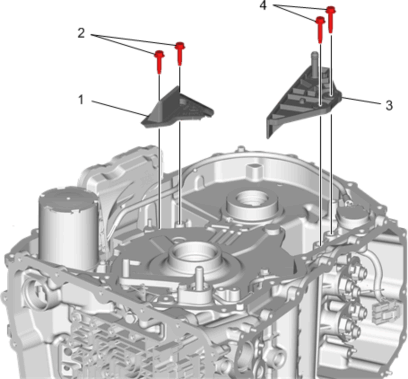
Fig. 249: Drive Link Snubber
Courtesy of GENERAL MOTORS COMPANY
|
Callout
|
Component Name
|
|
1
|
Drive Link Snubber - Coast Side
|
|
2
|
Drive Link Snubber Bolt (Qty: 2)
CAUTION:
Refer to
Fastener
Caution
.
Tighten
9 N.m (80 lb in)
|
|
3
|
Drive Link Snubber - Drive Side
|
|
4
|
Drive Link Snubber Bolt (Qty: 2)
Tighten
9 N.m (80 lb in)
|
FRONT DIFFERENTIAL CARRIER BAFFLE INSTALLATION

Fig. 250: Front Differential Carrier Baffle
Courtesy of GENERAL MOTORS COMPANY
|
Callout
|
Component Name
|
|
1
|
Automatic Transmission Fluid Chip Collector Magnet
|
|
2
|
Front Differential Carrier Baffle
|
|
3
|
Front Differential Carrier Baffle Bolt (Qty: 2)
CAUTION:
Refer to
Fastener
Caution
.
Tighten
9 N.m (80 lb in)
|
DRIVE SPROCKET, DRIVEN SPROCKET, AND DRIVE LINK INSTALLATION

Fig. 251: Drive Sprocket, Driven Sprocket And Drive Link
Courtesy of GENERAL MOTORS COMPANY
|
Callout
|
Component Name
|
|
1
|
Driven Sprocket Bearing
|
|
2
|
Drive Sprocket, Driven Sprocket, and Drive Link
|
INPUT SUN GEAR SHAFT INSTALLATION

Fig. 252: Input Sun Gear Shaft
Courtesy of GENERAL MOTORS COMPANY
|
Callout
|
Component Name
|
|
1
|
Variable High Clutch Housing Seal
|
|
2
|
Input Sun Gear Shaft
|
|
3
|
Input Sun Gear
|
|
4
|
Input Sun Gear Retaining Ring
|
|
5
|
Input Sun Gear Shaft Assembly
|
|
6
|
Input Internal Gear Thrust Bearing
|
FRONT DIFFERENTIAL CARRIER INSTALLATION

Fig. 253: Front Differential Carrier
Courtesy of GENERAL MOTORS COMPANY
|
Callout
|
Component Name
|
|
1
|
Differential Carrier Sun Gear Thrust Bearing
|
|
2
|
Front Differential Carrier Sun Gear
|
|
3
|
Front Differential Carrier
|
|
4
|
Front Differential Carrier Bearing
|
AUTOMATIC TRANSMISSION TORQUE DAMPENER AND DIFFERENTIAL HOUSING DISASSEMBLE
Front Differential Ring Gear Removal
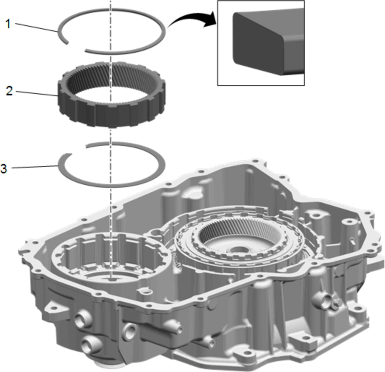
Fig. 254: Front Differential Ring Gear
Courtesy of GENERAL MOTORS COMPANY
Front Differential Ring Gear Removal
|
Callout
|
Component Name
|
|
Preliminary Procedure
Use wooden blocks or equivalent to elevate the torque dampener and differential housing on the bench to protect the front wheel drive shaft oil seal.
|
|
1
|
Front Differential Ring Gear Retainer
|
|
2
|
Front Differential Ring Gear
|
|
3
|
Front Differential Carrier Internal Gear Wear Ring
|
Input Brake Clutch Removal

Fig. 255: Input Brake Clutch
|
Callout
|
Component Name
|
|
1
|
Input Brake Clutch Retaining Ring
|
|
2
|
Input Brake Clutch
|
|
3
|
Input Brake Clutch Retaining Ring
|
|
Callout
|
Component Name
|
|
1
|
Input Brake Clutch Retaining Ring
|
|
2
|
Input Brake Clutch
|
|
3
|
Input Brake Clutch Retaining Ring
|
|
Callout
|
Component Name
|
|
1
|
Input Brake Clutch Retaining Ring
|
|
2
|
Input Brake Clutch
|
|
3
|
Input Brake Clutch Retaining Ring
|
Courtesy of GENERAL MOTORS COMPANY Input Brake Clutch Removal
Input Internal Gear Removal
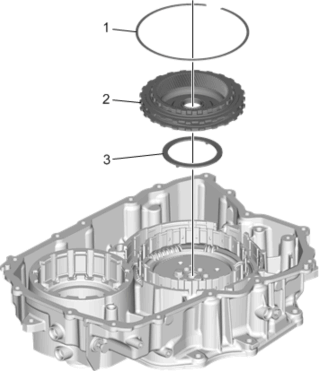
Fig. 256: Input Internal Gear
|
Callout
|
Component Name
|
|
1
|
Input Internal Gear Retaining Ring
|
|
2
|
Input Internal Gear
|
|
3
|
Automatic Transmission Torque Dampener Thrust Washer
|
|
Callout
|
Component Name
|
|
1
|
Input Internal Gear Retaining Ring
|
|
2
|
Input Internal Gear
|
|
3
|
Automatic Transmission Torque Dampener Thrust Washer
|
|
Callout
|
Component Name
|
|
1
|
Input Internal Gear Retaining Ring
|
|
2
|
Input Internal Gear
|
|
3
|
Automatic Transmission Torque Dampener Thrust Washer
|
Courtesy of GENERAL MOTORS COMPANY Input Internal Gear Removal
Input Drive Flange Removal

Fig. 257: Input Drive Flange
|
Callout
|
Component Name
|
|
1
|
Automatic Transmission Torque Dampener Bolt (Qty: 6)
Procedure
Use DT-51654 holder in a vise to hold the torque dampener while removing the bolts.
NOTE:
DISCARD
the bolts.
Special Tools
DT-51654 Dampener Holder
For equivalent regional tools, refer to Special Tools.
|
|
2
|
Input Drive Flange
|
|
Callout
|
Component Name
|
|
1
|
Automatic Transmission Torque Dampener Bolt (Qty: 6)
Procedure
Use DT-51654 holder in a vise to hold the torque dampener while removing the bolts.
NOTE:
DISCARD
the bolts.
Special Tools
DT-51654 Dampener Holder
For equivalent regional tools, refer to Special Tools.
|
|
2
|
Input Drive Flange
|
|
Callout
|
Component Name
|
|
1
|
Automatic Transmission Torque Dampener Bolt (Qty: 6)
Procedure
Use DT-51654 holder in a vise to hold the torque dampener while removing the bolts.
NOTE:
DISCARD
the bolts.
Special Tools
DT-51654 Dampener Holder
For equivalent regional tools, refer to Special Tools.
|
|
2
|
Input Drive Flange
|
Courtesy of GENERAL MOTORS COMPANY Input Drive Flange Removal
Automatic Transmission Torque Dampener Removal

Fig. 258: Automatic Transmission Torque Dampener
Courtesy of GENERAL MOTORS COMPANY
Automatic Transmission Torque Dampener Removal
|
Callout
|
Component Name
|
|
1
|
Automatic Transmission Torque Dampener
|
|
2
|
Automatic Transmission Torque Dampener Thrust Bearing
NOTE:
The thrust bearing may be stuck to the torque dampener.
|
Automatic Transmission Torque Dampener Bypass Clutch Piston Removal

Fig. 259: Automatic Transmission Torque Dampener Bypass Clutch Piston
Courtesy of GENERAL MOTORS COMPANY
Automatic Transmission Torque Dampener Bypass Clutch Piston Removal
|
Callout
|
Component Name
|
|
CAUTION:
Refer to
Seal
Reuse
Caution
.
|
|
1
|
Automatic Transmission Torque Dampener Bypass Clutch Piston Return Spring Retaining Ring
|
|
2
|
Automatic Transmission Torque Dampener Bypass Clutch Piston Return Spring
|
|
3
|
Automatic Transmission Torque Dampener Bypass Clutch Apply Bearing
|
|
4
|
Automatic Transmission Torque Dampener Bypass Clutch Piston
NOTE:
It may be necessary to apply air to the apply passage to remove the piston.
|
|
5
|
Automatic Transmission Torque Dampener Bypass Clutch Piston Outer Seal
NOTE:
DISCARD
the seal.
|
|
Callout
|
Component Name
|
|
6
|
Automatic Transmission Torque Dampener Bypass Clutch Piston Inner Seal
NOTE:
DISCARD
the seal.
|
FRONT WHEEL DRIVE SHAFT OIL SEAL REMOVAL - RIGHT SIDE

Fig. 260: Front Wheel Drive Shaft Oil Seal - Right Side
Courtesy of GENERAL MOTORS COMPANY
|
Callout
|
Component Name
|
|
1
|
Front Wheel Drive Shaft Oil Seal
Special Tools
 DT-23129
Universal Seal Remover
DT-23129
Universal Seal Remover
 GE-6125-1B
Slide Hammer
GE-6125-1B
Slide Hammer
For equivalent regional tools, refer to Special Tools.
|
INPUT SHAFT SEAL REMOVAL
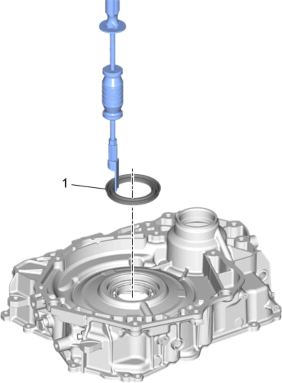
Fig. 261: Input Shaft Seal
Courtesy of GENERAL MOTORS COMPANY
|
Callout
|
Component Name
|
|
1
|
Input Shaft Seal
Special Tools
 DT-23129
Universal Seal Remover
DT-23129
Universal Seal Remover
 GE-6125-1B
Slide Hammer
GE-6125-1B
Slide Hammer
For equivalent regional tools, refer to Special Tools.
|
INPUT SHAFT BEARING REMOVAL

Fig. 262: Input Shaft Bearing
Courtesy of GENERAL MOTORS COMPANY
|
Callout
|
Component Name
|
|
1
|
Input Shaft Bearing
Procedure
Use a punch and hammer to remove the bearing.
|
AUTOMATIC TRANSMISSION TORQUE DAMPENER AND DIFFERENTIAL HOUSING CLEANING AND INSPECTION

Fig. 263: Automatic Transmission Torque Dampener And Differential Housing
Courtesy of GENERAL MOTORS COMPANY
|
Callout
|
Component Name
|
|
CAUTION:
Do not use abrasive pads or bristle devices to clean the sealing surfaces. Abrasive pads produce a fine grit that can effect transmission function.
Abrasive pads can also remove enough metal to create oil leaks.
|
|
Callout
|
Component Name
|
|
CAUTION:

After CAUTION: e
tDroannsomt irsesuisoen cloemanpionngents, aslololvwentotsa. ir dPre.vDioounsloyt
usedcloth or spoalpveernttoswels imnaoyr derptoosit dserydiamneynt twrahnicshmmisasyion dcoampagoenethnets. Lcoinmt pfroonmentht.e towels can
Pcraeulismeinary Procedures
component
fail1u.rTeh. oroughly clean the torque dampener and differential housing, including case threads, with clean solvent.
2. Clean gasket sealing surfaces. Remove all residual gasket material.
3. Inspect all threaded holes. If necessary, repair any thread damage.
|
|
1
|
Transmission Fluid Filler Tube Plug
|
|
2
|
Transmission Fluid Filler Tube Plug
|
|
3
|
Transmission Case to Torque Dampener and Differential Housing Sealing Surface
|
|
4
|
Automatic Transmission Fluid Pressure Test Hole Plug (Qty: 2)
|
|
5
|
Retaining Ring Grooves
|
cleaning th
cleaning th
cleaning th
INPUT SHAFT BEARING INSTALLATION

Fig. 264: Input Shaft Bearing
Courtesy of GENERAL MOTORS COMPANY
|
Callout
|
Component Name
|
|
1
|
Input Shaft Bearing
Procedure
Use DT-48008 support with the small shoulder facing up to support the housing while using
DT-51625-1 installer and a press to install the bearing.
Special Tools
 DT-48008
Press Support/Pinion Bearing Installer
DT-48008
Press Support/Pinion Bearing Installer
 DT-51625-1
Bearing Installer
DT-51625-1
Bearing Installer
For equivalent regional tools, refer to Special Tools.
|
INPUT SHAFT SEAL INSTALLATION

Fig. 265: Input Shaft Seal
Courtesy of GENERAL MOTORS COMPANY
|
Callout
|
Component Name
|
|
1
|
Input Shaft Seal
Special Tools
 DT-8092
Drive Handle
DT-8092
Drive Handle
 DT-51622
Seal Installer
DT-51622
Seal Installer
For equivalent regional tools, refer to Special Tools.
|
FRONT WHEEL DRIVE SHAFT OIL SEAL INSTALLATION - RIGHT SIDE

Fig. 266: Front Wheel Drive Shaft Oil Seal - Right Side
Courtesy of GENERAL MOTORS COMPANY
|
Callout
|
Component Name
|
|
1
|
Front Wheel Drive Shaft Oil Seal
Special Tools
 DT-46629-A
Axle Seal Installer
DT-46629-A
Axle Seal Installer
 GE-8092
Driver Handle
GE-8092
Driver Handle
For equivalent regional tools, refer to Special Tools.
|
INPUT INTERNAL GEAR ASSEMBLY OVERHAUL
Automatic Transmission Torque Limit Clutch

Fig. 267: Automatic Transmission Torque Limit Clutch
Courtesy of GENERAL MOTORS COMPANY
Automatic Transmission Torque Limit Clutch
|
Callout
|
Component Name
|
|
1
|
Automatic Transmission Torque Limit Clutch Backing Plate Ring
|
|
2
|
Automatic Transmission Torque Limit Clutch Backing Plate
|
|
3
|
Automatic Transmission Torque Limit Clutch Spring
|
|
4
|
Automatic Transmission Torque Limit Clutch Backing Plate
|
Input Internal Gear Hub

Fig. 268: Input Internal Gear Hub
|
Callout
|
Component Name
|
|
1
|
Input Internal Gear Retaining Ring
|
|
2
|
Input Internal Gear Hub
|
|
3
|
Input Internal Gear
|
|
Callout
|
Component Name
|
|
1
|
Input Internal Gear Retaining Ring
|
|
2
|
Input Internal Gear Hub
|
|
3
|
Input Internal Gear
|
|
Callout
|
Component Name
|
|
1
|
Input Internal Gear Retaining Ring
|
|
2
|
Input Internal Gear Hub
|
|
3
|
Input Internal Gear
|
Courtesy of GENERAL MOTORS COMPANY Input Internal Gear Hub
AUTOMATIC TRANSMISSION TORQUE DAMPENER AND DIFFERENTIAL HOUSING ASSEMBLE
Automatic Transmission Torque Dampener Bypass Clutch Piston Installation

Fig. 269: Automatic Transmission Torque Dampener Bypass Clutch Piston
Courtesy of GENERAL MOTORS COMPANY
Automatic Transmission Torque Dampener Bypass Clutch Piston Installation
|
Callout
|
Component Name
|
|
CAUTION:
Refer to
Seal
Reuse
Caution
.
|
|
1
|
Automatic Transmission Torque Dampener Bypass Clutch Piston Inner Seal
NOTE:
Install a NEW seal.
|
|
2
|
Automatic Transmission Torque Dampener Bypass Clutch Piston Outer Seal
NOTE:
Install a NEW seal.
|
|
3
|
Automatic Transmission Torque Dampener Bypass Clutch Piston
Procedure
Align the dot on the piston to the 6 o'clock notch on the dampener and differential housing.
NOTE:
Lubricate the piston seals with
|
|
Callout
|
Component Name
|
|
|
automatic transmission fluid (ATF) to aid in installation of the piston.
|
|
4
|
Automatic Transmission Torque Dampener Bypass Clutch Apply Bearing
|
|
5
|
Automatic Transmission Torque Dampener Bypass Clutch Piston Return Spring
|
|
6
|
Automatic Transmission Torque Dampener Bypass Clutch Piston Return Spring Retaining Ring
|
Automatic Transmission Torque Dampener Installation

Fig. 270: Automatic Transmission Torque Dampener
Courtesy of GENERAL MOTORS COMPANY
Automatic Transmission Torque Dampener Installation
|
Callout
|
Component Name
|
|
1
|
Automatic Transmission Torque Dampener Thrust Bearing
|
|
2
|
Automatic Transmission Torque Dampener
|
Input Drive Flange Installation

Fig. 271: Input Drive Flange
|
Callout
|
Component Name
|
|
1
|
Input Drive Flange
|
|
2
|
Automatic Transmission Torque Dampener Bolt (Qty: 6)
CAUTION:
Refer to
Fastener
Caution
.
CAUTION:
Refer to
Torque-to-
Yield
Fastener
Caution
.
Procedure
NOTE:
Install NEW bolts.
|
|
Callout
|
Component Name
|
|
1
|
Input Drive Flange
|
|
2
|
Automatic Transmission Torque Dampener Bolt (Qty: 6)
CAUTION:
Refer to
Fastener
Caution
.
CAUTION:
Refer to
Torque-to-
Yield
Fastener
Caution
.
Procedure
NOTE:
Install NEW bolts.
|
|
Callout
|
Component Name
|
|
1
|
Input Drive Flange
|
|
2
|
Automatic Transmission Torque Dampener Bolt (Qty: 6)
CAUTION:
Refer to
Fastener
Caution
.
CAUTION:
Refer to
Torque-to-
Yield
Fastener
Caution
.
Procedure
NOTE:
Install NEW bolts.
|
Courtesy of GENERAL MOTORS COMPANY Input Drive Flange Installation
|
Callout
|
Component Name
|
|
|
Use DT-51654 holder in a vise to hold the torque dampener while installing the bolts.
Tighten
58 N.m (35 lb ft) +37.5 Degrees
Special Tools
 DT-51654
Dampener Holder
DT-51654
Dampener Holder
 EN-45059
Angle Meter
EN-45059
Angle Meter
For equivalent regional tools, refer to Special Tools.
|
Input Internal Gear Installation

Fig. 272: Input Internal Gear
|
Callout
|
Component Name
|
|
1
|
Automatic Transmission Torque Dampener Thrust Washer - Selective
Procedure
Select the correct thrust washer. Refer to: Automatic Transmission Torque Dampener Thrust
Washer Measurement.
|
|
2
|
Input Internal Gear
|
|
3
|
Input Internal Gear Retaining Ring
|
|
Callout
|
Component Name
|
|
1
|
Automatic Transmission Torque Dampener Thrust Washer - Selective
Procedure
Select the correct thrust washer. Refer to: Automatic Transmission Torque Dampener Thrust
Washer Measurement.
|
|
2
|
Input Internal Gear
|
|
3
|
Input Internal Gear Retaining Ring
|
|
Callout
|
Component Name
|
|
1
|
Automatic Transmission Torque Dampener Thrust Washer - Selective
Procedure
Select the correct thrust washer. Refer to: Automatic Transmission Torque Dampener Thrust
Washer Measurement.
|
|
2
|
Input Internal Gear
|
|
3
|
Input Internal Gear Retaining Ring
|
Courtesy of GENERAL MOTORS COMPANY Input Internal Gear Installation
Input Brake Clutch Installation

Fig. 273: Input Brake Clutch
|
Callout
|
Component Name
|
|
1
|
Input Brake Clutch Retaining Ring
|
|
2
|
Input Brake Clutch
NOTE:
The input brake clutch should rotate freely in one direction and lock in the opposite direction.
Rotate the clutch assembly and listen/feel for the ratchet of the clutch in it's designed rotational direction.
|
|
Callout
|
Component Name
|
|
1
|
Input Brake Clutch Retaining Ring
|
|
2
|
Input Brake Clutch
NOTE:
The input brake clutch should rotate freely in one direction and lock in the opposite direction.
Rotate the clutch assembly and listen/feel for the ratchet of the clutch in it's designed rotational direction.
|
|
Callout
|
Component Name
|
|
1
|
Input Brake Clutch Retaining Ring
|
|
2
|
Input Brake Clutch
NOTE:
The input brake clutch should rotate freely in one direction and lock in the opposite direction.
Rotate the clutch assembly and listen/feel for the ratchet of the clutch in it's designed rotational direction.
|
Courtesy of GENERAL MOTORS COMPANY Input Brake Clutch Installation
|
Callout
|
Component Name
|
|
3
|
Input Brake Clutch Retaining Ring
|
Front Differential Ring Gear Installation

Fig. 274: Front Differential Ring Gear
Courtesy of GENERAL MOTORS COMPANY
Front Differential Ring Gear Installation
|
Callout
|
Component Name
|
|
1
|
Front Differential Carrier Internal Gear Wear Ring
NOTE:
Inspect the dampener housing for wear before installing the wear ring. If excessive wear is found, replace the dampener housing.
|
|
2
|
Front Differential Ring Gear
|
|
3
|
Front Differential Ring Gear Retainer
|
|
Callout
|
Component Name
|
|
|
NOTE:
|
Stake the
AUTOMATICreTtaRiAneNrStMo ISSION TORQUE DAMPENER THRUST WASHER MEASUREMENT
ensure it is
retaining ring groove.
retaining ring groove.
retaining ring groove.
Automatic Transsmeaistseiodn iTnortqhuee Dampener Thrust Washer Measurement (Step 1)

Fig. 275: Automatic Transmission Torque Dampener Thrust Washer Measurement (Step 1)
Courtesy of GENERAL MOTORS COMPANY
Automatic Transmission Torque Dampener Thrust Washer Measurement (Step 1)
|
Callout
|
Component Name
|
|
1
|
Automatic Transmission Case Mating Surface
Procedure
1. Using 2 inch gauge blocks and at least a 16 inch straight edge, set up the measurement as shown.
2. Measure from the case mating surface to the top of the straight edge and record the measurement.
3. Measure from the top of the input internal gear thrust bearing to the top of the straight edge and subtract this dimension from the measurement taken in step 2. Record the measurement
4. Measure the thickness of the torque dampener and differential housing gasket and subtract from the measurement recorded in step 3. Record this as dimension A.
|
|
2
|
Input Internal Gear Thrust Bearing
|
Automatic Transmission Torque Dampener Thrust Washer Measurement (Step 2)

Fig. 276: Automatic Transmission Torque Dampener Thrust Washer Measurement (Step 2)
Courtesy of GENERAL MOTORS COMPANY
Automatic Transmission Torque Dampener Thrust Washer Measurement (Step 2)
|
Callout
|
Component Name
|
|
1
|
Automatic Transmission Torque Dampener
Procedure
1. Apply 50 PSI of compressed air to the torque dampener bypass clutch and measure from the torque dampener and differential housing mating face to the torque dampener. Record this as dimension B.
2. Subtract dimension A from dimension B to determine the correct automatic transmission torque dampener thrust washer. Refer to Automatic Transmission Torque Dampener
Thrust Washer Specifications.
|
AUTOMATIC TRANSMISSION TORQUE DAMPENER AND DIFFERENTIAL HOUSING INSTALLATION

Fig. 277: Automatic Transmission Torque Dampener And Differential Housing With Bolt Tightening
Sequences
Courtesy of GENERAL MOTORS COMPANY
|
Callout
|
Component Name
|
|
1
|
Automatic Transmission Torque Dampener and Differential Housing Gasket
NOTE:
Install a NEW gasket.
|
|
2
|
Automatic Transmission Torque Dampener and Differential Housing
NOTE:
Use care not to crush the front differential carrier baffle, this may prevent the torque dampener and differential housing from seating properly.
|
|
Callout
|
Component Name
|
|
3
|
Torque Converter and Differential Housing Bolt (Qty: 16)
CAUTION:
Refer to
Fastener
Caution
.
Tighten
32 N.m (24 lb ft)
|
CONTROL VALVE ASSEMBLY DISASSEMBLE

Fig. 278: Control Valve Assembly
Courtesy of GENERAL MOTORS COMPANY
|
Callout
|
Component Name
|
|
1
|
Line Pressure Control Solenoid Valve Retainer
|
|
2
|
Line Pressure Control Solenoid Valve
|
CONTROL VALVE ASSEMBLY ASSEMBLE

Fig. 279: Control Valve Assembly
Courtesy of GENERAL MOTORS COMPANY
|
Callout
|
Component Name
|
|
1
|
Line Pressure Control Solenoid Valve
|
|
2
|
Line Pressure Control Solenoid Valve Retainer
|
CONTROL VALVE ASSEMBLY AND TRANSMISSION WIRING HARNESS INSTALLATION
Automatic Transmission Wiring Harness Installation

Fig. 280: Automatic Transmission Wiring Harness
Courtesy of GENERAL MOTORS COMPANY
Automatic Transmission Wiring Harness Installation
|
Callout
|
Component Name
|
|
1
|
Automatic Transmission Wiring Connector Seal
|
|
2
|
Automatic Transmission Wiring Harness - Shift Shaft Position Switch
|
|
3
|
Automatic Transmission Wiring Connector Seal
|
|
4
|
Automatic Transmission Wiring Harness - Control Solenoid Valve
|
Control Valve (with Body and Valve) Installation

Fig. 281: Control Valve (With Body And Valve) With Bolt Tightening Sequence
Courtesy of GENERAL MOTORS COMPANY
Control Valve (with Body and Valve) Installation
|
Callout
|
Component Name
|
|
1
|
Variable Low Clutch Fluid Passage Seal
NOTE:
Install a NEW seal.
|
|
2
|
Control Valve Lower Body Spacer Plate
NOTE:
Install a NEW spacer plate.
|
|
3
|
Control Valve Body Spacer Plate Retainer (Qty: 2)
|
|
4
|
Control Valve (with Body and Valve)
Procedure
Connect the transmission wiring harness to the control valve body.
|
|
5
|
CAUTION:
Refer to
Fastener
Caution
.
Control Valve Body Bolt (Qty: 13)Tighten 9 N.m (80 lb in)
|
|
6
|
Fluid Transfer Pipe
|
|
Callout
|
Component Name
|
|
7
|
Fluid Transfer Pipe Bolt
Tighten
9 N.m (80 lb in)
|
Control Solenoid Valve Installation

Fig. 282: Control Solenoid Valve (With Bolt Tightening Sequence)
Courtesy of GENERAL MOTORS COMPANY
Control Solenoid Valve Installation
|
Callout
|
Component Name
|
|
1
|
Control Solenoid Valve Filter Plate
Procedure
Align and engage the alignment tabs on the control solenoid valve filter plate to the control solenoid valve.
NOTE:
The filter plate is reusable, inspect the filter plate and replace if damaged.
|
|
2
|
Control Solenoid Valve
Procedure
Connect the control solenoid valve wiring harness.
|
|
Callout
|
Component Name
|
|
3
|
Control Valve Body Bolt (Qty: 4)
Tighten
9 N.m (80 lb in)
|
CONTROL VALVE BODY COVER INSTALLATION

Fig. 283: Control Valve Body Cover (With Bolt Tightening Sequence)
Courtesy of GENERAL MOTORS COMPANY
|
Callout
|
Component Name
|
|
1
|
Automatic Transmission Fluid Level Control Valve Seal - O-ring
NOTE:
The seal is reusable, inspect the seal and replace if damaged.
|
|
2
|
Automatic Transmission Fluid Level Control Valve Seal
NOTE:
The gasket is reusable, inspect the gasket and replace if damaged.
|
|
3
|
Control Valve Body Cover
|
|
Callout
|
Component Name
|
|
4
|
Control Valve Body Cover Bolt (Qty: 16)
CAUTION:
Refer to
Fastener
Caution
.
Tighten
9 N.m (80 lb in)
|
DRIVE MOTOR POWER INVERTER MODULE INSTALLATION

Fig. 284: Drive Motor Power Inverter Module (With Bolt Tightening Sequence)
Courtesy of GENERAL MOTORS COMPANY
|
Callout
|
Component Name
|
|
Preliminary Procedure
Ensure the drive motor power inverter module cavity is free of debris and coolant before installation.
|
|
1
|
Drive Motor Power Inverter Module Fluid Seal
Procedure
Ensure proper operation of the seal after installation of the drive motor power inverter module. Refer to Drive Motor Power Inverter Module Fluid Seal Pressure Test.
NOTE:
Install a NEW seal.
|
|
2
|
Drive Motor Power Inverter Module
|
|
Callout
|
Component Name
|
|
3
|
Drive Motor Power Inverter Module Bolt (Qty: 7)
CAUTION:
Refer to
Fastener
Caution
.
Procedure
Use threadlocker blue on the bolt threads. Refer to Adhesives, Fluids, Lubricants, and Sealers. Tighten
9 N.m (80 lb in)
|
|
4
|
Drive Motor Power Inverter Module 3-Phase Buss Bar Bolt (Qty: 6)
Procedure
1. Connect the 3 drive motor power inverter module connectors after the drive motor power inverter module is installed.
2. Ensure the wiring harness is routed properly and the wires are in the plastic conduit to prevent cut or chaffed wires.
Tighten
9 N.m (80 lb in)
|
DRIVE MOTOR POWER INVERTER MODULE COVER INSTALLATION
Drive Motor Power Inverter Module Cover Installation

Fig. 285: Drive Motor Power Inverter Module Cover (With Bolt Tightening Sequence)
Courtesy of GENERAL MOTORS COMPANY
Drive Motor Power Inverter Module Cover Installation
|
Callout
|
Component Name
|
|
1
|
Drive Motor Power Inverter Module Electrical Connector Seal
NOTE:
The seal is reusable, inspect the seal and replace if damaged.
|
|
2
|
Drive Motor Power Inverter Module Cover Vent
|
|
3
|
Drive Motor Power Inverter Module Cover Gasket
|
|
4
|
Drive Motor Power Inverter Module Cover
Procedure
Use the DT-51626 protector when installing the cover to avoid damaging the connector seal.
NOTE:
Ensure the drive motor power inverter module cover alignment pins are clean and free of debris to allow the cover to seat flush to the case sealing surface.
Special Tools
DT-51626 Seal Protector
For equivalent regional tools, refer to Special Tools.
|
|
5
|
Drive Motor Power Inverter Module Cover Bolt (Qty: 17)
CAUTION:
Refer to
Fastener
Caution
.
|
|
Callout
|
Component Name
|
|
|
Tighten
9 N.m (80 lb in)
|
Drive Motor Battery Positive and Negative Cable Connector Installation
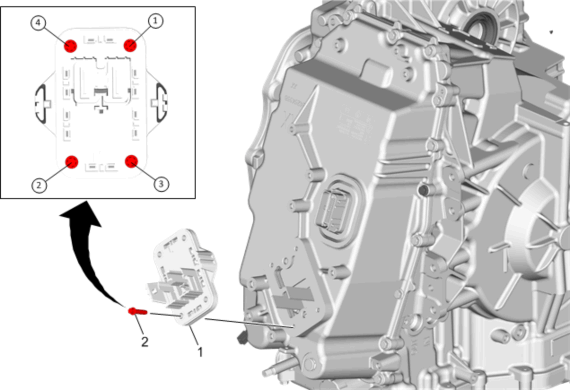
Fig. 286: Drive Motor Battery Positive And Negative Cable Connector (With Bolt Tightening Sequence)
Courtesy of GENERAL MOTORS COMPANY
Drive Motor Battery Positive and Negative Cable Connector Installation
|
Callout
|
Component Name
|
|
1
|
Drive Motor Battery Positive and Negative Cable Connector
|
|
2
|
Drive Motor Battery Positive and Negative Cable Connector Bolt (Qty: 4)
Tighten
9 N.m (80 lb in)
|
FRONT DIFFERENTIAL CARRIER FINAL ROTATIONAL TORQUE MEASUREMENT

Fig. 287: Front Differential Carrier Final Rotational Torque Measurement
Courtesy of GENERAL MOTORS COMPANY
|
Callout
|
Component Name
|
|
1
|
Front Differential Carrier Procedure
Use a dial or beam torque wrench with DT-49938 Differential Rotating Tool to measure turning torque.
The rotational torque should be below 7.45 N.m (65.94 lb in)
Special Tools
DT-49938 Differential Rotating Tool
For equivalent regional tools, refer to Special Tools.
|
HOLDING FIXTURE REMOVAL

Fig. 288: Holding Fixture Assembly
Courtesy of GENERAL MOTORS COMPANY
|
Callout
|
Component Name
|
|
1
|
Â
WARNING:
Handle with care, the transmission assembly weighs over 183 Kg (403
lbs). Bodily injury could occur if not handled properly.
Procedure
1. Install DT-46625 Holding Fixture.
2. Remove lock pin from DT-3289-20 Holding Fixture.
3. Raise the transmission with an overhead hoist in order to remove the holding DT-46625
Transmission Holding Fixture.
4. Lower the transmission assembly onto the transmission jack.
Special Tools
|
|
Callout
|
Component Name
|
|
|
 DT-03289-20
Holding Fixture Base Assembly
DT-03289-20
Holding Fixture Base Assembly
 DT-46625
Holding Fixture
DT-46625
Holding Fixture
 DT-46625-20
Holding Fixture Adapters
DT-46625-20
Holding Fixture Adapters
For equivalent regional tools, refer to Special Tools.
|
DESCRIPTION AND OPERATION
DEFINITIONS AND ABBREVIATIONS
Throttle Positions
Engine Braking
A condition where the engine is used to slow the vehicle by manually downshifting during a zero throttle coastdown.
Full Throttle Downshift
A quick apply of the accelerator pedal to its full travel, forcing a downshift.
Heavy Throttle
Approximately 3/4 of accelerator pedal travel, 75 percent throttle position.
Light Throttle
Approximately 1/4 of accelerator pedal travel, 25 percent throttle position.
Medium Throttle
Approximately 1/2 of accelerator pedal travel, 50 percent throttle position.
Minimum Throttle
The least amount of throttle opening required for an upshift.
Wide Open Throttle (WOT)
Full travel of the accelerator pedal, 100 percent throttle position.
Zero Throttle Coastdown
A full release of the accelerator pedal while the vehicle is in motion and in drive range.
Shift Condition Definitions
Bump
A sudden and forceful apply of a clutch or a band.
Chuggle
A bucking or jerking. This condition may be most noticeable when the converter clutch is engaged. It is similar to the feel of towing a trailer.
Delayed
A condition where a shift is expected but does not occur for a period of time. This could be described as a clutch or band engagement that does not occur as quickly as expected during a part throttle or wide open throttle apply of the accelerator, or during manual downshifting to a lower range. This term is also defined as LATE or EXTENDED.
Double Bump - Double Feel
Two sudden and forceful applies of a clutch or a band.
Early
A condition where the shift occurs before the car has reached proper speed. This condition tends to labor the engine after the upshift.
End Bump
A firmer feel at the end of a shift than at the start of the shift. This is also defined as END FEEL or SLIP BUMP.
Firm
A noticeably quick apply of a clutch or band that is considered normal with a medium to heavy throttle. This apply should not be confused with HARSH or ROUGH.
Flare
A quick increase in engine RPM along with a momentary loss of torque. This most generally occurs during a shift. This condition is also defined as SLIPPING.
Harsh - Rough
A more noticeable apply of a clutch or band than FIRM. This condition is considered undesirable at any throttle position.
Hunting
A repeating quick series of upshifts and downshifts that causes a noticeable change in engine RPM, such as a 4
- 3 - 4 shift pattern. This condition is also defined as BUSYNESS.
Initial Feel
A distinctly firmer feel at the start of a shift than at the finish of the shift.
Late
A shift that occurs when the engine RPM is higher than normal for a given amount of throttle.
Shudder
A repeating jerking condition similar to CHUGGLE but more severe and rapid. This condition may be most noticeable during certain ranges of vehicle speed.
Slipping
A noticeable increase in engine RPM without a vehicle speed increase. A slip usually occurs during or after initial clutch or band apply.
Soft
A slow, almost unnoticeable clutch or band apply with very little shift feel.
Surge
A repeating engine related condition of acceleration and deceleration that is less intense than CHUGGLE.
Tie-Up
A condition where two opposing clutch and/or bands are attempting to apply at the same time causing the engine to labor with a noticeable loss of engine RPM.
Noise Conditions
Drive Link Noise
A whine or growl that increases or fades with vehicle speed, and is most noticeable under a light throttle acceleration. It may also be noticeable in PARK or NEUTRAL operating ranges with the vehicle stationary.
Final Drive Noise
A hum related to vehicle speed which is most noticeable under a light throttle acceleration.
Planetary Gear Noise
A whine related to vehicle speed, which is most noticeable in FIRST gear, SECOND gear, FOURTH gear or REVERSE. The condition may become less noticeable, or go away, after an upshift.
Pump Noise
A high pitched whine that increases in intensity with engine RPM. This condition may also be noticeable in all operating ranges with the vehicle stationary or moving.
Driver Shift Control
Driver shift control (DSC) allows the driver to change gears similar to a manual transmission. Refer to the vehicle owner's manual for specific DSC operating instructions.
Transmission Abbreviations
A/C
Air Conditioning
AC
Alternating Current
AT
Automatic Transmission
CCDIC
Climate Control Driver Information Center
DC
Direct Current
DIC
Driver Information Center
DLC
Data Link Connector
DMM
Digital Multimeter
DSC
Driver Shift Control
DTC
Diagnostic Trouble Code
EBTCM
Electronic Brake/Traction Control Module
ECCC
Electronically-Controlled Capacity Clutch
ECT
Engine Coolant Temperature
EMI
Electromagnetic Interference
IAT
Intake Air Temperature
IGN
Ignition
IMS
Internal Mode Switch
MAP
Manifold Absolute Pressure
MIL
Malfunction Indicator Lamp
NC
Normally Closed
NO
Normally Open
OBD
On Board Diagnostic
OSS
Output Speed Sensor
PC
Pressure Control
PCM
Powertrain Control Module
PCS
Pressure Control Solenoid
PS
Pressure Switch
PWM
Pulse Width Modulation
RPM
Revolutions Per Minute
SS
Shift Solenoid
TAP
Transmission Adaptive Pressure
TFP
Transmission Fluid Pressure
TFT
Transmission Fluid Temperature
TP
Throttle Position
VSS
Vehicle Speed Sensor
WOT
Wide Open Throttle
TRANSMISSION IDENTIFICATION INFORMATION

Fig. 289: Transmission Identification Information Plate
Courtesy of GENERAL MOTORS COMPANY
|
Callout
|
Component Name
|
|
1
|
Line ID
|
|
2
|
Shift ID
|
|
3
|
Build Year
|
|
4
|
Julian Date
|
|
5
|
Broadcast Code
|
|
6
|
Reserved Use
|
|
7
|
Sequence Number
|
|
8
|
Machine Readable Matrix
|
|
9
|
Broadcast Code
|
|
10
|
GM Part Number
|
|
11
|
Transmission Unique Number (TUN)
|
TRANSMISSION GENERAL DESCRIPTION
The 5ET50 is a fully automatic, front wheel drive transaxle containing an electronically-controlled continuously-
variable electric transmission. It includes an input flange, a torque dampener assembly with a rotating friction clutch, a stationary mechanical (one way) clutch, one stationary and one rotating friction clutch assemblies, a hydraulic pressurization and control system, a power inverter (and control) module, an electric fluid pump, two planetary gear sets, and two electric drive motor-generators. Drive motor-generator A (1) is 48 kW and drive motor-generator B (2) is 87 kW.
The torque damper is internal to the transmission, bolted to the input flange, and contains coil springs and a damper bypass clutch. The torque damper acts as a spring coupling to smoothly transmit shaft power from the engine to the input planetary gear set in the transmission and as a direct mechanical coupling from the transmission to the engine using the damper bypass clutch during engine starting and engine stopping.
The power inverter module is under the angled top cover and includes a control circuit board, solid-state switches, capacitors, and other electronic components. The power inverter module receives and monitors driver commands and various other electronic sensor inputs and uses this information to vary the torque and speed of each electric motor- generator and to command the engine controller and engine operation. The power inverter module is connected with each of the two drive motor-generators through three internal terminal posts for transmitting variable-frequency,
high-voltage, three-phase alternating-current (AC) electricity. The power inverter module is also electrically connected with the battery pack through a high-voltage, high-power connector and cable assembly for transmitting direct-current (DC) electricity.
The hydraulic system includes a high pressure electric fluid pump driven by an electric motor supplied with high- voltage current from the power inverter module, shift solenoid valves, a variable line pressure control solenoid valve, and control wiring harness. All of the shift solenoids and the transmission fluid temperature sensor are packaged into a self-contained control solenoid valve assembly under the front cover. The electric pump maintains working pressure and control of the clutches when the engine is on and when the engine is off.
The two planetary gear sets, electric motor-generators, and other clutches together provide all-electric propulsion, continuously-variable hybrid transmission ratios, and a single fixed mechanical transmission ratio. When the vehicle is operating all-electrically, the stationary mechanical clutch reacts torque from motor-generator A to the output in the forward direction and the stationary friction clutch assembly can react torque from motor-generator B to the output. When the engine is in use, the stationary and rotating friction clutch assemblies are controlled by the power inverter module using hydraulic shift solenoids to select from a variable lower range of hybrid transmission ratios, a fixed mechanical transmission ratio, and a variable higher range of hybrid transmission ratios.
The transmission may be operated in any of the following gear ranges:
P (PARK)
This position locks the wheels and prevents the vehicle from rolling either forward or backward. PARK is the best position to use when starting the vehicle. Because the transmission utilizes a shift lock control system, it is necessary to fully depress the brake pedal before shifting out of PARK. For safety reasons, use the parking brake in addition to the PARK position.
R (REVERSE)
This position allows the vehicle to be operated in a rearward direction. There is no separate reverse clutch or gearing in the transmission. All of the torque for reverse comes from motor-generator B.
N (NEUTRAL)
In this position, the propulsion system does not provide power to the wheels.
D (DRIVE)
Drive range should be used for all normal driving conditions for maximum efficiency and fuel economy. Drive position allows the transmission to operate all-electrically using one or both motor-generators when sufficient battery power and energy are available or using the engine when the battery is not sufficient.
L (Low)
This position is used for the "feel" of engine braking and can be used for the slowing of the vehicle once the throttle is lifted. While in the position the vehicle will slow quicker and use the drive motor generator B to more aggressively collect energy during a regenerative braking event.
TRANSMISSION COMPONENT AND SYSTEM DESCRIPTION
The mechanical components of the hybrid 5ET50 Transmission are as follows:
 Input Brake Clutch (MKV Only)
 Input Drive Flange
 Input Sun Gear Shaft
 Input Carrier
 Input Internal Gear
 Drive Motor (1) and (2)
 Driven and Drive Sprocket with Drive Link Assembly
 Output Carrier Internal Gear
 Variable Low Clutch Assembly
 Variable High Clutch Assembly
 Control Valve Body Assembly
 Automatic Transmission Torque Dampener
 Front Differential Carrier
The electrical components of the 5ET50 are as follows:
 Drive Motor (1)
 Drive Motor (2)
 Fluid Pump Motor
 Output Speed Sensor
 Manual Shift Detent Lever
 Drive Motor Generator Power Inverter Module
 Drive Motor Power Inverter Module Connector
For more information, refer to Electronic Component Description. HYBRID TRANSMISSION MODES OF OPERATION
Single Motor Electric Vehicle (EV)
Single motor EV operation is used when lower torque is required. This includes reverse gear. The Internal Combustion Engine (ICE) and drive motor A (1) are OFF. The high range clutch is open and the low range
clutch is closed. Drive motor B (2) provides torque through the planetary gear set to the wheels.
Dual Motor Electric Vehicle (EV)
Dual motor EV operation is used when high torque is required at any vehicle speed. The Internal Combustion Engine (ICE) is OFF. Drive motor A (1) and drive motor B (2) are ON. The high range clutch (C2) is open and the low range clutch (C1) is closed. Drive motors A (1) and B (2) both provide torque through the planetary gear sets to the wheels.
Extended Range Low
Extended range low is used when the rechargeable energy storage system (RESS) requires charging at lower vehicle speeds. The Internal Combustion Engine (ICE) is ON. Drive motor A (1) and drive motor B (2) are ON. The low range clutch (C1) is closed, and the high range clutch (C2) is open. Drive motor A (1) is generating to charge the RESS. Drive motor B (2) provides torque through the planetary gear set to the wheels.
Extended Range Fixed Ratio
Extended range fixed ratio is used when the rechargeable energy storage system (RESS) requires charging at mid-range vehicle speeds. The Internal Combustion Engine (ICE) is ON. The ICE provides power through the planetary gear set to the wheels. Drive motor A (1) and drive motor B (2) are ON. The low range clutch (C1) is closed, and the high range clutch (C2) is closed. Drive motor B (2) can perform regeneration to charge the RESS in low torque demands or provide torque through the planetary gear set to the wheels in high torque demands.
Extended Range High
Extended range high is used when the rechargeable energy storage system (RESS) requires charging at higher vehicle speeds. The Internal Combustion Engine (ICE) is ON. The ICE provides power through the planetary gear set to the wheels. Drive motor A (1) and drive motor B (2) are ON. The low range clutch (C1) is open and the high range clutch (C2) is closed. Both drive motor A (1) and drive motor B (2) can either operate in regeneration mode to charge the RESS or provide power to the wheels.
TRANSMISSION INDICATORS AND MESSAGES
No transmission-related indicators or messages are displayed on the instrument panel cluster (IPC). For a complete listing and description of all vehicle indicators and messages, refer to Indicator/Warning Message Description and Operation.
ELECTRONIC COMPONENT DESCRIPTION
Electronic Components
The 5ET50 transmission contains the electronic components listed below:
 Automatic Transmission Fluid Pump
 Control Solenoid Valve
 Drive Motor Assembly - 1st Position
 Drive Motor Assembly - 2nd Position
 Manual Shift Detent Lever A/Trans Output Speed Sensor Assembly
This transmission is a fully automatic front wheel drive transaxle, and is an electronically-controlled continuously-
variable electric transmission. High voltage three phase circuits connect the 2 motor/generators and the electric automatic transmission fluid pump drive motor assembly, to the drive motor control modules. The high voltage electric automatic transmission fluid pump provides transmission fluid pressure.
Drive Motor Assembly (1st Position)

Fig. 290: Drive Motor Assembly (1st Position)
Courtesy of GENERAL MOTORS COMPANY
|
Callout
|
Component Name
|
|
500
|
Drive Motor Support
|
|
501
|
Drive Motor Position Sensor Stator
|
|
502
|
Drive Motor Position Sensor Bolt
|
|
503
|
Drive Motor Position Sensor Connector Clip
|
|
504
|
Drive Motor Power Inverter Module 3-Phase Cable Bolt
|
|
505
|
Drive Motor Power Inverter Module Cable Bolt Install Guide Retainer
|
|
506
|
Drive Motor Power Inverter Module Cable Bolt Install Guide Bushing
|
|
507
|
Drive Motor Power Inverter Module Cable Guide
|
|
508
|
Drive Motor Stator - (1st Position)
|
|
509
|
Drive Motor Stator Bolt
|
|
510
|
Drive Motor Rotor - (1st Position)
|
|
Callout
|
Component Name
|
|
511
|
Drive Motor Rotor Bearing Retaining Ring
|
The drive motor generator power inverter module controls the three permanent magnet 3-phase electric motors that are internal to the transmission, and perform the following functions:
 Torque for vehicle propulsion
 Engine cranking
 Battery charging
 Regenerative Braking
 Transmission fluid pressure
Drive Motor Assembly (2nd Position)

Fig. 291: Drive Motor Assembly (2nd Position)
Courtesy of GENERAL MOTORS COMPANY
|
Callout
|
Component Name
|
|
520
|
Drive Motor Support
|
|
521
|
Drive Motor Position Sensor Stator
|
|
522
|
Drive Motor Position Sensor Bolt
|
|
Callout
|
Component Name
|
|
523
|
Drive Motor Position Sensor Connector Clip
|
|
524
|
Drive Motor Power Inverter Module 3-Phase Cable Bolt
|
|
525
|
Drive Motor Power Inverter Module Cable Bolt Install Guide Retainer
|
|
526
|
Drive Motor Power Inverter Module Cable Bolt Install Guide Bushing
|
|
527
|
Drive Motor Power Inverter Module Cable Guide
|
|
528
|
Drive Motor Stator - (2nd Position)
|
|
529
|
Drive Motor Stator Bolt
|
|
530
|
Drive Motor Rotor - (2nd Position)
|
|
531
|
Drive Motor Rotor Bearing Retaining Ring
|
|
532
|
Output Sun Gear
|
|
533
|
Output Sun Gear Retaining Ring
|
The Drive Motor/Generator Description
Drive Motor Assembly (1st position) is a generator referred to as Drive Motor 1 on the scan tool and consists of a permanent magnet rotor with a distributed bar wound, NdFeB magnet stator capable of producing 55 kW of peak electrical energy and 138 N.m (102 lb ft).
Drive Motor Assembly (2nd position) is a traction motor referred to as Drive Motor 2 on the scan tool and consists of a permanent magnet rotor with a distributed bar wound, NdFeB magnet stator capable of producing 76 kW of peak electrical energy and 178 N.m (131 lb ft).
Both are actively cooled via transmission fluid. Drive Motor Assembly (1st position) is used to start the engine and maintain charge to the hybrid battery. Drive Motor Assembly (2nd position) propels the vehicle. Motor speeds are controlled and monitored by resolver-type position sensors. The drive motor position sensors are monitored by the motor control modules. The motor control modules monitor the angular position, speed and direction of the drive motor generator based upon the signals of these position sensors. The position sensor, or resolver, contains a drive coil, 2 driven coils and an irregular shaped metallic rotor. The metallic rotor is mechanically attached to the shaft of the drive motor generator. At ignition ON, the motor control module outputs a low AC voltage, 10 kHz excitation signal to the drive coil. The drive coil excitation signal creates a magnetic field surrounding the 2 driven coils and the irregular shaped rotor. The motor control module then monitors the 2 driven coil circuits for a return signal. The position of the irregular shaped metallic rotor causes the magnetically-induced return signals of the driven coils to vary in size and shape. A comparison of the 2 driven coils signals allows the motor control module to determine the exact angle, speed and direction of the drive motor generator. For more information on the drive motor function and system interaction refer to Drive Motor Power Inverter Module Description and Operation
.
Automatic Transmission Fluid Pump

Fig. 292: Electric Auxiliary Pump Drive Motor Assembly Components
Courtesy of GENERAL MOTORS COMPANY
The electric automatic transmission fluid pump assembly is driven by high voltage AC which is controlled by the drive motor/generator power inverter module assembly. The purpose of the auxiliary fluid pump motor is to supply oil pressure to the transmission for lube, cooling and clutch application during vehicle propulsion. The automatic transmission fluid pump motor is commanded on when the propulsion system is active.
Control Solenoid Valve
The control solenoid valve assembly contains the following components:
Control Solenoid Valve Assembly

Fig. 293: Control Solenoid Valve Assembly
Courtesy of GENERAL MOTORS COMPANY
|
Callout
|
Component Name
|
|
1
|
Transmission Fluid Temperature Sensor
|
|
2
|
Pressure Control Solenoid Valve 2
|
|
3
|
Pressure Control Solenoid Valve 5
|
|
4
|
Electrical Connector - 8 Pins
|
|
5
|
Pressure Control Solenoid Valve 3
|
|
6
|
Pressure Control Solenoid Valve 4
|
These components are not serviced separately. The control solenoid valve bolts directly to the valve body within the transmission. The control solenoid assembly X1 connector connects to the Automatic Transmission Wiring Harness - Control Solenoid Valve.
Line Pressure Control Solenoid Valve
The line pressure solenoid control valve is located in the H bore of the control valve body assembly. The A - H bores are stamped on the control valve body assembly in order to aid in the locating the control valve body components.
The line pressure control solenoid valve is a variable force solenoid valve, this type of solenoid can increase or decrease the amount of pressurized fluid based on the amount of current applied to solenoid valve coil. The line pressure solenoid control valve is used to control transmission fluid pressure for clutch pressure, lube, and drive motor cooling.
Solenoid Characterization
The line pressure solenoid control valve is tested after assembly to determine the output fluid pressure at certain electrical current values, applied to coil windings. This information is referred to as solenoid current/pressure data points. The solenoid valves are tested two ways, with an increasing and decreasing electrical current applied to the
coil windings. The resultant current versus pressure data points are saved and assigned a file number. The file number is marked on the solenoid valve housing end. The performance data file is stored on the TIS web site. This data file is programmed and stored in the vehicle's hybrid/EV powertrain control module 1. Replacing any of the following components will require the hybrid/EV powertrain control module 1 to be programmed with the new or existing solenoid valve performance data.
 Hybrid/EV powertrain control module 1 - program the new hybrid/EV powertrain control module 1 with the existing solenoid data files stored on the TIS web site for the line pressure solenoid control valve.
 Line pressure solenoid control valve - program the hybrid/EV powertrain control module 1 with the new solenoid data file stored on the TIS web site for the line pressure solenoid control valve.
 Control valve body assembly - program the hybrid/EV powertrain control module 1 with the existing solenoid data files stored on the TIS web site for the line pressure solenoid control valve.
 Line pressure solenoid control valve and control valve body as a complete assembly - program the hybrid/EV powertrain control module 1 with the new solenoid data file stored on the TIS web site for the line pressure solenoid control valve.
 Transmission Assembly - A new transmission assembly will have the solenoid characterization data programmed into the hybrid/EV powertrain control module 1.

Fig. 294: Line Pressure Control Solenoid Valve
Courtesy of GENERAL MOTORS COMPANY
|
Callout
|
Bore
|
Description
|
|
1
|
H Bore
|
Line Pressure Control Solenoid Valve
|
Manual Shift Detent Lever

Fig. 295: Internal Mode Switch (IMS)
Courtesy of GENERAL MOTORS COMPANY
The 5 electronic switches are called the transmission range switches and are used to indicate the gear position the vehicle operator has selected. The 5 outputs (A, B, C, P, S) are range selection inputs to the hybrid/EV powertrain control module 1, through the Automatic Transmission Wiring Harness - Shift Shaft Position Switch. The manual shift detent lever assembly is mounted on the interior front of the transmission case above the control valve body assembly. The internal mode switch indicates to the hybrid/EV powertrain control module 1 which gear position the vehicle operator has selected. The Internal Mode Switch consists of 5 separate hall effect switches. Each hall effect switch is supplied a 9 V reference circuit, and a signal circuit from the hybrid/EV powertrain control module 1. Each signal circuit for each gear selector position will have either a voltage reading of 0.70 - 0.96 V indicting ON or 1.68 -
2.38 V indicating OFF. The voltage values on each Internal Mode Switch circuit will change and are dependent on the position of the gear selector. The state of each Internal Mode Switch A/B/C/P/S circuit is displayed on the scan tool.
Output Speed Sensor (OSS)

Fig. 296: Output Speed Sensor (OSS) Assembly
Courtesy of GENERAL MOTORS COMPANY
The output speed sensor assembly has 2 internal hall-effect type sensors, and is capable of sensing both speed and direction. The output speed sensor mounts to the A/Trans case assembly and is connected to the hybrid/EV powertrain control module 1 through Automatic Transmission Wiring Harness - Control Solenoid Valve. The sensor faces the front differential drive pinion (w/transfer gear) gear assembly machined teeth surface. The sensor receives
8.3 - 9.3 volts on the OSS supply voltage circuit from the hybrid/EV powertrain control module 1. As the output shaft rotates, the sensor produces a signal frequency based on the machined surface of the output shaft.
The two sensor elements in the output speed sensor assembly are spaced approximately 1/2 a tooth apart.
 When the vehicle is moving in a forward direction, sensor A detects a particular tooth before sensor B.
 When the vehicle is moving in a reverse direction, sensor B detects a particular tooth before sensor A.
The electronics in the sensor combine the two signals and send a signal with a different pulse width. This signal is interpreted by the hybrid/EV powertrain control module 1 for speed and direction and is transmitted through the serial data circuits to the ECM. The ECM and hybrid/EV powertrain control module 1, compare the output speed sensor signal with the anti-lock brake system wheel speed sensor signal. The hybrid/EV powertrain control module 1 also compares the output shaft direction with the drive motor 1 and drive motor 2 direction.
PARK ENGINE OFF
When the gear selector lever is in the Park (P) position and the internal combustion engine is OFF, the fluid pump is commanded ON and line pressure is directed to the pressure regulator valve and other various components. The following steady-state conditions exist in the transmission's hydraulic and electrical systems.
Fluid Pressure Directed In Preparation For A Shift
Line Fluid Circuit
Line fluid from the automatic transmission fluid pump supplies constant fluid flow to various components such as the line pressure regulating valve, line pressure control solenoid, variable high clutch dam feed regulator valve, shift solenoid 2, shift solenoid 3, shift solenoid 4, shift solenoid 5, variable low clutch valve, variable high clutch valve and dampener bypass clutch valve. Line pressure is controlled by the HPCM by varying electrical current supplied to the line pressure control solenoid dependent on transmission operating conditions.
Variable Low Clutch Applies
Shift Solenoid 3
The shift solenoid 3 is energized ON, allowing line fluid to enter the solenoid 3 signal circuit. Solenoid 3 signal fluid is then routed to the variable low clutch valve.
Variable Low Clutch Valve
Solenoid 3 signal fluid, at the variable low clutch valve, opposes variable low clutch valve spring force to supply line fluid pressure into the variable low clutch fluid circuit.
Variable Low Clutch Assembly
Line fluid is routed through orifice #8 through the variable low clutch valve and into the variable low clutch circuit. Variable low clutch fluid passes through the variable low clutch housing and moves the variable low clutch piston against spring force to apply the variable low clutch.
Variable Low Clutch Accumulator Piston
Variable low clutch fluid is also sent to the variable low clutch accumulator piston. Variable low clutch fluid moves the variable low clutch accumulator piston against accumulator spring force to cushion apply of the variable low clutch assembly.
Torque Dampener Clutch Applies
Shift Solenoid 5
The shift solenoid 5 is energized ON, allowing line fluid to enter the solenoid 5 signal circuit. Solenoid 5 signal fluid is then routed to the dampener bypass clutch valve.
Dampener Bypass Clutch Valve
Solenoid 5 signal fluid, at the dampener bypass clutch valve, opposes dampener bypass clutch valve spring force to supply line pressure into the dampener bypass clutch circuit.
Torque Damper Assembly
Line fluid is routed through orifice #12 through the damper bypass clutch valve and into the damper bypass clutch circuit. Damper bypass clutch fluid passes through the automatic transmission case and automatic transmission torque damper and differential housing and moves the torque damper bypass clutch piston against spring force to apply the automatic transmission torque damper in preparation for an engine start.
Lube boost is available
Shift Solenoid 4
Shift solenoid 4 (Lube Boost) is commanded ON based on torque and temperature inputs to the HPCM. The shift solenoid 4 is energized ON, allowing line fluid to enter the solenoid 4 signal circuit. Solenoid 4 signal fluid is then routed through orifice #4 to the lube regulator valve elevating lube and motor cooling pressure and flow.
Park Engine Off

Fig. 297: Park Engine Off - Hydraulic Flow Diagram
Courtesy of GENERAL MOTORS COMPANY
PARK ENGINE ON
If the HPCM determines that operating conditions (low state of battery charge, low temperature) are appropriate for the internal combustion engine (ICE) to be ON in Park, the fluid pump is commanded ON and line pressure is directed to the pressure regulator valve and other various components. The following steady-state conditions exist in the transmission's hydraulic electrical systems. Note that the torque damper assembly is commanded ON only during the start sequence and is OFF once the ICE is ON.
Fluid Pressure Directed in Preparation for a Shift
Line Fluid Circuit
Line fluid from the automatic transmission fluid pump supplies constant fluid flow to various components such as the line pressure regulating valve, line pressure control solenoid, variable high clutch dam feed regulator valve, shift solenoid 2, shift solenoid 3, shift solenoid 4, shift solenoid 5, variable low clutch valve, variable high clutch valve and dampener bypass clutch valve. Line pressure is controlled by the HPCM by varying electrical current supplied to the line pressure control solenoid dependent on transmission operating conditions.
Variable Low Clutch Applies
Shift Solenoid 3
The shift solenoid 3 is energized ON, allowing line fluid to enter the Solenoid 3 signal circuit. Solenoid 3 signal fluid is then routed to the variable low clutch valve.
Variable Low Clutch Valve
Solenoid 3 signal fluid, at the variable low clutch valve, opposes variable low clutch valve spring force to supply line fluid pressure into the variable low clutch fluid circuit.
Variable Low Clutch Assembly
Line fluid is routed through orifice #8 through the variable low clutch valve and into the variable low clutch circuit. Variable low clutch fluid passes through the variable low clutch housing and moves the variable low clutch piston against spring force to apply the variable low clutch.
Variable Low Clutch Accumulator Piston
Variable low clutch fluid is also sent to the variable low clutch accumulator piston. Variable low clutch fluid moves the variable low clutch accumulator piston against accumulator spring force to cushion apply of the variable low clutch assembly.
Lube Boost Is Available
Shift Solenoid 4
Shift solenoid 4 (Lube Boost) is commanded ON based on torque and temperature inputs to the HPCM. The shift solenoid 4 is energized ON, allowing line fluid to enter the Solenoid 4 signal circuit. Solenoid 4 signal fluid is then routed through orifice #4 to the lube regulator valve elevating lube and motor cooling pressure and flow.
Park Engine ON

Fig. 298: Park Engine ON - Hydraulic Flow Diagram
Courtesy of GENERAL MOTORS COMPANY
NEUTRAL ENGINE OFF
When the gear selector lever is in the Neutral (N) position and the internal combustion engine is OFF, the fluid pump is commanded ON and line pressure is directed to the pressure regulator valve and other various components. If Neutral is selected after the vehicle was operating in Reverse EV Mode or Drive Single Motor EV Mode, the variable low clutch releases and the torque damper clutch stays applied.
Fluid Pressure Directed In Preparation For A Shift
Line Fluid Circuit
Line fluid from the automatic transmission fluid pump supplies constant fluid flow to various components such as the line pressure regulating valve, line pressure control solenoid, variable high clutch dam feed regulator valve, shift solenoid 2, shift solenoid 3, shift solenoid 4, shift solenoid 5, variable low clutch valve, variable high clutch valve and dampener bypass clutch valve. Line pressure is controlled by the HPCM by varying electrical current supplied to the line pressure control solenoid dependent on transmission operating conditions.
Variable Low Clutch Releases
Shift Solenoid 3
The shift solenoid 3 is commanded OFF, allowing Solenoid 3 signal fluid to exhaust from the variable low clutch valve.
Variable Low Clutch Valve
Variable low clutch valve spring force moves the variable low clutch valve to the released position, allowing variable low clutch accumulator fluid and variable low clutch pressure to exhaust.
Variable Low Clutch Accumulator Piston
Variable low clutch fluid pressure is exhausted from the variable low clutch accumulator piston. Accumulator spring force moves the variable low clutch piston accumulator to the released position.
Variable Low Clutch Assembly
Variable low clutch fluid pressure is exhausted from the clutch assembly, allowing variable low clutch spring force to move the variable low clutch to the OFF position.
Torque Dampener Clutch Applies
Shift Solenoid 5
The shift solenoid 5 is energized ON, allowing line fluid to enter the solenoid 5 signal circuit. Solenoid 5 signal fluid is then routed to the dampener bypass clutch valve.
Dampener Bypass Clutch Valve
Solenoid 5 signal fluid, at the damper bypass clutch valve, opposes damper bypass clutch valve spring force to supply line fluid pressure into the damper bypass clutch fluid circuit.
Torque Damper Assembly
Line fluid is routed through orifice #12 through the damper bypass clutch valve and into the damper bypass clutch circuit. Damper bypass clutch fluid passes through the automatic transmission case and automatic transmission torque damper and differential housing and moves the torque damper bypass clutch piston against spring force to
apply the automatic transmission torque damper in preparation for an engine start.
Lube Boost Is Available
Shift Solenoid 4
Shift solenoid 4 (Lube Boost) is commanded ON based on torque and temperature inputs to the HPCM. The shift solenoid 4 is energized ON, allowing line fluid to enter the solenoid 4 signal circuit. Solenoid 4 signal fluid is then routed through orifice #4 to the lube regulator valve elevating lube and motor cooling pressure and flow.
Neutral Engine Off

Fig. 299: Neutral Engine Off - Hydraulic Flow Diagram
Courtesy of GENERAL MOTORS COMPANY
REVERSE EV MODE ENGINE OFF
When the gear selector lever is moved to the Reverse (R) position (from the Park position), and the internal combustion engine (ICE) is OFF, the following steady-state conditions exist in the transmission's hydraulic and electrical systems.
Fluid Pressure Directed In Preparation For A Shift
Line Fluid Circuit
Line fluid from the automatic transmission fluid pump supplies constant fluid flow to various components such as the line pressure regulating valve, line pressure control solenoid, variable high clutch dam feed regulator valve, shift solenoid 2, shift solenoid 3, shift solenoid 4, shift solenoid 5, variable low clutch valve, variable high clutch valve and dampener bypass clutch valve. Line pressure is controlled by the HPCM by varying electrical current supplied to the line pressure control solenoid dependent on transmission operating conditions.
Variable Low Clutch Applied
Shift Solenoid 3
The shift solenoid 3 is energized ON, allowing line fluid to enter the Solenoid 3 signal circuit. Solenoid 3 signal fluid is then routed to the variable low clutch valve.
Variable Low Clutch Valve
Solenoid 3 signal fluid, at the variable low clutch valve, opposes variable low clutch valve spring force to supply line fluid pressure into the variable low clutch fluid circuit.
Variable Low Clutch Assembly
Line fluid is routed through orifice #8 through the variable low clutch valve and into the variable low clutch circuit. Variable low clutch fluid passes through the variable low clutch housing and moves the variable low clutch piston against spring force to apply the variable low clutch.
Variable Low Clutch Accumulator Piston
Variable low clutch fluid is also sent to the variable low clutch accumulator piston. Variable low clutch fluid moves the variable low clutch accumulator piston against accumulator spring force to cushion apply of the variable low clutch assembly.
Torque Dampener Clutch Applied
Shift Solenoid 5
The shift solenoid 5 is energized ON, allowing line fluid to enter the Solenoid 5 signal circuit. Solenoid 5 signal fluid is then routed to the dampener bypass clutch valve.
Dampener Bypass Clutch Valve
Solenoid 5 signal fluid, at the dampener bypass clutch valve, opposes dampener bypass clutch valve spring force to supply line fluid pressure into the dampener bypass clutch fluid circuit.
Torque Damper Assembly
Line fluid is routed through orifice #12 through the damper bypass clutch valve and into the damper bypass clutch circuit. Damper bypass clutch fluid passes through the automatic transmission case and automatic transmission torque damper and differential housing and moves the torque damper bypass clutch piston against spring force to apply the automatic transmission torque damper in preparation for an engine start.
Lube Boost Is Available
Shift Solenoid 4
Shift solenoid 4 (Lube Boost) is commanded ON based on torque and temperature inputs to the HPCM. When required, shift solenoid 4 is energized ON, allowing line fluid to enter the solenoid 4 signal circuit. Solenoid 4 signal fluid is then routed through orifice #4 to the lube regulator valve elevating lube and motor cooling pressure and flow.
Reverse EV Mode Engine Off

Fig. 300: Reverse EV Mode Engine Off - Hydraulic Flow Diagram
Courtesy of GENERAL MOTORS COMPANY
DRIVE SINGLE OR DUAL MOTOR EV ENGINE OFF
When the gear selector lever is in the Drive (D) position and the internal combustion engine (ICE) is OFF, the fluid pump is commanded ON and line pressure is directed to the pressure regulator valve and other various components. The following steady-state conditions exist in the transmission's hydraulic and electrical systems. If Drive (D) was selected after the vehicle was operating in Reverse EV Mode or Park (Engine off), the variable low clutch and the torque damper clutch stay applied.
Fluid Pressure Directed In Preparation For A Shift
Line Fluid Circuit
Line fluid from the automatic transmission fluid pump supplies constant fluid flow to various components such as the line pressure regulating valve, line pressure control solenoid, variable high clutch dam feed regulator valve, shift solenoid 2, shift solenoid 3, shift solenoid 4, shift solenoid 5, variable low clutch valve, variable high clutch valve and dampener bypass clutch valve. Line pressure is controlled by the HPCM by varying electrical current supplied to the line pressure control solenoid dependent on transmission operating conditions.
Variable Low Clutch Applied
Shift Solenoid 3
The shift solenoid 3 is energized ON, allowing line fluid to enter the solenoid 3 signal circuit. Solenoid 3 signal fluid is then routed to the variable low clutch valve.
Variable Low Clutch Valve
Solenoid 3 signal fluid, at the variable low clutch valve, opposes variable low clutch valve spring force to supply line fluid pressure into the variable low clutch fluid circuit.
Variable Low Clutch Accumulator Piston
Variable low clutch fluid is also sent to the variable low clutch accumulator piston. Variable low clutch fluid moves the variable low clutch accumulator piston against accumulator spring force to cushion apply of the variable low clutch assembly.
Variable Low Clutch Assembly
Line fluid is routed through orifice #8 through the variable low clutch valve and into the variable low clutch circuit. Variable low clutch fluid passes through the variable low clutch housing and moves the variable low clutch piston against spring force to apply the variable low clutch.
Torque Dampener Clutch Applied
Shift Solenoid 5
The shift solenoid 5 is energized ON, allowing line fluid to enter the solenoid 5 signal circuit. Solenoid 5 signal fluid is then routed to the dampener bypass clutch valve.
Dampener Bypass Clutch Valve
Solenoid 5 signal fluid, at the damper bypass clutch valve, opposes damper bypass clutch valve spring force to supply line fluid pressure into the damper bypass clutch fluid circuit.
Torque Damper Assembly
Line fluid is routed through orifice #12 through the damper bypass clutch valve and into the damper bypass clutch circuit. Damper bypass clutch fluid passes through the automatic transmission case and automatic transmission torque damper and differential housing and moves the torque damper bypass clutch piston against spring force to apply the automatic transmission torque damper in preparation for an engine start.
Lube Boost Is Available
Shift Solenoid 4
Shift solenoid 4 (Lube Boost) is commanded ON based on torque and temperature inputs to the HPCM. When required, shift solenoid 4 is energized ON, allowing line fluid to enter the solenoid 4 signal circuit. Solenoid 4 signal fluid is then routed through orifice #4 to the lube regulator valve elevating lube and motor cooling pressure and flow.
Drive Single or Dual Motor EV Engine Off

Fig. 301: Drive Single Or Dual Motor EV Engine Off - Hydraulic Flow Diagram
Courtesy of GENERAL MOTORS COMPANY
DRIVE EXTENDED RANGE LOW ENGINE ON
When the gear selector lever is in the Drive (D) position and the HPCM determines that operating conditions are appropriate, the internal combustion engine (ICE) is started, the main fluid pump provides hydraulic fluid pressure. If Drive (D) is selected after the vehicle was operating in Reverse EV Mode or Park (Engine off), the variable low clutch stays applied. After Engine Start, the following changes would occur to the transmission's hydraulic and electrical systems in order to start the vehicle moving from a stopped position.
Torque Dampener Clutch Releases
Shift Solenoid 5
The shift solenoid 5 is commanded OFF, allowing Solenoid 5 signal fluid to exhaust from the dampener bypass clutch valve.
Dampener Bypass Clutch Valve
Dampener bypass clutch valve spring force moves the dampener bypass clutch valve to the released position, allowing dampener bypass clutch fluid pressure to exhaust.
Torque Dampener Assembly
Dampener bypass clutch fluid exhausts from the torque dampener clutch assembly through the dampener bypass clutch valve allowing the torque dampener clutch to release.
Drive Extended Range Low Engine On

Fig. 302: Drive Extended Range Low Engine On - Hydraulic Flow Diagram
Courtesy of GENERAL MOTORS COMPANY
DRIVE EXTENDED RANGE HIGH ENGINE ON
When the gear selector lever is in the Drive (D) position and the HPCM determines that operating conditions are appropriate, the internal combustion engine (ICE) is started, the main fluid pump provides hydraulic fluid pressure. If the transmission is operating in extended range fixed gear ratio and the HPCM determines that operating conditions are appropriate for a shift to extended range high, the following changes would occur to the transmission's hydraulic and electrical systems.
Variable Low Clutch Releases
Shift Solenoid 3
The shift solenoid 3 is commanded OFF, allowing Solenoid 3 signal fluid to exhaust from the variable low clutch valve.
Variable Low Clutch Valve
Variable low clutch valve spring force moves the variable low clutch valve to the released position, allowing variable low clutch accumulator fluid pressure to exhaust.
Variable Low Clutch Accumulator Piston
Variable low clutch fluid pressure is exhausted from the variable low clutch accumulator piston. Accumulator spring force moves the variable low clutch piston accumulator to the released position.
Variable Low Clutch Assembly
Variable low clutch fluid pressure is exhausted from the clutch assembly, allowing variable low clutch spring force to move the variable low clutch to the OFF position.
Drive Extended Range High Engine On

Fig. 303: Drive Extended Range High Engine On - Hydraulic Flow Diagram
Courtesy of GENERAL MOTORS COMPANY
DRIVE EXTENDED RANGE FIXED RATIO ENGINE ON
When the gear selector lever is in the Drive (D) position and the HPCM determines that operating conditions are appropriate, the internal combustion engine (ICE) is started, the main fluid pump provides hydraulic fluid pressure. If the transmission is operating in extended range low (mode 1) and the HPCM determines that operating conditions are appropriate for a shift to extended range fixed ratio, the following changes would occur to the transmission's hydraulic and electrical systems.
Variable High Clutch Applies
Shift Solenoid 2
The shift solenoid 2 is energized ON, allowing line fluid to enter the Solenoid 2 signal circuit. Solenoid 2 signal fluid is then routed to the variable high clutch valve.
Variable High Clutch Valve
Solenoid 2 signal fluid, at the variable high clutch valve, opposes variable high clutch valve spring force to supply line fluid pressure into the variable high clutch fluid circuit. This also allows compensator feed fluid to exhaust through the variable high clutch valve exhausting the variable high clutch dam.
Variable High Clutch Assembly
Line fluid is routed through orifice #9 through the variable high clutch valve and into the variable high clutch fluid circuit. Variable high clutch fluid passes through the transmission case and variable high clutch housing and moves the variable high clutch piston against spring force to apply the variable high clutch.
Drive Extended Range Fixed Ratio Engine On

Fig. 304: Drive Extended Range Fixed Ratio Engine On - Hydraulic Flow Diagram
Courtesy of GENERAL MOTORS COMPANY
SPECIAL TOOLS AND EQUIPMENT
SPECIAL TOOLS
|
Illustration
|
Tool Number/Description
|
|
Illustration
|
Tool Number/Description
|
|

|
CH-51999
Volt Cradle Bushing Remover/Installer
|
|
Illustration
|
Tool Number/Description
|
|

|
DT-8092 GE-8092
Drive Handle
|
|
Illustration
|
Tool Number/Description
|
|

|
DT-03289-20
Holding Fixture Base Assembly
|
|
Illustration
|
Tool Number/Description
|
|

|
DT-23129
Universal Seal Remover
|
|
Illustration
|
Tool Number/Description
|
|

|
DT-45201
Seal Remover
|
|
Illustration
|
Tool Number/Description
|
|

|
DT-46625
Holding Fixture
|
|
Illustration
|
Tool Number/Description
|
|

|
DT-46625-20
Holding Fixture Adapters
|
|
Illustration
|
Tool Number/Description
|
|

|
DT-46629-A
Axle Seal Installer
|
|
Illustration
|
Tool Number/Description
|
|

|
DT-47694
Piston Spring Compressor
|
|
Illustration
|
Tool Number/Description
|
|

|
DT-48008
Press Support/Pinion Bearing Installer
|
|
Illustration
|
Tool Number/Description
|
|

|
DT-48903
Spring Compressor
|
|
Illustration
|
Tool Number/Description
|
|

|
DT-49938
Differential Rotating Tool
|
|
Illustration
|
Tool Number/Description
|
|

|
DT-50301
Seal Installer
|
|
Illustration
|
Tool Number/Description
|
|

|
DT-50900
Clutch Travel Support Fixture
|
|
Illustration
|
Tool Number/Description
|
|

|
DT-50903
Clutch Travel Load Gauge
|
|
Illustration
|
Tool Number/Description
|
|

|
DT-50905
Clutch Air Travel Adapter
|
|
Illustration
|
Tool Number/Description
|
|

|
DT-50911
Seal Installer
|
|
Illustration
|
Tool Number/Description
|
|

|
DT-51436
Manual Shaft Pin Installer
|
|
Illustration
|
Tool Number/Description
|
|

|
DT-51621
Rotor Remover/Installer
|
|
Illustration
|
Tool Number/Description
|
|

|
DT-51622
Seal Installer
|
|
Illustration
|
Tool Number/Description
|
|

|
DT-51623
Motor Lift Bar
|
|
Illustration
|
Tool Number/Description
|
|

|
DT-51625-1
Bearing Installer
|
|
Illustration
|
Tool Number/Description
|
|

|
DT-51624
Alignment Pins
|
|
Illustration
|
Tool Number/Description
|
|

|
DT-51626
Seal Protector
|
|
Illustration
|
Tool Number/Description
|
|

|
DT-51627
Clutch Travel Air Adapter
|
|
Illustration
|
Tool Number/Description
|
|

|
DT-51628
Clutch Holder
|
|
Illustration
|
Tool Number/Description
|
|

|
DT-51654
Dampener Holder
|
|
Illustration
|
Tool Number/Description
|
|

|
DT-51669
Protector
|
|
Illustration
|
Tool Number/Description
|
|

|
DT-51672
Seal Installer
|
|
Illustration
|
Tool Number/Description
|
|

|
DT-51700
Seal Installer
|
|
Illustration
|
Tool Number/Description
|
|

|
EL-35616
Terminal Test Kit
|
|
Illustration
|
Tool Number/Description
|
|

|
EL-38522
Variable Signal Generator
|
|
Illustration
|
Tool Number/Description
|
|

|
EN-21867-A
Pressure Gauge
|
|
Illustration
|
Tool Number/Description
|
|

|
EN-45059 J-45059
Angle Meter
|
|
Illustration
|
Tool Number/Description
|
|

|
GE-23129
Universal Seal Removal
|
|
Illustration
|
Tool Number/Description
|
|

|
GE-6125-1B
Slide Hammer with Adapter
|
|
Illustration
|
Tool Number/Description
|
|

|
GE-8092
Driver Handle
|
|
Illustration
|
Tool Number/Description
|
|

|
GE-48494 J-48494
Power Electronics Pressure Test Adapter Kit
|
|
Illustration
|
Tool Number/Description
|
|

|
GE-48494-10
Pressure Tester Kit
|
|
Illustration
|
Tool Number/Description
|
|

|
GE-7057 J-7057
Dial Indicator Extension
|
|
Illustration
|
Tool Number/Description
|
|

|
GE-8001 J-8001
Dial Indicator Set
|
|
Illustration
|
Tool Number/Description
|
|

|
J-23327-1
Clutch Spring Compressor (Bridge)
|
|
Illustration
|
Tool Number/Description
|
|

|
J-24460-01
Cooling System Pressure Tester
|


< Назад
|
Содержимое
|
Далее >